
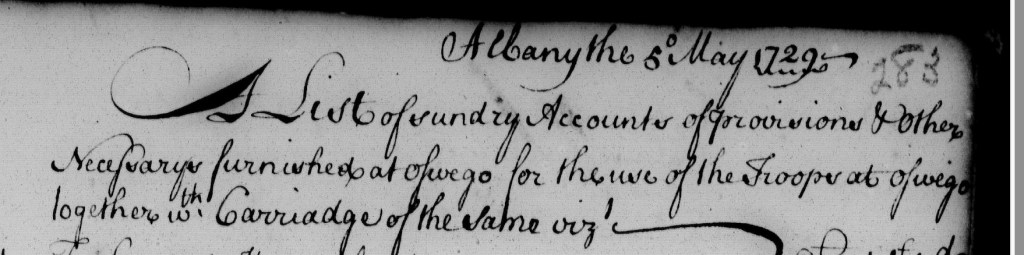
The entry for May 5, 1729 is a detailed two page account of the expenses incurred in furnishing the fort at Oswego with provisions and necessities, with a cover letter to the governor asking him to submit it to the New York Assembly for reimbursement.
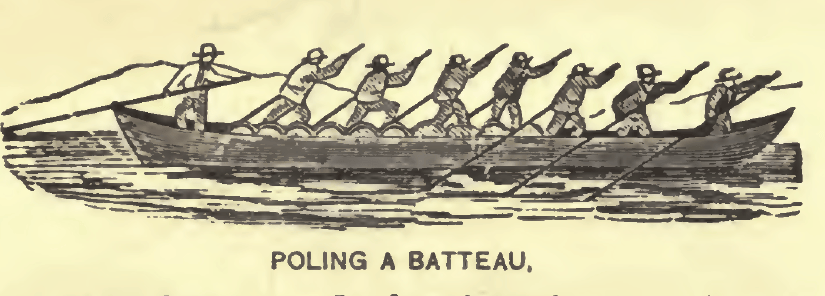
In Library and Archives Canada’s digital copy of the original minutes, the list of people who had done work related to the fort starts here on p. 283. A wide variety of crafts people, boat men, carriage men, laborers, and others had claims. The list reveals the effort required to transport people and goods up the Mohawk River to maintain English troops at a fortified trading center at a considerable distance from Anglo-Dutch population centers. It also shows that Oswego had become a source of income for many Dutch and Palatine families. Provisioning Oswego would make up to some degree for the income lost when the English cracked down on the direct fur trade between Albany and the Saint Lawrence Valley.
But what about the Haudenosaunee, Mohicans, and other native people living between Albany and Montreal who had derived an income from that trade? One might think that they could have been hired as boatmen, or that the garrison could have bought food from the Haudenosaunee directly instead of importing it, or hired them to work in other capacities that would have funneled English funds into their economies. There are no names on the list that can be clearly identified as native people, and while it is true that a few native people were starting to take English or Dutch names, the Indian Commissioners generally identified them as Indians when writing about them. The rest of the documentation on Oswego confirms the impression that New York bought most goods and services from colonists.
Allowing for some inconsistencies in spelling, more than 60 people from about 47 families applied to be reimbursed. In alphabetical order, they were: Jacob Beekman, Anthony Bogardus, Arent Bradt, Barent A. Bradt, Barnardus Bradt, Eghbert Bradt, Joseph Clement, Johannis Cloet, Adam Condu, Abraham Cuyler, Arent Danielse, Daniel Danielse, Dirck de Garmoy, Jelles de Garmoy, Abraham Douw, Dirck Dumont, Robert Dunbarr, Evert Evertse [Wendell?], Jelles Fonda, John Foster, Harme Grodt, Thomas Harris, Landert Helmer, William Hogan, Evert Janse [Wendell?] Frederick Kipman, Johannis Lansingh, Philip Livingston, Dirck Lucas, Johannis Myndertse, Joshua Perry, William Peters, Peter Quackenboss Jr., Godfrey Reile [Riley?], Guysbert Roseboom, Barent Sanders, Thomas Schoenmaker, Adam Staring, Juria Taxsteeder [Doxtator?], Adam Taxtieder [Doxtator?], Abraham Trueax, Jacob Trueax, Peter Van Alen, Guysbert Van Brakelis, Adam Van den Bergh, Wilhelmus Van den Bergh, Johannes D Van der Heyden, Evert Van Eps, Douw Van Veghten, Johannis Van Veghten, Ruben Van Veghten, Benjamin Van Vlecq, Harmanus Vedder, Jacobus Vedder, Simon Veeder, Jacob Visger, Barent Vroman, Johannis Vroman, Jan Wemp, Evert H. Wendell, and Johannis Wyngaert.
On May 22, the Commissioners submitted a memorial to Governor Montgomerie suggesting a solution to the recurring problems in supplying the garrison at Oswego. They thought it would be easier if the legislature would set appropriate conditions for the job, and then let people bid for it. The work would then be awarded to “the cheapest and lowest undertaker.” They said several people had already made proposals to take on this work. They claimed that farming the work out in this way would be “a benefitt to the Province in general” and even “of great Ease to those who now have the Management thereof.”
They also submitted a second list of expenses for reimbursement, including some of the same names and some new ones as follows: Evert Janse, Casper Ham, Mark Van Buren, Johannis Wyngaert, Dirch Hun, Johannis Roseboom, Johannis Cuyler, William Barret, Arent Danielse, Sanders Glen, Andries Van Petten, and Jan Baptiste Van Eps.


