Minute Book 3: 1729-May Part 2: A possible Shawnee and Mohican migration; the French prepare to attack, but where? A Smith for the Senecas.

The next entry In Library and Archives Canada’s digital copy of the original minutes, starts here on p. 284. It contains the minutes of a meeting between the commissioners and two messengers from the Six Nations, who informed the commissioners that three hundred “Makinders and Shawhownus” (probably meaning Mohican and Shawnee) wanted to settle in Iroquoia with their families, a large number of people. The Haudenosaunee asked the English to send one or two representatives to Onondaga to attend a general meeting of the Six Nations, which was scheduled to be held in about a week to discuss this matter. The messengers laid down seven hands of wampum, a sign that this was an official and important matter. The messengers also brought word about news from Kahnahwàke that the Governor of Canada had assembled two thousand troops for a military expedition which he was going to lead in person. The target was being kept secret.

Commissioner Myndert Schuyler went in person to inform the governor about the situation. The Commissioners also dispatched Lawrence Claessen to Onondaga by way of Oswego, with a letter informing the commander there, Captain John Price, to be on his guard. Claessen was told to encourage the group of Mohicans and Shawnees that wanted to join the Six Nations and invite two leaders from each group to come to Albany “and Enter into the Covenant Chain, according to the Promises they made upon their last Treaty with his Excellency.” He was also to find out whether Oswego was the target for the French attack, and ask the Six Nations to help Commander Price to prevent any such attack. Lawrence returned on May 23rd and said that in reality the southern nations were only sending some sachims to renew their old covenants with the Five Nations. He had no new information about the plans of the French.

The Commissioners also sent their own Indian messengers to Kahnawà:ke to find out more about the French plans. On May 14th they returned. Their contact at Kahnawake had told them that the Governor of Canada was definitely planning an attack, even though there was an official peace, because the French King had ordered the governor to take steps to deal with the construction of the fort at Oswego. The French were frustrated because they were losing out to the English in the fur trade, and wanted to prevent furs going to the English either by Oswego or by “Corlaers Lake,” i.e. Lake Champlain. The precise target of the attack was still a secret, but people at Kahnawà:ke expected it to be against either Oswego or Albany. The Commissioners passed this information on to Governor Montgomerie and asked that the Legislature take steps to preserve them in case of an attack.

On May 29th five principal sachims from “the Castle Called Onnah in the Sinekes Land” came to renew the Covenant Chain with the English. They brought the belt of black wampum that was a symbol of their agreement, as well as a silver dollar with a black ribbon attached that stood for the death of King George the First and the succession to the throne of George the Second. They wanted to exchange the dollar for a different token, but the Commissioners would not agree, because it was the same as what had been used to announce the succession to other nations. The sachims of Onnah also asked to have a gunsmith in their castle. The Commissioners agreed to send someone to the Seneca country for the coming winter but not to Onnah specifically. The smith would go to “the Castle called Canassedaha” where the smith’s tools were already located.

“Onnah” is probably the town called “Onaghee,” or “Onahe” located at present day Hopewell, N.Y. “Canassedaha” is probably Kanadesaga near present day Geneva N.Y. See Beauchamp’s Aboriginal Place Names of New York, p. 158-159.
Minute Book 3: 1729-May, Part 1: Oswego’s economy

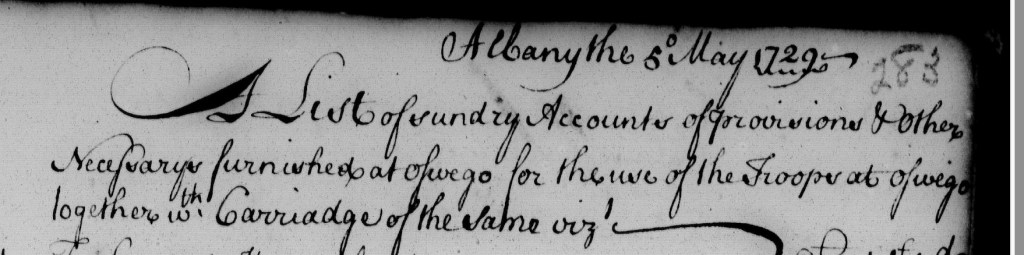
MAIC Reel 1 p. 283: List of expenses for provisioning the fort at Oswego.

The entry for May 5, 1729 is a detailed two page account of the expenses incurred in furnishing the fort at Oswego with provisions and necessities, with a cover letter to the governor asking him to submit it to the New York Assembly for reimbursement.

In Library and Archives Canada’s digital copy of the original minutes, the list of people who had done work related to the fort starts here on p. 283. A wide variety of crafts people, boat men, carriage men, laborers, and others had claims. The list reveals the effort required to transport people and goods up the Mohawk River to maintain English troops at a fortified trading center at a considerable distance from Anglo-Dutch population centers. It also shows that Oswego had become a source of income for many Dutch and Palatine families. Provisioning Oswego would make up to some degree for the income lost when the English cracked down on the direct fur trade between Albany and the Saint Lawrence Valley.

But what about the Haudenosaunee, Mohicans, and other native people living between Albany and Montreal who had derived an income from that trade? One might think that they could have been hired as boatmen, or that the garrison could have bought food from the Haudenosaunee directly instead of importing it, or hired them to work in other capacities that would have funneled English funds into their economies. There are no names on the list that can be clearly identified as native people, and while it is true that a few native people were starting to take English or Dutch names, the Indian Commissioners generally identified them as Indians when writing about them. The rest of the documentation on Oswego confirms the impression that New York bought most goods and services from colonists.

Allowing for some inconsistencies in spelling, more than 60 people from about 47 families applied to be reimbursed. In alphabetical order, they were: Jacob Beekman, Anthony Bogardus, Arent Bradt, Barent A. Bradt, Barnardus Bradt, Eghbert Bradt, Joseph Clement, Johannis Cloet, Adam Condu, Abraham Cuyler, Arent Danielse, Daniel Danielse, Dirck de Garmoy, Jelles de Garmoy, Abraham Douw, Dirck Dumont, Robert Dunbarr, Evert Evertse [Wendell?], Jelles Fonda, John Foster, Harme Grodt, Thomas Harris, Landert Helmer, William Hogan, Evert Janse [Wendell?] Frederick Kipman, Johannis Lansingh, Philip Livingston, Dirck Lucas, Johannis Myndertse, Joshua Perry, William Peters, Peter Quackenboss Jr., Godfrey Reile [Riley?], Guysbert Roseboom, Barent Sanders, Thomas Schoenmaker, Adam Staring, Juria Taxsteeder [Doxtator?], Adam Taxtieder [Doxtator?], Abraham Trueax, Jacob Trueax, Peter Van Alen, Guysbert Van Brakelis, Adam Van den Bergh, Wilhelmus Van den Bergh, Johannes D Van der Heyden, Evert Van Eps, Douw Van Veghten, Johannis Van Veghten, Ruben Van Veghten, Benjamin Van Vlecq, Harmanus Vedder, Jacobus Vedder, Simon Veeder, Jacob Visger, Barent Vroman, Johannis Vroman, Jan Wemp, Evert H. Wendell, and Johannis Wyngaert.

On May 22, the Commissioners submitted a memorial to Governor Montgomerie suggesting a solution to the recurring problems in supplying the garrison at Oswego. They thought it would be easier if the legislature would set appropriate conditions for the job, and then let people bid for it. The work would then be awarded to “the cheapest and lowest undertaker.” They said several people had already made proposals to take on this work. They claimed that farming the work out in this way would be “a benefitt to the Province in general” and even “of great Ease to those who now have the Management thereof.”

They also submitted a second list of expenses for reimbursement, including some of the same names and some new ones as follows: Evert Janse, Casper Ham, Mark Van Buren, Johannis Wyngaert, Dirch Hun, Johannis Roseboom, Johannis Cuyler, William Barret, Arent Danielse, Sanders Glen, Andries Van Petten, and Jan Baptiste Van Eps.

Minute Book 3: 1729-April: At Oswego: Shortages, Illness, and French Threats

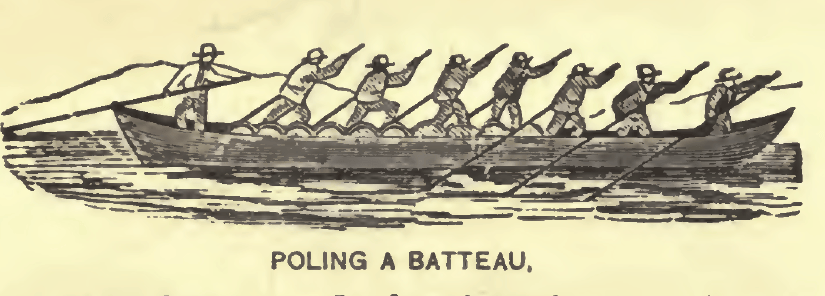
Oswego continued to face the problems that had dogged it from the time it was constructed: a shortage of supplies, recurrent illness, and the threat of French attacks. During April the Commissioners of Indian Affairs took steps to address them. In early March they had heard from Dr. Kerr, the resident physician at Oswego, that the men were “much out of order” and short of supplies. They wrote to him on April 14th to tell him that the governor had given them a box of medicines that they were sending along with twenty gallons of rum, a hundred pounds of sugar, twenty-five pounds of rice, and two pounds of pepper.  Provisions for Oswego were provided by the Palatine farmer Johan Jurch Kast and  the commissioners arranged for them to be conveyed there by Casper Ham, Johannes Wyngaert, Evert Janse, and Marte Van Buren Junior along with the medical supplies. Each man was provided with a bateau for the purpose. They were told to bring back any empty bags from Oswego and leave twenty five of them with John Jurch Kast if he needed them.

After hearing that the French were making preparations to attack Oswego “this Spring with their Indians,” the commissioners sent Lourence Claese to ask the Six Nations for help. He was instructed to point out that if the French took Oswego, the Haudenosaunee would be surrounded on all sides by hostile forces. While this seems like an exaggeration, it is true that there were already several French forts on the Great Lakes.  The English position was that these were illegal, although the Haudenosaunee position was far more nuanced. Nonetheless, Claese was  told to remind the Six Nations leadership that they had agreed to the construction of the Oswego trade house and that it was built for their defense and security. Moreover they had promised to defend it if necessary. Governor Montgomerie now requested them to send two Sachims from each Nation to Oswego to remain there pending further orders from the governor. If the French attacked, the sachims should tell them that the trading house was built by the orders of the Haudenosaunee and upon their ground, and a attack on it would be considered as “an Attempt on their own Castles.”

These instructions framed what the Six Nations said at the treaty held with Governor Montgomery the previous October to make it sound more whole-hearted than it was.. The Six Nations did not see the Oswego trade house as one of their own castles, nor was it built “by their orders. ” They had agreed to let the English construct it, but with considerable ambivalence and reluctance. When asked to affirm their willingness to defend it, they initially pointed out that the English said they were building it to defend the Six Nations, not the other way around. As they put it, “Wee Acquaint you that last year when Liberty was Desired to build there it was told us that the same was built there on Purpose to Defend and Protect the Six Nations because It is a Fronteer of our Nations Therefore Wee Rely on your Promises to Perform them.” When the governor seemed to take offense, they soothed his feelings by acknowledging that the French were their “Ancient Enemies,” and they were willing to help defend the trade house. But they also made it clear that they expected the English to provide them with arms and ammunition and to use Great Britain’s much vaunted military resources if war should break out with the French.

In Library and Archives Canada’s digital copy of the original minutes, the first entry for April 1729 starts here on p. 282.

Minute Book 3: 1729-March: A Murder at Schoharie is Resolved

During the early 1700s, the term “Schoharie” was used to refer to multiple communities, both European and Native American, living in close proximity along Schoharie Creek in the vicinity of the New York State town presently known as Schoharie. They included Mohawks as well as people from other Indigenous nations and Palatine Germans. On March 22, 1729, the Indian Commissioners met with Mohawk leaders Hendrick and Arie and a group of three Indians from Schoharie as well as “others of Sundry Nations.” The subject was a murder that had occurred the previous year.  The commissioners were now working with the Mohawks to resolve the situation. Significantly, the commissioners did not try at any point to have the murderer or murderers turned over to the English authorities. Thus they implicitly acknowledged that Schoharie was within the jurisdiction of the Mohawks, not the English.

The commissioners told the perpetrators that they had had multiple complaints about their behavior toward the “Christians” at Schoharie, accusing them of causing trouble wherever they went, and of threatening to break the peaceful relationship between the English and the Six Nations. By “Christians” the Commissioners probably meant the Palatines, although most of the Indians living on Schoharie Creek were also Christians, so it is hard to be sure. The victim of the murder is described as “one of your brethren,” but since all the participants in the covenant chain called each other brethren, this term could apply to a person of any ethnicity.

The commissioners said they had kept the matter secret from the governor, hoping the Schoharie community would behave better in the future, but could do so no longer. As they said, “this blood lies yet on Earth and will Cry for Revenge Wherefore wee desire you to remove your Settlements in the woods beyond any Christian Plantation, that no mischiefe may Follow from your Insolent behaviour towards your brethren of the Six Nations. So that what mischiefe be done for the Future Shall be demanded off your hands.” These somewhat enigmatic words suggest that the perpetrators of the crime were not Mohawks, but people from elsewhere living at Schoharie with the permission of the Mohawks. They had offended the Six Nations as well as the English.

In order to prevent the people who had been complaining to the commisioners from taking revenge on their own and further escalating tensions, the commissioners asked the group involved in the murder to find another place to live. The Indians replied that they would not settle “Alone on the Christian Settlements” because some of their people, resentful about being made to leave, might attack the Christians and provoke more violence. Instead they agreed to relocate to their “native Countrey Cayouge and Oneyde.” They admitted that they should have “reconciled” the murder and said that the Sachems would do it, pointing out that it was done “in drink.” Finally they reminded the commissioners of the principle, often reiterated at treaties, that when individuals committed crimes, the Covenant Chain should not be broken. Instead the leaders of their respective communities should meet to resolve the situtation, as happened in this case. 

The Schoharie Mohawks, by John P. Ferguson, is a good place to start in learning more about the Mohawk presence there. It is published by the Iroquois Indian Museum, located near Schoharie Creek at Howes Cave, NY, and available from their website. 

In Library and Archives Canada’s digital copy of the original minutes, the entry for March starts here on p. 281.

Minute Book 3: 1729-February: A Proclamation Against Alcohol in Iroquoia

1729-2-22_alcohol[There are no entries for January 1729.]

In their first conference with Governor John Montgomerie in October 1728, the Haudenosaunee are recorded as saying they were glad the new Brother Corlaer was “a wise and prudent Man.” Perhaps this was more than the language of diplomatic flattery. Montgomery does seem to have gone farther than his predecessors in responding to one of the long standing complaints of the Six Nations, who had been trying for years to stem the destructive flow of alcohol into their country.  In February, after the Six Nations reminded them of Montgomerie’s agreement, the Commissioners of Indian Affairs issued a proclamation to all traders and others forbidding the transportation of strong liquor to any place in or near the “upper castles” (towns) of the Six Nations. Only Oswego was exempt, as agreed to at the conference. On the other hand, their use of the term “upper castles” suggests that at the very least Fort Hunter, and probably other Mohawk and Oneida communities, were not protected.

In Library and Archives Canada’s digital copy of the original minutes, the entry for February is here on p. 281.