Blog Posts

Minute Book 3: 1724-June

In Library and Archives Canada’s digital copy of the original minutes, June 1724 starts here

New York’s diplomacy continued to be hampered by a lack of communication and even some outright conflicts between Governor Burnet, former Indian commissioner Colonel Johannes Schuyler, and the Albany Indian Commissioners. The commissioners had not been informed in advance that three representatives of New England had come to Albany to meet with the Kahnawake sachems and they did not know whether the governor had been informed of it, but they wrote to him saying that they presumed that he had been told. Colonel John (Johannes Schuyler), a former mayor of Albany and Indian Commissioner, had sent his own belts of wampum to Kahnawake the previous fall asking the Kahnawake sachems to come to Albany and to keep their people out of the conflict between New England and the Abenaki. Now the New England representatives sent their own messenger to the Six Nations asking them to come to the treaty. Massachusetts Governor Dummer wrote to the Albany Indian Commissioners asking them to pay part of the costs of the treaty. In their letter to the governor they said they could not pay the costs without being authorized to do so.

They also informed Governor Burnet that seven Indians from Kahnawake had gone to Otter Creek on Lake Champlain on their way to raid New England and several parties of Eastern Indians were also out raiding. The commissioners just wanted the war to end.

The commissioners met with the deputies of Kahnawake and its allies, Schwannadie, Adirondax, and Skightquan (Nippissing) on June 10th. The deputies addressed the commissioners as “Corlaer,” the term used for the governor of New York, seemingly unaware of the confusion or choosing to ignore it. They admitted that they had gone to war against New England again.

They said they wished to lay down the hatchet (make peace), but they had heard that New York, the Haudenosaunee, and New England had all agreed to take up the hatchet against them and the Abenaki. They asked that New York lay down the hatchet as well. They said that the belts they had received the previous winter had told them they should not make war while the governments of Great Britain and France were at peace. They said they agreed and promised to “stop up the path to New England,” that is stop sending warriors there. They asked that both sides bury the hatchet in “everlasting oblivion” and throw it in “a swift Current of Water to Carry it away.” They thanked God for giving New York the wisdom to mediate between them and Boston.

They added that at New York’s request they had asked the Indians at St. Francis to lay down the hatchet as well. The St. Francis Indians had said they would not come to treat about peace until Boston returned the Indian prisoners that they were holding, although they authorized the four allied nations to act as they thought best for the welfare of all. Governor Veaudreuil had given them his word that when Boston set its captives free, then he would command the Eastern Indians to make peace with New England. They also suggested that if New York had included the Eastern Indians in the belts sent out to invite Kahnawake to this treaty they would have been there too to talk of peace. Finally they said that as they were leaving Montreal they learned that some Indians living near Quebec were setting out against the English. They sent the principal sachem of Skawinnadie to tell them to stay at home until the delegates returned from the treaty. The commisisoners told them they were glad to see them and approved of their answer.

The commissioners wrote to Governor Burnet explaining what had transpired. Governor Dummer had told John Schuyler and Colonel Stoddard, who were now representing Boston, to cultivate a good relationship with the commissioners, and the commissioners seemed to be taking ownership of the wampum belt message that Colonel Schuyler had sent the previous winter even though Schuyler had not consulted them in advance. The government of New England, or “Boston” as both the commissioners and the Haudenosaunee often called it, was beginning to be more inclined to make peace with the Eastern Indians, realizing that war would get them nowhere.

They added that they were receiving complaints from Indians against traders who “defrayed them in their trade” and asked to be empowered to act against such traders.  They wanted to be able to compel traders accused of such practices to testify under oath about whether the complaint was true.

A few days later, on June 23rd, the Kahnawake sachems met with the Board again. They said that they had found the Indian prisoner taken in Virginia in 1722, likely the servant of Governor Spotswood who is mentioned in the minutes for 1723. He had been adopted by a woman in the place of her dead son, and she did not want to give him up, but they had persuaded her to do so. They suggested that she should be compensated for her loss. The commissioners thanked them and the woman. They agreed to give her a present to wipe off her tears.

Finally on June 25th, the Commissioners gave a formal answer to Kahnawake and its three allied nations. They thanked them for laying down the hatchet and assured them that New York had not agreed with New England to take up the hatchet against them. They also thanked them for sending the Skawinnadie sachem to prevent the Quebec Indians from going out against New England. But they said they could not get New England to make peace because fresh murders had now been committed there. They agreed to use their best efforts as mediators. They did not think New England would agree to the request from the St. Francis Indians that they free their Indian hostages until peace was actually concluded.

They belittled Governor Vaudreuil’s offer to end the war if the hostages were freed. And they now identified the leader of the party of seven Indians from Kahnawake who had gone to fight in New England as none other than “that treacherous felon Skononda.” They demanded that the sachems free the prisoners in the hands of this party when they returned to Kahnawake.

They also told them that several negro slaves had recently fled to Canada and that others had been enticed to do so by “some of your men now here.” They asked the sachems to discourage such practices, which they said were “the same as robbing us of our Goods” and could interfere with the good relations between them.

The sachems said that they would discourage their young men from luring negro slaves to Canada, and that Sconondo and his party went out against their orders. The commissioners said they were glad that the conference had ended so well and hoped that the meeting with Boston would do the same. The Indians “gave four [shouts] in Confirmation of what has been transacted at this Meeting.”

Minute Book 3: 1724-May

In Library and Archives Canada digital copy of the original minutes, May 1724 starts here

Two Seneca sachems, Canakadrichha and Sagonadayane, met with the commissioners on May 11 and added to what they had heard in February from Sconondo about the relations between the Six Nations, the “far Indians” and New France. They confirmed that Onondaga leaders had met with the French governor (Philippe de Rigaud de Vaudreuil) and discussed their fears that western nations passing through the Six Nations on their way to Albany to trade might attack them. Governor Vaudreuil confirmed their fears and suggested that for their protection they should allow him to build two forts, one at “Jagara” (the present day Niagara River)

NiagaraFalls1751-Severance_FrenchFrontier
Niagara Falls, from Frank Severance, An Old Frontier of France, NY: Dodd, Mead, 1917, v. 1 p. 330.

and one at the mouth of the Onondaga River where it enters Cadaraghqua Lake (Lake Ontario in the vicinity of present day Oswego, where the English were also planning to build a fort.) The governor gave the Onondagas wampum belts to convey his request to the rest of the Six Nations.

Severance-FrenchFrontier_FtNiagPlan1
Plans for the fort that France wanted to build at Niagara. From Frank Severance, An Old Frontier of France, NY: Dodd Mead, 1917, v.1, p. 240.

At a public meeting to consider whether to let New France build the proposed forts, the Six Nations decided to deny the request. They returned the belts to the French governor with a message that he should talk to Corlaer (the Iroquois name for the Governor of New York) and get “a proper answer” as to whether forts could be built at the proposed locations.  The Oneidas and Mohawks were not at the meeting, but later concurred in the decision. Nonetheless, the Seneca envoys had learned from reliable sources that Jean Coeur (Louis-Thomas Chabert de Joncaire, also known as Sononchiez) was planning to go to Niagara with 50 men to build the fort there. They also told the commissioners that the Seneca messengers sent to the far nations to invite them to come trade at Albany were expected back in a few days. They had conveyed the message, but did not know how many far nations would actually come to Albany. Messieur Tonty (Alphonse de Tonty, Baron de Paludy), the commander of the French fort at Le Detroit (Tuchsagrondie, the location of present day Detroit) had told them not to come. Canakadrichha and Sagonadayane asked the commissioners to send their own representatives to Seneca country to hear what the messengers had to say and to find out what Joncaire planned to do with his 50 men.

The commissioners thanked the Seneca sachems for refusing the French request to build forts. They said the forts were intended to prevent them from hunting and keep them poor so that eventually the French could “drive them into the sea.” They gave them gifts of blankets, clothing, and rum.

A few weeks later on May 29, messengers arrived from Kahnawake and Skawiennadie bringing seven hands of wampum to confirm what they had to say. They asked the commissioners to send messengers to the Six Nations to come to Albany to meet with representatives of their own nations and New England. New England had asked for the Albany meeting because Albany was the appointed place to meet about public affairs. The commissioners assured them that the path was open and that they were happy about the meeting. They informed them that “Some Gentlement from N England” were in town, probably sent for the purpose of talking to their sachems. They said that the New York Governor did not know about the meeting so they could not comply with the request to send their own messengers. However, it would be proper to let the New England representatives know about their message so that they could send for the Six Nations themselves. They offered to do what they could to bring the proposed treaty to a good conclusion.

Minute Book 3: 1724-February

In Library and Archives Canada digital copy of the original minutes, February 1724 starts here

On February 14th, the commissioners continued negotiations with the four nations in Canada that included Kahnawake, Rondax, Schawenadie, and Skightqan (Nippising).  On February 14, they met with a delegation led by a Kahnewake sachem whose name is spelled in various ways, including Sconondo, Schonondoe, Sconondoe, and other variations. Possibly this was the Oneida leader John Skenandoa, who died in 1816 and may have been born as early as 1704. It was not uncommon in the 18th century for people to move back and forth between Kahnawake and the communities in Oneida and Mohawk country further south. However, even if the 1704 date is correct, he would have been very young to be a sachem in 1724. The commissioners used the word “sachem” to refer to many different kinds of leaders, and judging by later developments, Sconondo was the leader of a small group of people who were trading or hunting when they came to Albany, but later went raiding against New England. If Sconondo is not John Skenandoa, perhaps he was an ancestor.

Sconondo told the commissioners that an Onondaga called the Great World had asked the French authorities about a rumor that the Ottowawas planned to attack the Six Nations. If Sconondo was referring to Ohonsiowanne, an Onondaga sachem who is documented for the period between 1699-1704, this would mean that Ohonsiowanne continued to exert influence for a much longer period than historians have realized.

Governor Vaudreuil  denied the rumor, but the Great World remained suspicious. He told the governor that he planned to prevent the Wagonhaes (Anishinaabeg) from coming to Albany. (The Odawa (Ottawawas) were included in the term Wagonhaes.) The Governor thanked the Great World (since France did not want western nations to trade at Albany), but advised him not to strike first. If the Wagonhaes attacked them, the Six Nations should ask the French for help. The French would then be mediators between the parties. Schonondoe asked the commissioners not to name him as the source of this information.

The commissioners asked Sconondo to bring wampum belt messages to Kannawake and the other three nations asking them to make peace with New England. They said that if the four nations did not stop fighting with the Eastern Indians against New England, the path between Albany and Canada might become completely blocked and it would be their own doing. They reminded the delegation that the Eastern Indians had been their enemies in the past and were not to be trusted.

The commissioners reproached Sconondo’s delegation with committing new assaults on New England even after agreeing to peace the previous summer, reminding them that England and France were at peace and could not approve of the subjects of either one being murdered. Sconondo said that he understood and would do his best to persuade Kahnawake and its allies to listen to the message. He said the Sachems of the four nations were planning to come to Albany early in the Spring and asked for assurance that they could travel safely, without fear of attack by New England’s forces. He asked that the Governor of New York speak to the Governor of Boston in order to guarantee their safe passage.

The next entry for February is a letter from the commissioners to New York Governor Burnet. It is obvious from their  letter that they were still in conflict with him. He had accused them of undermining New England’s efforts to recruit the Six Nations and their allies to fight on the side of New England in the ongoing conflict with the Abenaki known as Father Rale’s War. More specifically Governor Burnet believed that the commissioners had privately told the Six Nations not to allow their young men to accept New England’s call to arms. The commissioners denied this charge. They protested that they would be blamed if the Indians did not fight for New England, even if it was really because of pressure from the French or other reasons. They expressed doubts about the wisdom of  Governor Burnet’s suggestion to “break” the fort that the French were trying to build at Irondequoit Bay.

The commissioners explained that they had sent Lawrence Claessen to the Senecas to ask them to send messengers to invite the “far Indians” living beyond the Six Nations to come to Albany to trade. They also said that the Eastern Indians were trying to draw the Schaghticoke Indians away to fight with them, and asked for more fortifications to ensure the safety of the local farmers and remove their “pannick frights.” The commissioners asked for money to reimburse the costs of recovering an Indian captive, the “negroe boy” mentioned in the January minutes. They asked how the governor would like to send him back to his owner in Virginia. Finally they told the governor that Captain Verplank, who was stationed in Seneca country, had written them that many far Indians were coming to trade in the spring, although the French were sending a force out to stop them.

Pieter_Schuyler
The death of Pieter Schuyler marked the end of an era.  Representatives from many native nations honored him with condolence rituals over the following months. The image was downloaded from the New York State Museum web site via Wikipedia. According to the NYSM, it was painted by Nehemiah Partridge between 1710 and 1718 and is now in the collection of the City of Albany.

In a postscript the commissioners noted that two former commissioners had passed away that month.The trader Hendrick Hansen, who challenged the infamous sale of the Mohawk Valley tract to Godfridius Dellius, Pieter Schuyler, and others in 1697, died on February 17th. His rival Colonel Pieter Schuyler, the famous “Quider,” died the following day.

In the final entry for February, the commissioners noted that people from the government of Massachusetts or Connecticut were in Kinderhook trying to buy land in New York from the Indians illegally, without a license from the government. They resolved to issue a warrant to bring the offenders in to answer this charge.

There are no entries for March or April.

Minute Book 3: 1724-January

In Library and Archives Canada’s digital copy of the original minutes, January 1724 starts here

DeLeryMap_Severance_OldFrontier
The pace of competition between France and England was heating up as both attempted to build new forts at strategic locations on the routes into the interior. The image is from Frank Severance, An Old Frontier of France, NY: Dodd Mead, 1917, v. 1 p.236

As 1724 began, the struggle between England and France for trade and a military presence in the North American interior continued in full force even though technically they were at peace. Both imperial powers were pressuring the Six Nations and the many nations to the west, south, and north of them for exclusive trade agreements. English and French diplomats and military commanders came into conflict with each other as they attempted to get permission from the Six Nations and other native people to build trading centers and forts around the Great Lakes.

In the meantime, the war between New England and the Eastern Indians (primarily the Abenaki Confederacy) continued.

Laurence Claessen returned from a trip to the Six Nations (Haudenosaunee), where the commissioners had sent him in November 1723, and gave them an account of what had transpired. His first order of business was to ask the Seneca to take wampum belts to the “far nations” to the west of Iroquoia to encourage them not to listen to the French government in Canada.  The commissioners believed that the French were encouraging the far nations to join the Eastern Indians in their war against New England (Father Rale’s War), thus preventing them from trading with Albany.

The Six Nations met and considered this proposal for several days before telling Lawrence that they agreed that the French would do everything possible to prevent a direct trade between the far Indians and New York. The Six Nations feared that the Governor of Canada was planning to incite the far Indians to attack the Haudenosaunee, and for that reason the Seneca had stayed home. Finally three Seneca sachems agreed to take the commissioners’ belts to the far nations and added six belts of their own, explaining that they needed additional belts to cover all the different nations that needed to get the message.

The Seneca said they would come to Albany the following Spring with a large number of the far Indians and would meet Captain Jacob Verplank at the Lake, as the Governor of New York had requested. “The Lake” probably means Lake Ontario near Irondequoit Bay, where a contingent of Dutch traders had been living among the Seneca. They also explained that Jean Coeur (Louis Thomas Chabert de Joncaire) planned to build a fort and trading house at Irondequoit the following Spring with the Six Nations consent.

The commissioners conveyed this information to New York Governor Burnet in a letter. They added that they had retrieved a “negroe boy” from a “ffrench Indian” who had taken the boy from “Captain Hicks,” probably Captain Robert Hicks, a Virginia trader who commanded Fort Christianna, Governor Alexander Spotswood’s project to educate (and control) the Saponi and other indigenous nations.

Minute Book 3: 1723-November

In Library and Archives Canada digital copy of the original minutes, November 1723 starts here

The two observer-messengers (or spies) sent to Canada in October returned in November. They told the commissioners what they had seen there, but the commissioners asked them to repeat it with Lawrence Claessen present. Perhaps this was because the commissioners did not speak the Mohawk language as well as he did, or perhaps it was because they wanted to bring in his expertise in diplomacy. Either way, it shows how much they relied on him. For most of 1723, no members of the Schuyler family are included in the lists of those present at the commissioners’ meetings, and developments in October had already revealed that John (Johannes) Schuyler was conducting parallel diplomacy on his own. The commissioners may have felt that they were loosing their influence with the Six Nations and needed all the help that Claessen could provide.

In any case, the messengers confirmed that John Schuyler gave them wampum belts to take to three “castles,” i.e. native communities, in Canada: Cachnawage (Kahnawake) Kanighnoghquadee (Gananoque?) and Rondaxis. (The Rondaxes or Adirondacks were Algonquian speakers who lived at Three Rivers and Oka, according to p. 239 of the Livingston Indian Records.) Schuyler had not informed the commissioners about the belts, but he  sent them in the name of Boston and New York. Apparently he was working behind the Albany Indian Commissioners’ back with New York as well as Massachusetts.

Schuyler’s wampum belt messages asked the three castles to stop fighting with the French and Abenaki against New England in the ongoing hostilities known to historians as Dummer’s War. He also invited them to “use and Cultivate the Road from Canada hither and trade as Usual,” promising to remove any obstacles to doing so. “Hither” apparently meant Albany. Did Schuyler promise to restore the trade in Indian goods between Albany and Montreal, a short distance from Kahnawake? That trade had benefits for both native and French traders in the St. Lawrence Valley, as well as for many Dutch traders in Albany, even though the commissioners were working with New York’s Governor Burnet to suppress it.

The few Kahnawake leaders who were home when the messengers arrived promised to convey their message to those who were away hunting and fighting. They sent wampum belts in return to the belts brought by the messengers, but they were delivered directly to John Schuyler.

The commissioners also learned that the French and their native allies had asked more distant “upper and remote” nations to join the French side in Dummer’s War the following spring. The commissioners feared that this would not only put New England in peril, but also jeopardize the trade between those distant nations and Albany that they were trying to encourage. They sent Lawrence Claessen to the Seneca Country to engage paid messengers there to negotiate with those nations on Albany’s behalf, in particular they wanted to encourage the “Denighcariages”, a nation that, at least in the understanding of the commissioners, had joined the Six Nations that summer as the Seventh Nation. Claessen was told to assure the far nations that peace was being negotiated between the Eastern Indians and New England, the road to Albany though the Six Nations would be safe, and Albany had cheap and plentiful goods for sale.

The remainder of the entries for November concern the Schaghticoke Indians. Located north of Albany where the Hoosick River joins the Hudson from the east, Schaghticoke was on Mohican land and the path along the Hoosick was a well used road to the Connecticut Valley, one of the areas where New England was under attack. The Schaghticoke community were refugees under New York’s protection, mainly people displaced by settlers in New England and the lower Hudson, close allies of the Mohican. They were caught in the middle of Dummer’s War both geographically and diplomatically, since many were Abenaki themselves. The commissioners reproached them with leaving their homes and “Stragling & Scatter[ing]” from one place to another, instead of staying at Schaghticoke under the “Tree of Friendship and Welfare” that was the symbol for New York’s protection. People from Schaghticoke had even been seen on their way to Canada, where the commissioners undoubtedly feared that they would join the French. The commissioners believed that the Schaghticokes needed to appoint some leading men as sachems to keep them in one place, and persuade those who had left for Canada to come back.

The Schaghticokes acknowledged the agreement made almost half a century earlier with New York, joining them together and giving them protection at Schaghticoke. They said they wanted to stay there even if Canada offered them land. They agreed to consider the proposal to appoint leaders and try to bring back those who had left. They offered the commissioners gifts of venison and strings of wampum, as was customary. But the following day they said it would be impossible to get the people who had left to come back, since they had fled after committing robberies at Saratoga. They also pointed out that the Tree of Welfare was now bare at the roots, that is that their relationship with Albany was under a strain because they did not have enough land at Schaghticoke and the (Dutch) inhabitants there were harassing them. The Minute Book entry does not say what the commissioners knew well. The reason the Schaghticokes had little land left was that under New York law Albany owned that land and was leasing more and more of it out to Dutch farmers. It was Albany’s tenants who were harassing the Schaghticokes.

The Schaghticokes proposed that part of their people should move to Sinchjack, where there was still good land available. Sinchjack, which they also spelled as Sinkhaijck, probably refers to the area farther up the Hoosic River from Schaghticoke, near where the Walloomsac River flows into it in the vicinity of present day Williamstown Massachusetts. It was also known as St. Croix.  Its history is discussed in Arthur Latham Perry’s Origins In Williamstown, beginning on p. 114.

The Schaghticokes asked the commissioners to nominate leaders for them and to mend their weapons, as was customary. The commissioners agreed to all of this, including the move to Sinckhaijck. They nominated Nanratakietam, Aspenoot, Wapelanrie, Kakaghsanreet, Mashequant, and Akamsomett, with Nansasant as a successor if any of them passed away. They said it was essential to bring back those who had gone to Canada, and offered to forgive those who had committed faults, that is the Saratoga robbers. They also promised to stop the settlers at Schaghticoke from interfering with the Schaghticokes’ use of their land. They thanked them for the venison, promised to have their weapons mended, and gave them gifts of ammunition, shirts, and alcohol, with blankets for the elders Nanratakelam and Waleghlanret..

There are no entries in the Minute Book for December, so this concludes the summaries for 1723.

Minute Book 3: 1723-October

In Cornell’s digital copy of the original minutes, October 1723 starts here

In Library and Archives Canada digital copy of the original minutes, October 1723 starts here

The Albany Indian Commissioners were increasingly anxious that their own community would be attacked in the course of the ongoing war between Massachusetts Bay and the Abenaki (Dummer’s War). They took it as a bad sign that no Indians had come to Albany from Canada recently, as was usual. Rather than attributing this to New York’s ban on trading Indian goods to Canada, they began to worry that the Saint Lawrence Valley communities like Caughnawaga (Kahnawake) were going to join the Abenaki in attacking English settlements, including theirs. They decided to send two Indian observers to Canada to see what was going on and to persuade the young men at Caughnawaga and elsewhere to stay at home, as their leaders had agreed.

When the deputies of the Six Nations came through Albany on their way back from the peace negotiations at Boston, it was clear that there were serious disagreements between the Six Nations and the commissioners, between New York and Massachusetts, and within Albany itself. John (Johannes) Schuyler, former mayor of Albany, an Indian Commissioner himself at times, and one of the people most trusted by the Six Nations, had gone to Boston at the invitation of Massachusetts, independently of the commissioners or the governor of New York. The commissioners asked the Six Nations deputies to tell them what happened at the meeting, to which they responded that Schuyler had written it down and given an account to the governor, so there should be no need for them to repeat it. The commissioners said they did not want to rely on Schuyler’s account and preferred to hear what happened directly from the deputies. The Six Nations deputies equivocated, first saying that Schuyler asked them to join the war on Massachusetts’s behalf and they had accepted, then denying that it happened. They said that they had asked Massachusetts to tell the kings of France and Great Britain to end the war in the colonies since they were at peace in Europe. They finally admitted that a few men from the Six Nations had joined Boston’s forces. John Schuyler had agreed to provide them with ammunition and to pay the 100 pound bounty for each Eastern Indian scalp they took. After the other deputies had left, Hendrick (probably Hendrick Tejonihokarawa) assured the commissioners that John Schuyler had approved everything they did at Boston. The Six Nations delegates seemed to be stubbornly holding to the position that John Schuyler represented Albany regardless of what the commissioners said.

The commissioners also learned that Schuyler had sent his own belts (wampum belt messages) to Canada by way of the commissioners’ messenger-observers. The commissioners feared the belts would be taken by the Abenaki as signs that they were working together with Schuyler. Massachusetts had also sent two more Albanians, Philip Schuyler (probably Johannes Schuyler’s son by that name) and John Groesbeeck, to Canada to redeem prisoners.

The commissioners learned that Rutland had not been attacked, but two forts nearby at Northfield had been overrun by a war party of 60-80. Colonel John Stoddard of Massachusetts asked them to send a force from the Six Nations and River Indians to Otter Creek (in present day Vermont) to intercept the attackers, but the commissioners told him they would not be able to muster a force in time to do any good. Nonetheless they informed three Mohawks who were in Albany, including the sachim Taquajanott, who said they would tell their people.

The commissioners wrote to New York Governor Burnet to try to convince him that the danger to New York was real, expressing regret that “you Excel.cy is not pleas’d to agree in our Opinions.” They stated openly that they believed Massachusetts wanted to sacrifice them in order to pursue its own “quarrel” with the Abenaki. In an enigmatic footnote, they added that Cornelis Cuyler, one of those who had refused to take the oath that he was not trading with Canada, had now gone to Canada along with “the three french men” (probably the same ones who had gone to Pennsylvania in June?) to recover his debts. Evidently suppressing the Albany-Canada trade had serious economic repercussions for those who had invested in it. And perhaps the economic repercussions for indigenous traders in Canada were adding to the commissioners’ fears that their allies there would be more likely now to join the war on the French side and even target Albany.

Minute Book 3: 1723-September

In Library and Archives Canada digital copy of the original minutes, September 1723 starts here

Early in September, peace between New England and the Abenaki began to look remote. The Albany Indian Commissioners heard that “french Indians” from Canada were planning to join the Eastern Indians in attacking New England. They also heard that Northfield and Rutland had been attacked. They examined someone from Caughnawaga (Kahnawake), who said that neither Kahnawake nor Schawenadie were involved in the war, but they would fight if the governor of Canada asked them too. The commissioners were now afraid that Albany would be attacked. They sent notice to Colonel Samuel Partridge in Massachusetts to be on guard, and wrote to New York Governor Burnet suggesting that the governors of all the English colonies should write to the governor of Canada to ask him to stop encouraging the Indians to attack New England, since the English and French monarchs were at peace.

Minute Book 3: 1723-August

In Cornell’s digital copy of the original minutes, August 1723 starts here

In Library and Archives Canada digital copy of the original minutes, August 1723 starts here

On August 9th, delegates of the Six Nations stopped at Albany on their way to Boston for the upcoming peace conference to resolve the war between Massachusetts Bay and the Abenaki. Their speaker Odastichta told the commissioners that a new leader, Annatseineiin, or Annutseerie, had been appointed to replace Blue Back, who had recently passed away and who had cultivated good relations with the English. They also addressed the issue of forts and trading posts in their country, taking a diplomatic approach in explaining why the French had not removed the trading post at Niagara as New York Governor Burnet had requested. They explained that they had asked the French interpreter and diplomat to the Six Nations, Jean Coeur (Louis-Thomas Chabert de Joncaire) to remove it, but he said he would have to discuss it with the French governor. Odasticha said he thought that the kings of France and England would have informed the commissioners about this by now.

The Six Nations also announced that they were now entirely at peace with the Waganhas (Anishinaabeg), French allies who had nonetheless joined with the Six Nations in the Covenant Chain. Last but not least, they asked the commissioners to appoint three representatives to go with them to Boston.

The commissioners condoled the deaths of Blue Back and two other sachems who recently died. They agreed to tell the governor about the Six Nations attempts to remove the trading house at Niagara and Jean Coeur’s response, and said they were glad that the Waganhas had joined the Covenant Chain. Somewhat surprisingly, the commissioners declined to send representatives to Boston, explaining that the New York governor had not asked them to do so.

On the 20th of August the commissoners wrote to New York Governor Burnet, explaining what they had done to enforce the oath against trading with Canada and informed him that they had heard from Laurence Claessen that a party of Eastern Indians were going to attack New England, and also a rumor that Rutland had actually been attacked. They feared being attacked themselves, and asked for help in building stockades for the blockhouse at Mount Burnet.

They also informed the Governor that Massachusetts had communicated directly with Peter and John Schuyler about the upcoming peace negotiations, that John Schuyler had gone to Boston, and that Massachusetts would ask him to lead their forces [against the Abenaki]

The last entry for August is a request that the government reimburse the Reverend Thomas Barclay for the costs of educating Michell Montour, the son of Louis Couq dit Montour, a French and native trader who was killed by Chabert de Joncaire in 1709 after he began to work for the English recruiting “far Indians” to trade at Albany. The year before he was killed, Montour asked Barclay to care for Michell, who was five years old at the time.


Minute Book 3: 1723-July

In Library and Archives Canada digital copy of the original minutes, July 1723 starts here

More groups of native traders came to Albany in July. Fourteen “Twightwights” or Miami met with the commissioners on July 12th. Like the “Denighcareage” group that came in May, they were accompanied by a Haudenosaunee translator who lived among them, a man named Dewadirko who was an Onondaga who had been taken prisoner by them. They recited a story similar to that of the previous groups, rehearsing the difficulties of their journey, emphasizing that the French had tried to discourage them from coming, asking for good prices on trade goods, and leaving calumet pipes for the commissioners to keep and smoke when others of their nation came.

At the same meeting, an Onondaga man named Oquaront reported that another nation living farther away than the Miami, called Agottsaragoka (or Oguttsarahake) wished to make an agreement to pass through the Five Nations and come to trade at Albany. In addition, some native traders arrived from Tughsaghrondie, the area where the French had built Fort Detroit at the beginning of the century. They renewed the Covenant Chain and they too asked for cheap goods, suggesting that the French goods at Fort Detroit were not meeting their needs.

The commissioners welcomed all of the visitors, accepted the Miami calumet pipes, assured Oquaront that the way would be clear for the Oguttsarahake to come to trade, and renewed the Covenant Chain with the Tuchsagrondie. They invited the group to send some principal leaders to New York to meet the governor, but were told it was too late in the year. However, they offered to come to see the governor the following spring.


Minute Book 3: 1723-June

In Library and Archives Canada digital copy of the original minutes, June 1723 starts here

The conference with Massachusetts Bay and the Six Nations (I will refer to them that way from now on, since the Tuscaroras were now established as a member of the Five Nations) continued on June 1st, when William Tailer, Spencer Phips, and John Stoddard renewed the Covenant Chain with the Schaghticoke, Katskill, and “River” Indians, a term used for the Mohican and the peoples of the lower Hudson.  Massachusetts Bay asked them to join the war if the the Six Nations accepted the Massachusetts Bay offer to fight the Eastern Indians. They replied that they would follow the Six Nations’ lead.

The Six Nations gave their answer on June 3rd. They soothed the feelings of the Massachusetts Bay representatives by rehearsing the wrongs inflicted on them by the Eastern Indians. But they explained that the Eastern Indians, had now sent a messenger to make peace. They needed to discuss matters further and it would take several months.

The representatives from Massachusetts Bay were clearly disappointed. They asked what the point of renewing the covenant was if the Six Nations would not help them fight their enemies, especially since they would be generously rewarded. They explained that they were not empowered to make peace with the Eastern Indians and asked once again for the Six Nations to join the war. Instead the Six Nations urged them to meet with the Eastern Indians at Boston in two months to discuss peace, promising to punish the Eastern Indians if an agreement was reached and they did not honor it. The Massachusetts Bay delegates finally agreed to attend the proposed meeting.

The Six Nations and the Albany Indian Commissioners went on to discuss their own issues, in particular the competing centers for French and English trade that were being constructed in Iroquoia. The French diplomat Louis-Thomas Chabert de Joncaire, referred to by the commissioners using every imaginable variant spelling of “Jean Coeur” had persuaded the Six Nations to allow the French to build a trading center at Kaskeghsago near Irondequoit, at the site of present day Rochester, where the Genesee River meets Lake Ontario. The commissioners asked the Six Nations to reverse this decision and forbid the French to build any settlements in Iroquoia, predicting that if  the French built a trading house at Irondequoit it would become a fort that would be used to stop “far Indians” from coming to Albany and eventually to take control of the Six Nations’ country. Furthermore, they asked the Six Nations to tell the French to remove their trading center already constructed at Niagara, as they had promised the New York governor previously. The Six Nations speaker, Thannintsorowee, said they would take the request back to their council and provide a response at the Boston meeting.

The Six Nations and the Albany commissioners held another meeting with the Abenaki envoy, lectured him about the violence inflicted on New England by the Abenaki, and told him that the Eastern Indians should come to the meeting in Boston scheduled in two months to negotiate.

The rest of June was devoted to trade. Another group of 10 far Indians came to trade on June 16th, asking for good prices and promising to bring more people if they received them. They were welcomed with provisions and rum, and assured that prices would be good. The name of their castle is left blank, suggesting that the commissioners were not familiar with it and unable to make sense of it. Magepanans, a River Indian, was asked to invite more nations to come to trade and promised a reward if he succeeded.

Governor Burnet had asked the Albany Indian Commissioners to enforce a recent act of the New York Assembly intended to stop the flourishing trade between Albany and Montreal. In this trade, which had been going on for decades, English goods were sold to the French and the French then resold those goods to indigenous fur traders. This practice undermined the English policy that aimed to monopolize the fur trade for England by persuading the indigenous fur traders to bring their goods directly to Albany.

Under the new act, Albany traders had to swear an oath that they were not trading with Canada, on penalty of a fine of a hundred pounds. The commissioners took the oath themselves and spent several days at the end of June in summoning local traders, many of whom were prominent citizens or relatives of the commissioners, and asking them to take the oath. Several refused and were fined, including Colonel John Schuyler and his son Philip Schuyler. The notes indicate that the money would be applied to repairing Albany’s fortifications or used as needed. On the 22nd, they wrote to the governor and reported on this, assuring him that they supported the policy, while acknowledging that goods were still being traded with the French. They also asked the governor to allow passage for three Frenchmen who were going to visit their uncle, a “famous trader” in Pennsylvania.


Minute Book 3: 1723-May

0027_listOfGoodspng

In Library and Archives Canada digital copy of the original minutes, May 1723 starts here

In May, the Albany Indian Commissioners were busy on several different fronts simultaneously. They entertained and traded with two groups of people from “far Nations,” a general term for the peoples to the west and north of Iroquoia. The second group of Far Indians came not only to trade, but to meet with the Mohawks and to tell the commissioners that they were joining the Five Nations. The proceedings held with them are printed in Volume 5 of O’Callaghan’s Documents Relative to the Colonial History of the State of New York, beginning on page 693. Simultaneously, Albany hosted a major treaty conference with representatives from the Five Nations and Massachusetts Bay to discuss the ongoing war between New England and the Abenaki. They also met with an Abenaki delegate who appeared unexpectedly (at least to the reader.) The initial proceedings between the Five Nations and Massachusetts can be found in the Livingston Indian Records beginning on page 236, but the Livingston records do not include a gruesome Massachusetts proposal to pay for Abenaki scalps.

The May minutes also include related entries not printed in these sources, including a report by Laurence Claessen Van der Volgen about his recent trip to invite the Five Nations to the meeting with Massachusetts, during which which he learned that they had officially accepted the Tuscaroras as a sixth nation. He also encountered problems with the Senecas and Onondagas, who initially did not want to come to the meeting because the French had advised them to stay away.  Representatives of all of the Six Nations came to Albany in the end.

 The first group of twenty “far Indians” arrived on May 8th, followed by a larger group on May 29th that included 80 men in addition to women and children whose number is not given. Simultaneously, the Five Nations sent a delegation of 80 people and Massachusetts sent at least three representatives, William Tailer, Spencer Phips, and John Stoddard. The first group of twenty “far Indians” was housed in the Indian houses that Albany maintained in order to provide a place where people who came to trade could stay without being pressured to sell their goods to a particular trader.  If all the other native visitors stayed there as well, the Indian houses must have been filled to capacity.

Cadwallader Colden described one of these houses as it looked when he visited it two years earlier in early September 1721:

Wee diverted ourselves one day before the Indians were all meet in a Large boarded house without the towne which stands their alway for Lodging the Indians Their wee saw a great many animals tollerably well delineated with coal by the Indians on the boards of the house The most remarkable was a Crocodile very well designed which shows that they travell very far to the southward’s perhaps near to the mouth of the river Misasipi The Indians pointed towards the southwest as the place where these animals are found The Interpeter told us they have the dried skin of one of them att one of their Castles They had beefs likewise drawn in sevaral postures which show’d that the persone who did them was not without a genius for Painting these the Indians pointed to us were found to the Westward We saw fowls exactly resembling Harpies butt perhaps they were design’d for owls. [Collections of the New-York Historical Society for the Year 1917, NY, 1918, p. 128]

Trade

The nation of the first group of 20 Far Indians is never identified. Possibly they were an advance party from the second group. They began by smoking the calumet (peace pipe) and singing, after which they said they had come to Albany to trade. They explained that they came from several castles (communities) which had sent them to see whether they could get good prices at Albany. The commissioners welcomed them, accepted their calumet to show to others of their nations who might come to trade, warned them against listening to the French, gave them a present of blankets, shirts, food, and liquor, and assured them that they would find cheap goods and pure rum at Albany.

Expanding the Six Nations to Seven?

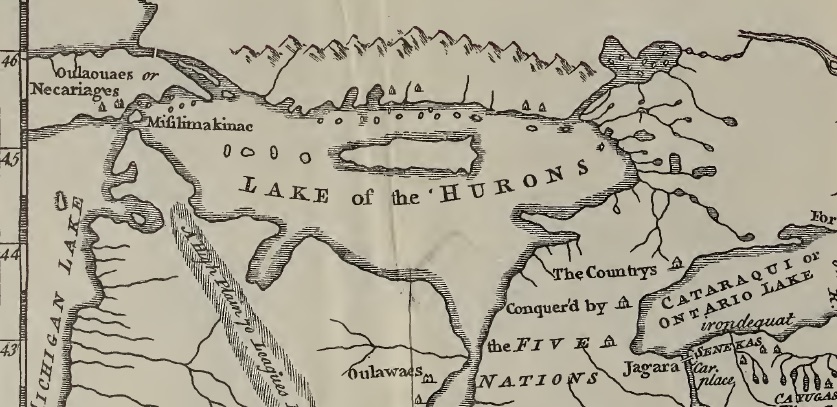
The second group, led by Awistoenis, or Owiestoenis, and a Seneca translator, Sakema,   described themselves as the true members of the “Denighcariages Nation.” They told the commissioners that others who had visited Albany claiming to be from that nation were not telling the truth. The commissioners asked what the French called their settlements, to which they responded “Monsiemakerac.” They came from six communities, one of which, Neghkareage (probably the same word as “Denighcariages”) had two castles (towns). The other four are written as Ronawadainie, Onnighsiesannairoene, Kajenatroene, and Tienonoatdeaga. In a note on p. 693 of DRCHNY 5, O’Callaghan identifies them as Hurons from “Mtellimakenack,” based on a French map. The name of their fourth town suggests that they were from the Tobacco Nation. also known as the Petun or Tionondati. The French built Fort Michilimackinac on the Straits of Mackinac between Lake Michigan and Lake Huron around 1715. In describing the Denighcariages visit to Albany, Governor Burnet said in a letter to Lords of Trade that they came from “Misilimakenak, which lyes between Lac superieur & Lac Huron” (DRCHNY 5:684). Clearly they were from somewhere in the area where the three great lakes meet. Like the first group, they brought a calumet and left it with the commissioners to use when others from their nation came to Albany.

The Denighcariages, the Mohawks, and the commissioners began by smoking the calumet together, then proceeded to discuss trade, as well as a proposal that the Denighcariages join the Five Nations as the Tuscarora were in the process of doing. The commissioners promised them cheap goods and encouraged the idea that they should join the Five Nations, becoming the Seventh Nation, since the Tuscaroras were now the Sixth. The commissioners worded this in terms of joining “this Government,” seeming to imply that New York and the Five Nations were one. The commissioners promised to address Awistoenis’s complaint that local waggoners had overcharged them for transporting their goods, assuring them that it would not happen again and sending them on their way with blankets, shirts, food, and 26 gallons of rum.

The map at the front of Volume 2 of Cadwallader Colden’s History of the Five Indian Nations, shows the Necariages of Misilimacinac. The legend explains that they were “received to be the seventh Nation at Albany, May 30th 1723: at their own desire, 80 Men of that Nation being present beside Women and children.”

"A Map of the Country of the Five Nations ...
“A Map of the Country of the Five Nations belonging to the Province of New York and of the Lakes near which the Nations of Far Indians live, with part of Canada” from Cadwallader Colden, The History of the Five Indian Nations …

ColdenMapExcerpt

Massachusetts Offers to Pay for Scalps

In the conference between the Five Nations and the three commissioners sent from Massachusetts, the parties began with an initial meeting on May 28th in which they followed the usual protocols to renew the covenant chain of friendship. The Five Nations reminded Massachusetts that it was customary for the English to mend their guns, kettles, and hatchets on such occasions.

On May 30th the Massachusetts commissioners proceeded to business, laying out a proposal from Governor Dummer that spelled out the the terms on which Massachusetts wanted the Five Nations to join it in fighting the Abenaki Confederacy. After rehearsing the ways in which Massachusetts considered the Abenaki to have wronged the English, the proposal, worded like a legal contract, says that “for the further Encouragement of your Warlike peopl[e]” Massachusetts will pay 100 pounds for the scalp of every male enemy Indian of twelve years or older, and 50 pounds for the scalps of all others killed “in fight.” Massachusetts will pay 50 pounds for each male prisoner. The Five Nations may keep female prisoners and children under twelve, as well as any plunder taken. The Massachusetts government will supply the Five Nations with any needed provisions or ammunition, but the value will be deducted from the money paid for scalps.

For each ten members of the Five Nations, Massachusetts planned to assign two Englishmen to accompany them in order to protect them from “any mischief that may happen to them from our Souldiers by mistake” and to avoid disputes about scalps. The Englishmen would confirm under oath that the scalp was that of an enemy Indian killed in battle as well as the age and sex of the person scalped. For testifying, the Englishman would receive an amount equal to what was payed to the warrior who took the scalp or prisoner.

Guns, kettles, and hatchets would be mended only if the Five Nations accepted the offer, and Massachusetts would also give them a large present if and when they did so.

At Least Some of the Abenaki Want Peace

As was customary, the Five Nations did not respond right away to Massachusetts’ proposal. And on the following day the minutes record a new development with the arrival of Achjamawat, a delegate sent to the Six Nations by three Eastern Indian castles, “Owanagonga, Kwepowanne, and Onjanawarea.” Although they were still in Albany, the Massachusetts commissioners are not listed as being present when Achjamawat met with the Albany commissioners.  The Five Nations are not listed either, but his words are addressed to them (as the Six Nations) and the interpreter for the meeting was the Mohawk leader Hendrick, who translated from Abenaki to Mohawk, after which Laurence Claessen translated from Mohawk to Dutch and Philip Livingston translated from Dutch to English for the written record.

Achjamawat began with an extended condolence ritual in which he reiterated several times that Albany was the place to treat about peace and to condole any blood shed “through Rashness or misunderstanding.” He went on to say that the Eastern Indians regret that they could not meet with the Six Nations when they came to Boston the previous fall to meditate between them and Massachusetts. They received the message sent by the Six Nations asking them to stop fighting. His people have now sent him to lay down the hatchet against New England and bury it forever.


Minute Book 3: 1723-April

1280px-FORT_CHRISTANNA,_BRUNSWICK_COUNTY,_VA
Fort Christanna (from Wikipedia, taken by Jerrye & Roy Klotz, MD – Own work, CC BY-SA 3.0, https://commons.wikimedia.org/w/index.php?curid=28230287)

In Library and Archives Canada digital copy of the original minutes, April 1723 starts here

On April 6th, the Onondaga diplomat Teganissorens (the commissioners spelled his name D’Canassore) came to Albany to discuss relations between the Five Nations and Virginia. He assured the Commissioners that the Five Nations would respect the peace agreement they had made with Virginia the previous fall and refrain from attacking Virginia’s native allies. By 1723, Teganissorens had had a long and successful career during which he helped to shape the relations between indigenous and colonial powers throughout the North Atlantic region. He was no longer young, and the journey from Onondaga to Albany was a lengthy one. His trip to Albany suggests that the treaty with Virginia had been called into question in a significant way.

The next entry in the Minute Book, an April 23rd letter to New York Governor Burnet, suggests that the issue was the Saponi man taken captive near Fort Christanna in Virginia by a raiding party from Kahnawake, the Mohawk community near Montreal, as described in the minutes for January and February. The commissioners told Burnet in their letter that they had still been unable to get him released. Perhaps Governor Spotswood of Virginia, who saw the Saponi captive as his own servant, had argued that keeping the prisoner violated the treaty and asked Governor Burnet to pressure the commissioners to force the Five Nations to use their influence with the Kahnawagas to have the captive returned.

Teganissorens reassured the English that the treaty remained in place, but if the captive was the issue, he either could not or would not force his return. The end of the letter finally reveals what is really going on.  The captive has chosen to go to Kahnawake in Canada rather than return to his own country, and now he has been made a Sachim. The commissioners have sent orders to Kahnawaga for him to return, but they don’t expect him to do so. Apparently the captive, who remains anonymous, would rather be a chief at Kahnawake than work for Governor Spotswood.

From the Five Nations and Kahnawake point of view, he likely could be a valuable player in Iroquois negotiations with the Sapponis as well as the English. His proficiency in his own language as well as English could be an important asset. Perhaps he had even learned to read and write at Governor Spotswood’s school at Christanna, making him even more useful.

As often happened, the commissioners were caught in the middle of a delicate situation. Kahnawake and the Five Nations had the upper hand.  All the commissioners could do was try to assure the English authorities that they had done everything they could to assert English sovereignty and get the captive returned.  Their letter provides insights into the relations between Kahnawake and the Five Nations, as well as between the Five Nations, Albany, and the English government. As they explain, the residents of Kahnawake are part of the Five Nations. If they are treated roughly, the Five Nations will take offense. They may not react publicly, because they want to maintain good relations with Albany, where they obtain “bread & Cloathing.” But they will find “underhand” ways to injure English subjects in the “remotest part of the Government,” that is the areas distant from the centers of colonial control. The commissioners and their families frequented those areas. Without the support of the Five Nations, even Albany itself was still vulnerable to military attack and the loss of the fur trade.

The entry for Fort Christanna in the WordPress blog Native American Roots provides some interesting additional information. The fort itself was closed in 1718, but Saponi people continued to live in the area. Some of their children were “bound out” to local colonists. Perhaps this is how the captive became Governor Spotswood’s servant.


Minute Book 3: 1723-March

Boston_ca_1723_WM
Boston in about 1723, from Wikimedia Commons 


In Library and Archives Canada digital copy of the original minutes, March 1723 starts here

The two entries for March 1723 describe the arrangements for the meeting between Massachusetts Bay, the Five Nations, and New York scheduled to be held in May. The commissioners resolve to send Laurence Claessen Van der Volgen, translator and unsung hero of New York diplomacy, to invite the Five Nations to the meeting. There is also an entry for March 26th that is blank except for the heading.