In Library and Archives Canada digital copy of the original minutes, February 1723 starts here
There is only one entry for February, a copy of a letter to Governor Burnet that reveals more about the story of Governor Spotswood’s Saponi servant. Taken prisoner in Virginia, Spotswood’s servant prefers to go to Canada with his Kahnawake captors rather than return to servitude in Virginia. The Albany Indian Commissioners claim that they did everything they could to persuade the Mohawks to turn him over, but to no avail. They say they could not force the issue without jeopardizing the Five Nations’ support for suppressing the Eastern Indians (Abenaki Confederacy.) hostilities against New England. They explain to New York Governor Burnet that the Five Nations consider the “Canada Indians” who hold the prisoner to be part of themselves.
In Library and Archives Canada’s digital copy of the original minutes, January 1723 starts here
The minutes for January begin with the Albany Indian Commissioners and the Haudenosaunee (Five Nations) in the middle of negotiations with New England authorities, usually referred by the Five Nations to as “Boston” or “the Brethren of New England,” and the “Eastern Indians,” a coalition of Abenaki nations allied with New France. (“Abenaki” loosely translates as “Eastern Indians.”) Massachusetts and the Abenaki coalition were caught up in a conflict known by various names, including Dummer’s War,Gray Lock‘s War, and Father Rale’s War. The fighting had started a year earlier in 1722, triggered by conflicts over land, sovereignty, and Massachusetts’ attack on Father Sebastian Rale, a Jesuit priest who lived at the Abenaki town of Norridgewock on the Kennebec River in what is now Maine.
Massachusetts, supported by New York Governor William Burnet, wanted the Albany Commissioners to persuade the Five Nations (Haudenosaunee) to enter the war on Massachusetts’ side. The Haudenosaunee preferred to try to negotiate a peace. Albany also preferred peace. As they explain to Governor Burnet in a letter dated January 9, they do not want to get caught up in a war that might lead to retaliation on their own settlements by France and its native allies. For diplomatic reasons, however, neither Albany nor the Five Nations want to directly refuse the requests of Governor Burnet or the Massachusetts authorities. Their language in the minutes must be read with these complications in mind.
The initial entry is a report by Laurence Claessen (Van der Volgen), Albany’s main interpreter and on the ground liaison to the Five Nations during this period. He describes a recent trip by Haudenosaunee diplomats to Boston, where they tell the Boston government that the Eastern Indians have put themselves under the Five Nations’ protection and are required to remain peaceful under that arrangement. They assure Boston that New England has a valid case, and promise to destroy the Eastern Indians if they don’t stop fighting, but they ask for time to speak to them. They set up a meeting with the Governor of Massachusetts at Albany for the coming Spring. In an interesting footnote, “Hendrik,” a member of the Five Nations’ delegation, says that he talked to a minister at Boston who spoke “the Eastern Language” about coming to teach the Mohawks in their country. “Hendrik” is probably Tejonihokarawa (ca. 1660-1735), although he could also be Theyanoguin (ca. 1691=1755), who would have known “the Eastern language” because his father was Mohegan. The Albany Commissioners send this report to Governor Burnet and propose to work with the Five Nations on a diplomatic solution.
The second theme in January concerns a prisoner, a servant of Colonel Alexander Spotswood, the Governor of Virginia. He was taken prisoner in Virginia by “French Indians” from Canastoque & two from Fort Hunter, a statement that does not make sense since Fort Hunter at this period can only refer to the Lower Mohawk Town, Tiononderoga, in the Mohawk Valley at the mouth of Schoharie Creek. His captors are taking him to Kahnawake, the Mohawk community on the Saint Lawrence river, but they agree to meet with the Albany Commissioners. “Canastoque” is probably Kanesatake, near Montreal, although there was also a settlement of the Susquehannock nation at Conestoga on the Susquehanna River in Pennsylvania at this time.
The prisoner is identified as a Saponi Indian, but never identified by name, although he speaks good English. He tells the commissioners he is from “Christiana,” presumably Fort Christanna, where Governor Spotswood had settled the Sapponis on a reservation designed to educate them in English and incorporate them into colonial society. Governor Spotswood has requested the prisoner’s return, and the Albany Commissioners tell Governor Burnet they are trying to secure it. The nature of the prisoner’s servitude is never described. Is he a slave or an indentured servant? What claim of ownership does Governor Spotswood have to him, and how was it acquired? Has he been taken prisoner or liberated? For more on the Saponi (also spelled Sappony) Nation and their history, see http://www.sappony.org/index.htm and http://haliwa-saponi.com .
A few days ago, New York Governor Andrew Cuomo wrote a letter affirming the safety of those who fear being targeted by the incoming Republican administration.
His reassurance that New York is a safe place brings to mind a much earlier Governor, Sir Edmund Andros,
Sir Edmund Andros. Rhode Island State House collection. Creator:Frederick Stone Batcheller (1837-1889. Image from Wikipedia.
who worked with the Albany Indian Commissioners, the Haudenosaunee, and the Mohicans to make New York a safe haven for the native peoples who were targeted by governments in New England following Metacomet (King Philip)’s War (1675-1678). During Metacomet’s War, casualties on both sides were high, but they were far higher for the native peoples of New England. Thousands were displaced from their lands, even those who had remained at peace. Many were sold into slavery in the West Indies by the governments of Boston and Connecticut. Andros worked with the Mohawks and Mohicans to prevent Metacomet from using New York as a military base, but once peace was achieved, he showed no desire to take revenge on native people or exploit the situation to acquire or sell slaves. On December 5, 1679, New York’s Council adopted a resolution declaring that Indians in New York could not be held as slaves. (Documents Relative to the Colonial History of New York, v. 13, p.537-538). Connecticut asked Andros to return Indians who had fled from there in order to punish them, but Andros refused (Trelease, Allen W., Indian Affairs in Colonial New York: the Seventeenth Century,. Ithaca: Cornell, 1960, 235; DRCHNY 13:496-497).
Mohawks, Mohicans, Dutch, and English worked together to invite the refugees to settle on Mohican land at Schaghticoke, New York, where the Hoosick River meets the Hudson.The photograph at the top of this page shows the remains of a very old white oak tree at Schaghticoke on the Knickerbacker Mansion historic site, the home of Dutch trader and translator Johannes Knickerbacker. Local tradition asserts that Governor Andros planted this “council tree” in 1676 to represent protection and refuge. The records of the Albany Indian Commissioners show that the Schaghticoke Indians repeatedly thanked successive British governors for inviting them to take shelter under the “Tree of Welfare” planted at Schaghticoke, and asked for assurances that they could remain secure there. Governor after Governor assured them that they could live there in peace. In many of these meetings it is clear that Schaghticoke leaders and British governors used the Tree of Welfare as a metaphor rather than referring to a physical tree, but the physical tree came at some point to represent Andros’s policy, even if he did not actually plant it. The town of Schaghticoke still remembers this history.
Unfortunately, the Albany Indian Commissioners began to lease land at Schaghticoke to Dutch settlers, starting in 1707. Although they continued to invite Indians to come there, they also continued to lease out more of the land, and the Tree of Welfare policy gradually fell apart. The last Schaghticoke Indians left the area in 1754 during a raid by the French (Shirley Dunn, The Mohicans and their Land, 1609-1730. Fleischmann’s, NY: Purple Mountain Press, 1994, p. 162.) Many settled at the French mission town at Odanak, now an Abenaki First Nations community.
Even though the Tree of Welfare eventually succumbed to colonialism, at least Schaghticoke provided a sanctuary for three quarters of a century to people who needed one. May Governor Cuomo’s policy last even longer.
The records that were bound together in the mid 18th century and labelled as “Minute Books” of the Albany Indian Commissioners had earlier precedents that were not included in those compilations. I am going to post copies of as many of these as I can find in order to look at how the Albany Indian Commissioners, and the diplomatic protocols they followed, evolved out of both European and Native American traditions.
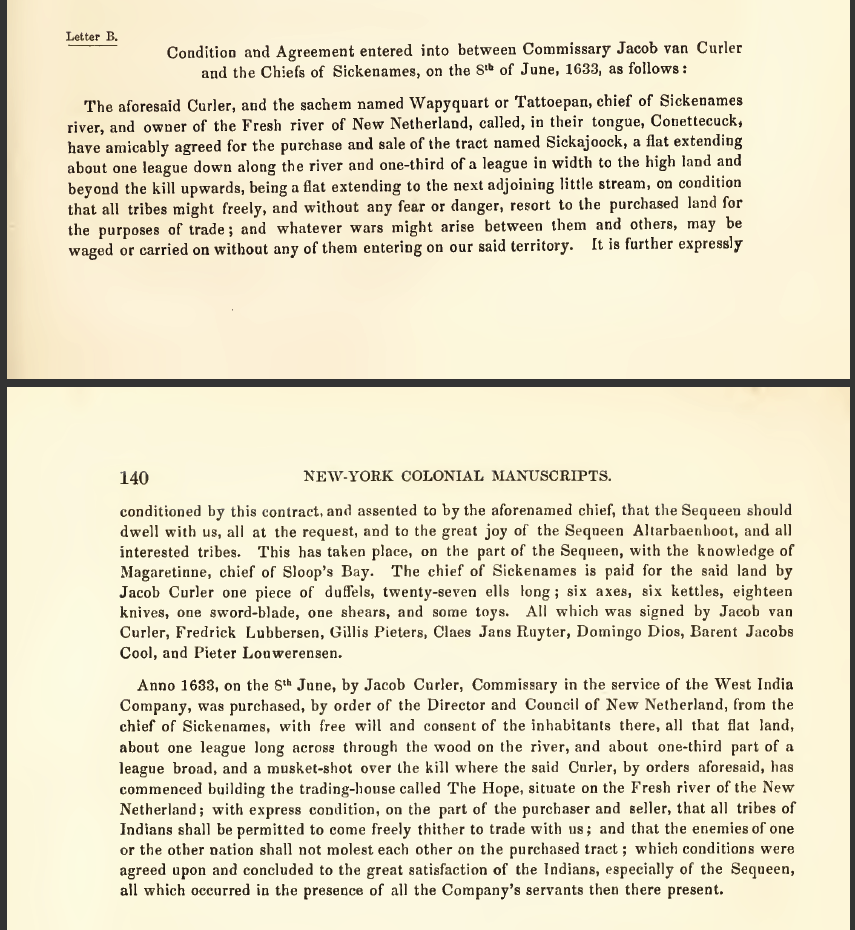
Here is one of the earliest, an agreement made on June 8, 1633, between Jacob Van Curler, Commissary for the Dutch West India Company, and Tattoepan, the chief of Sickenames, on the Connecticut River at what is now Hartford. Although framed by the Dutch as the purchase of a piece of land, this agreement contains the condition that the native owners will live there with the Dutch. The purpose of the agreement is clearly to allow the Dutch to build a “trading-house” that can be used by “all tribes of Indians,” even those in conflict with each other. The Dutch proceeded to construct a fort called Huys de Hoop . Sadly, the intent to keep things peaceful did not last and the trading house was soon caught up in the violence of Dutch-English-Pequot quarrels.
Source: E.B. O’Callaghan (ed.). Documents Relative to the Colonial History of the State of New York, Albany: Weed, Parsons, 1853. You can download it from the Internet Archive here.
Source: John Romeyn Brodhead, Berthold Fernow, E.B. O’Callaghan, Documents Relative to the Colonial History of the State of New York, Albany: Weed, Parsons, 1881, v. 13, p. 510. Available through the Internet Archive here . The original, which has the same gaps as the printed version, is held by the New York State Archives. See Series A1894, New York (Colony) Council Papers 26-69. It must have already have been damaged by 1881, when the printed version was published.
This document is not listed in the “Schedule of Propositions” or in Peter Wraxall’s Abridgement of the Indian Affairs, which starts with an entry for March 1678. The date is a few months earlier than the earliest entry in the “Schedule of Propositions,” but that entry is for page two of the original. Perhaps this was page one.
Although this document does not mention the Commander of Fort Orange or the Commissaries of Albany, the meeting was held in the court house at Albany and Robert Livingston was the Secretary.
British Historical Documents (Series A1894, New York (Colony) Council Papers)
26-162
transcribed 9-7-2016 by Ann Hunter
not in DRCHNY
Schedule of Propositions says this begins on p. 8 of Volume I of the Minutes of the Commissioners of Indian Affairs
Document is damaged.
The Commander and Commissaries answer to ye Oneydes Propositions made yesterday in ye Court house of Albanie this 21th day of Decemb 1677
Brethren
1 Yow have understood by ye Gov:rs messenger which brougt yow ye Zew.t that he did demaund ye mahikanders boy who was taken Prisoner by you at Claverak, and yow have now delivered him up, It is well, we shall make it known to ye Gov.r Genl. [of] ye first, & yow doe Likeways well that yow only look upon ye gov: order and not hearken to ye talk of any others.
2 As Concerning that which your Indians have done to those of mary Land, we shall according to your desire give ym of Maryland Notice of ye first [& we doubt not but yt yow will keep [the] covenant which is made betwixt Coll: Coursey authori[zed] of maryland [&] yow.
Doe give them the value of [illeg.] in Zewt Rumm Indian Corn & Tobacco.
Source: New York State Archives: A1894, New York (Colony) Council Papers 26-161.
Transcribed 9-7-2016 by Ann Hunter.
The Schedule of Propositions says this begins on p. 2 of Volume I of the Minutes of the Commissioners of Indian Affairs.
The document is damaged. Material in brackets is my best guess for what it said before the damage occurred.
See S of P 28149 [0006], Richter 46-47, Colden 24-25, DRCHNY 13:516.
Propositions made by ye Oneydes to ye Commander & Commissaries of Albanie Colonie [of] Renselaerswyck &c. in ye. Court house of Albanie this 20th day of December 1677
[Translated] by [Arnout] Cornelise Viele
The Sachims are
Sweensee
Jagoseragaraw
Degahowagoe
Sagahaurnichta
Soringwasorni
They say Brethren —
1st Our Young Indians have a while agoe by a misunderstanding taken a Mahikander Boy Prisoner at [Claverack] being in ye Governr. Genls Government where it is not free for us to doe [in yr house] & whereas ye Gov: Genl. did [advertise us] (by a maquese who Brought 9 hand of white Zewt. as a Letter) that we should deliver up [said young Mahicander] who was already [become a part in our] Castle to Remain there, we [illeg] that, [illeg.] order, & doe deliver him [illeg.] to you (who Represent [illeg.]) Gov: Genl. Wee were here we [illeg.] 4 Monthes agoe to see & speak wt. his honr. ye. gov. genl. but had no occasion to doe ye Same, and now we heare he is gone to England [hole in mss.] [nevert]helesse we obey his Comma[nd to] bring iyr this young Indian [hole in mss.] 3 Layss.
And if soo bee ye maquese might chance to say that they were ye occasion of this our obedience, believe them not for we only doe obey the Gov: Genl. herein
2 Doe Say That there is a Covenant made here Lately, betwixt Collonel Coursey authorized from Maryland & us that we use no hostility one against another: but Live in Love & friendship (as ye Covenant is betwixt the Gov: Genl. & us,) but there happend something after the makeing of this Covenant [illeg] Some Sinnekes & Oneydes were [out] against there enemies (but quite ignorant of foresaid Covenant, being gone [hole in mss.] before the Same was made) [hole in mss.] were fallen upon behind virginis by ye. Susquehannes (Indyans of Maryland) who Shott upon them [&] wounded two, one throw the arm, and another throw ye Shoulder, whereupon they Likeways fell upon the Susquenannes and killed four & took six Prisoners, and being come home it was thougt good by ye Sinnekes Sachims to send home the 5 which there Poeple had taken Prisoners wt Presents, ye better to keep the Covenant which was made, and ye 6th is wt us at Liberty and goes out a hunting
This is that which the Sinnekes desired us to acquaint you withall, & doe give a bever (being sent from ye. Sinnekes) which they call there Letter, & another Bever as a letter for to desire that ye news be sent to them of maryland


 The records that were bound together in the mid 18th century and labelled as “Minute Books” of the Albany Indian Commissioners had earlier precedents that were not included in those compilations. I am going to post copies of as many of these as I can find in order to look at how the Albany Indian Commissioners, and the diplomatic protocols they followed, evolved out of both European and Native American traditions.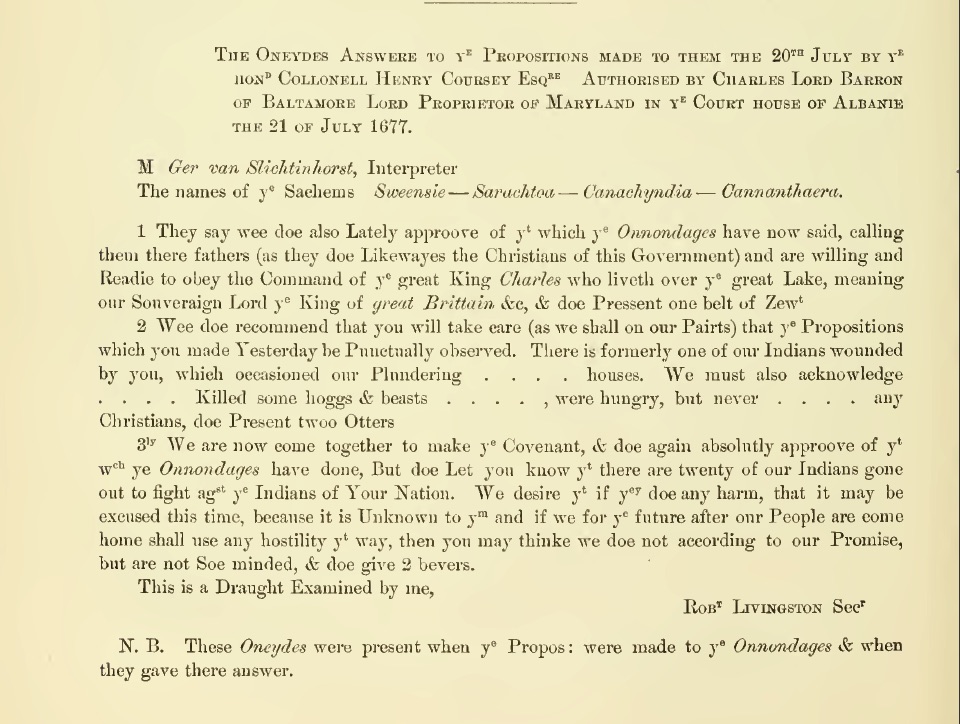
 The Albany Indian Commissioners