Minute Book 3: 1724-January

In Library and Archives Canada’s digital copy of the original minutes, January 1724 starts here

DeLeryMap_Severance_OldFrontier
The pace of competition between France and England was heating up as both attempted to build new forts at strategic locations on the routes into the interior. The image is from Frank Severance, An Old Frontier of France, NY: Dodd Mead, 1917, v. 1 p.236

As 1724 began, the struggle between England and France for trade and a military presence in the North American interior continued in full force even though technically they were at peace. Both imperial powers were pressuring the Six Nations and the many nations to the west, south, and north of them for exclusive trade agreements. English and French diplomats and military commanders came into conflict with each other as they attempted to get permission from the Six Nations and other native people to build trading centers and forts around the Great Lakes.

In the meantime, the war between New England and the Eastern Indians (primarily the Abenaki Confederacy) continued.

Laurence Claessen returned from a trip to the Six Nations (Haudenosaunee), where the commissioners had sent him in November 1723, and gave them an account of what had transpired. His first order of business was to ask the Seneca to take wampum belts to the “far nations” to the west of Iroquoia to encourage them not to listen to the French government in Canada.  The commissioners believed that the French were encouraging the far nations to join the Eastern Indians in their war against New England (Father Rale’s War), thus preventing them from trading with Albany.

The Six Nations met and considered this proposal for several days before telling Lawrence that they agreed that the French would do everything possible to prevent a direct trade between the far Indians and New York. The Six Nations feared that the Governor of Canada was planning to incite the far Indians to attack the Haudenosaunee, and for that reason the Seneca had stayed home. Finally three Seneca sachems agreed to take the commissioners’ belts to the far nations and added six belts of their own, explaining that they needed additional belts to cover all the different nations that needed to get the message.

The Seneca said they would come to Albany the following Spring with a large number of the far Indians and would meet Captain Jacob Verplank at the Lake, as the Governor of New York had requested. “The Lake” probably means Lake Ontario near Irondequoit Bay, where a contingent of Dutch traders had been living among the Seneca. They also explained that Jean Coeur (Louis Thomas Chabert de Joncaire) planned to build a fort and trading house at Irondequoit the following Spring with the Six Nations consent.

The commissioners conveyed this information to New York Governor Burnet in a letter. They added that they had retrieved a “negroe boy” from a “ffrench Indian” who had taken the boy from “Captain Hicks,” probably Captain Robert Hicks, a Virginia trader who commanded Fort Christianna, Governor Alexander Spotswood’s project to educate (and control) the Saponi and other indigenous nations.

Minute Book 3: 1723-November

In Library and Archives Canada digital copy of the original minutes, November 1723 starts here

The two observer-messengers (or spies) sent to Canada in October returned in November. They told the commissioners what they had seen there, but the commissioners asked them to repeat it with Lawrence Claessen present. Perhaps this was because the commissioners did not speak the Mohawk language as well as he did, or perhaps it was because they wanted to bring in his expertise in diplomacy. Either way, it shows how much they relied on him. For most of 1723, no members of the Schuyler family are included in the lists of those present at the commissioners’ meetings, and developments in October had already revealed that John (Johannes) Schuyler was conducting parallel diplomacy on his own. The commissioners may have felt that they were loosing their influence with the Six Nations and needed all the help that Claessen could provide.

In any case, the messengers confirmed that John Schuyler gave them wampum belts to take to three “castles,” i.e. native communities, in Canada: Cachnawage (Kahnawake) Kanighnoghquadee (Gananoque?) and Rondaxis. (The Rondaxes or Adirondacks were Algonquian speakers who lived at Three Rivers and Oka, according to p. 239 of the Livingston Indian Records.) Schuyler had not informed the commissioners about the belts, but he  sent them in the name of Boston and New York. Apparently he was working behind the Albany Indian Commissioners’ back with New York as well as Massachusetts.

Schuyler’s wampum belt messages asked the three castles to stop fighting with the French and Abenaki against New England in the ongoing hostilities known to historians as Dummer’s War. He also invited them to “use and Cultivate the Road from Canada hither and trade as Usual,” promising to remove any obstacles to doing so. “Hither” apparently meant Albany. Did Schuyler promise to restore the trade in Indian goods between Albany and Montreal, a short distance from Kahnawake? That trade had benefits for both native and French traders in the St. Lawrence Valley, as well as for many Dutch traders in Albany, even though the commissioners were working with New York’s Governor Burnet to suppress it.

The few Kahnawake leaders who were home when the messengers arrived promised to convey their message to those who were away hunting and fighting. They sent wampum belts in return to the belts brought by the messengers, but they were delivered directly to John Schuyler.

The commissioners also learned that the French and their native allies had asked more distant “upper and remote” nations to join the French side in Dummer’s War the following spring. The commissioners feared that this would not only put New England in peril, but also jeopardize the trade between those distant nations and Albany that they were trying to encourage. They sent Lawrence Claessen to the Seneca Country to engage paid messengers there to negotiate with those nations on Albany’s behalf, in particular they wanted to encourage the “Denighcariages”, a nation that, at least in the understanding of the commissioners, had joined the Six Nations that summer as the Seventh Nation. Claessen was told to assure the far nations that peace was being negotiated between the Eastern Indians and New England, the road to Albany though the Six Nations would be safe, and Albany had cheap and plentiful goods for sale.

The remainder of the entries for November concern the Schaghticoke Indians. Located north of Albany where the Hoosick River joins the Hudson from the east, Schaghticoke was on Mohican land and the path along the Hoosick was a well used road to the Connecticut Valley, one of the areas where New England was under attack. The Schaghticoke community were refugees under New York’s protection, mainly people displaced by settlers in New England and the lower Hudson, close allies of the Mohican. They were caught in the middle of Dummer’s War both geographically and diplomatically, since many were Abenaki themselves. The commissioners reproached them with leaving their homes and “Stragling & Scatter[ing]” from one place to another, instead of staying at Schaghticoke under the “Tree of Friendship and Welfare” that was the symbol for New York’s protection. People from Schaghticoke had even been seen on their way to Canada, where the commissioners undoubtedly feared that they would join the French. The commissioners believed that the Schaghticokes needed to appoint some leading men as sachems to keep them in one place, and persuade those who had left for Canada to come back.

The Schaghticokes acknowledged the agreement made almost half a century earlier with New York, joining them together and giving them protection at Schaghticoke. They said they wanted to stay there even if Canada offered them land. They agreed to consider the proposal to appoint leaders and try to bring back those who had left. They offered the commissioners gifts of venison and strings of wampum, as was customary. But the following day they said it would be impossible to get the people who had left to come back, since they had fled after committing robberies at Saratoga. They also pointed out that the Tree of Welfare was now bare at the roots, that is that their relationship with Albany was under a strain because they did not have enough land at Schaghticoke and the (Dutch) inhabitants there were harassing them. The Minute Book entry does not say what the commissioners knew well. The reason the Schaghticokes had little land left was that under New York law Albany owned that land and was leasing more and more of it out to Dutch farmers. It was Albany’s tenants who were harassing the Schaghticokes.

The Schaghticokes proposed that part of their people should move to Sinchjack, where there was still good land available. Sinchjack, which they also spelled as Sinkhaijck, probably refers to the area farther up the Hoosic River from Schaghticoke, near where the Walloomsac River flows into it in the vicinity of present day Williamstown Massachusetts. It was also known as St. Croix.  Its history is discussed in Arthur Latham Perry’s Origins In Williamstown, beginning on p. 114.

The Schaghticokes asked the commissioners to nominate leaders for them and to mend their weapons, as was customary. The commissioners agreed to all of this, including the move to Sinckhaijck. They nominated Nanratakietam, Aspenoot, Wapelanrie, Kakaghsanreet, Mashequant, and Akamsomett, with Nansasant as a successor if any of them passed away. They said it was essential to bring back those who had gone to Canada, and offered to forgive those who had committed faults, that is the Saratoga robbers. They also promised to stop the settlers at Schaghticoke from interfering with the Schaghticokes’ use of their land. They thanked them for the venison, promised to have their weapons mended, and gave them gifts of ammunition, shirts, and alcohol, with blankets for the elders Nanratakelam and Waleghlanret..

There are no entries in the Minute Book for December, so this concludes the summaries for 1723.

Minute Book 3: 1723-July

In Library and Archives Canada digital copy of the original minutes, July 1723 starts here

More groups of native traders came to Albany in July. Fourteen “Twightwights” or Miami met with the commissioners on July 12th. Like the “Denighcareage” group that came in May, they were accompanied by a Haudenosaunee translator who lived among them, a man named Dewadirko who was an Onondaga who had been taken prisoner by them. They recited a story similar to that of the previous groups, rehearsing the difficulties of their journey, emphasizing that the French had tried to discourage them from coming, asking for good prices on trade goods, and leaving calumet pipes for the commissioners to keep and smoke when others of their nation came.

At the same meeting, an Onondaga man named Oquaront reported that another nation living farther away than the Miami, called Agottsaragoka (or Oguttsarahake) wished to make an agreement to pass through the Five Nations and come to trade at Albany. In addition, some native traders arrived from Tughsaghrondie, the area where the French had built Fort Detroit at the beginning of the century. They renewed the Covenant Chain and they too asked for cheap goods, suggesting that the French goods at Fort Detroit were not meeting their needs.

The commissioners welcomed all of the visitors, accepted the Miami calumet pipes, assured Oquaront that the way would be clear for the Oguttsarahake to come to trade, and renewed the Covenant Chain with the Tuchsagrondie. They invited the group to send some principal leaders to New York to meet the governor, but were told it was too late in the year. However, they offered to come to see the governor the following spring.


Minute Book 3: 1723-June

In Library and Archives Canada digital copy of the original minutes, June 1723 starts here

The conference with Massachusetts Bay and the Six Nations (I will refer to them that way from now on, since the Tuscaroras were now established as a member of the Five Nations) continued on June 1st, when William Tailer, Spencer Phips, and John Stoddard renewed the Covenant Chain with the Schaghticoke, Katskill, and “River” Indians, a term used for the Mohican and the peoples of the lower Hudson.  Massachusetts Bay asked them to join the war if the the Six Nations accepted the Massachusetts Bay offer to fight the Eastern Indians. They replied that they would follow the Six Nations’ lead.

The Six Nations gave their answer on June 3rd. They soothed the feelings of the Massachusetts Bay representatives by rehearsing the wrongs inflicted on them by the Eastern Indians. But they explained that the Eastern Indians, had now sent a messenger to make peace. They needed to discuss matters further and it would take several months.

The representatives from Massachusetts Bay were clearly disappointed. They asked what the point of renewing the covenant was if the Six Nations would not help them fight their enemies, especially since they would be generously rewarded. They explained that they were not empowered to make peace with the Eastern Indians and asked once again for the Six Nations to join the war. Instead the Six Nations urged them to meet with the Eastern Indians at Boston in two months to discuss peace, promising to punish the Eastern Indians if an agreement was reached and they did not honor it. The Massachusetts Bay delegates finally agreed to attend the proposed meeting.

The Six Nations and the Albany Indian Commissioners went on to discuss their own issues, in particular the competing centers for French and English trade that were being constructed in Iroquoia. The French diplomat Louis-Thomas Chabert de Joncaire, referred to by the commissioners using every imaginable variant spelling of “Jean Coeur” had persuaded the Six Nations to allow the French to build a trading center at Kaskeghsago near Irondequoit, at the site of present day Rochester, where the Genesee River meets Lake Ontario. The commissioners asked the Six Nations to reverse this decision and forbid the French to build any settlements in Iroquoia, predicting that if  the French built a trading house at Irondequoit it would become a fort that would be used to stop “far Indians” from coming to Albany and eventually to take control of the Six Nations’ country. Furthermore, they asked the Six Nations to tell the French to remove their trading center already constructed at Niagara, as they had promised the New York governor previously. The Six Nations speaker, Thannintsorowee, said they would take the request back to their council and provide a response at the Boston meeting.

The Six Nations and the Albany commissioners held another meeting with the Abenaki envoy, lectured him about the violence inflicted on New England by the Abenaki, and told him that the Eastern Indians should come to the meeting in Boston scheduled in two months to negotiate.

The rest of June was devoted to trade. Another group of 10 far Indians came to trade on June 16th, asking for good prices and promising to bring more people if they received them. They were welcomed with provisions and rum, and assured that prices would be good. The name of their castle is left blank, suggesting that the commissioners were not familiar with it and unable to make sense of it. Magepanans, a River Indian, was asked to invite more nations to come to trade and promised a reward if he succeeded.

Governor Burnet had asked the Albany Indian Commissioners to enforce a recent act of the New York Assembly intended to stop the flourishing trade between Albany and Montreal. In this trade, which had been going on for decades, English goods were sold to the French and the French then resold those goods to indigenous fur traders. This practice undermined the English policy that aimed to monopolize the fur trade for England by persuading the indigenous fur traders to bring their goods directly to Albany.

Under the new act, Albany traders had to swear an oath that they were not trading with Canada, on penalty of a fine of a hundred pounds. The commissioners took the oath themselves and spent several days at the end of June in summoning local traders, many of whom were prominent citizens or relatives of the commissioners, and asking them to take the oath. Several refused and were fined, including Colonel John Schuyler and his son Philip Schuyler. The notes indicate that the money would be applied to repairing Albany’s fortifications or used as needed. On the 22nd, they wrote to the governor and reported on this, assuring him that they supported the policy, while acknowledging that goods were still being traded with the French. They also asked the governor to allow passage for three Frenchmen who were going to visit their uncle, a “famous trader” in Pennsylvania.


Minute Book 3: 1723-April

1280px-FORT_CHRISTANNA,_BRUNSWICK_COUNTY,_VA
Fort Christanna (from Wikipedia, taken by Jerrye & Roy Klotz, MD – Own work, CC BY-SA 3.0, https://commons.wikimedia.org/w/index.php?curid=28230287)

In Library and Archives Canada digital copy of the original minutes, April 1723 starts here

On April 6th, the Onondaga diplomat Teganissorens (the commissioners spelled his name D’Canassore) came to Albany to discuss relations between the Five Nations and Virginia. He assured the Commissioners that the Five Nations would respect the peace agreement they had made with Virginia the previous fall and refrain from attacking Virginia’s native allies. By 1723, Teganissorens had had a long and successful career during which he helped to shape the relations between indigenous and colonial powers throughout the North Atlantic region. He was no longer young, and the journey from Onondaga to Albany was a lengthy one. His trip to Albany suggests that the treaty with Virginia had been called into question in a significant way.

The next entry in the Minute Book, an April 23rd letter to New York Governor Burnet, suggests that the issue was the Saponi man taken captive near Fort Christanna in Virginia by a raiding party from Kahnawake, the Mohawk community near Montreal, as described in the minutes for January and February. The commissioners told Burnet in their letter that they had still been unable to get him released. Perhaps Governor Spotswood of Virginia, who saw the Saponi captive as his own servant, had argued that keeping the prisoner violated the treaty and asked Governor Burnet to pressure the commissioners to force the Five Nations to use their influence with the Kahnawagas to have the captive returned.

Teganissorens reassured the English that the treaty remained in place, but if the captive was the issue, he either could not or would not force his return. The end of the letter finally reveals what is really going on.  The captive has chosen to go to Kahnawake in Canada rather than return to his own country, and now he has been made a Sachim. The commissioners have sent orders to Kahnawaga for him to return, but they don’t expect him to do so. Apparently the captive, who remains anonymous, would rather be a chief at Kahnawake than work for Governor Spotswood.

From the Five Nations and Kahnawake point of view, he likely could be a valuable player in Iroquois negotiations with the Sapponis as well as the English. His proficiency in his own language as well as English could be an important asset. Perhaps he had even learned to read and write at Governor Spotswood’s school at Christanna, making him even more useful.

As often happened, the commissioners were caught in the middle of a delicate situation. Kahnawake and the Five Nations had the upper hand.  All the commissioners could do was try to assure the English authorities that they had done everything they could to assert English sovereignty and get the captive returned.  Their letter provides insights into the relations between Kahnawake and the Five Nations, as well as between the Five Nations, Albany, and the English government. As they explain, the residents of Kahnawake are part of the Five Nations. If they are treated roughly, the Five Nations will take offense. They may not react publicly, because they want to maintain good relations with Albany, where they obtain “bread & Cloathing.” But they will find “underhand” ways to injure English subjects in the “remotest part of the Government,” that is the areas distant from the centers of colonial control. The commissioners and their families frequented those areas. Without the support of the Five Nations, even Albany itself was still vulnerable to military attack and the loss of the fur trade.

The entry for Fort Christanna in the WordPress blog Native American Roots provides some interesting additional information. The fort itself was closed in 1718, but Saponi people continued to live in the area. Some of their children were “bound out” to local colonists. Perhaps this is how the captive became Governor Spotswood’s servant.


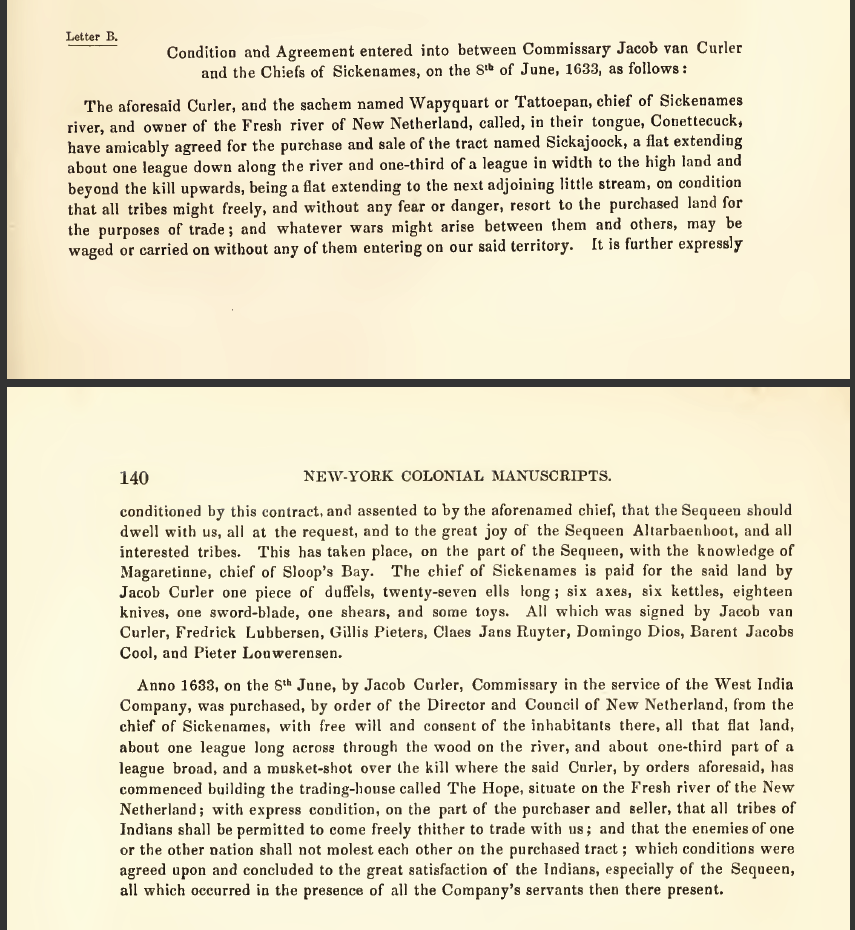
1633 June 8: Agreement for a Trading House on the Connecticut River (Pre-Minute Books documents)

vancurler_sickenames-drchny2-139The records that were bound together in the mid 18th century and labelled as “Minute Books” of the Albany Indian Commissioners had earlier precedents that were not included in those compilations. I am going to post copies of as many of these as I can find in order to look at how the Albany Indian Commissioners, and the diplomatic protocols they followed, evolved out of both European and Native American traditions.

Here is one of the earliest, an agreement made on June 8, 1633, between Jacob Van Curler, Commissary for the Dutch West India Company, and  Tattoepan, the chief of Sickenames, on the Connecticut River at what is now Hartford. Although framed by the Dutch as the purchase of a piece of land, this agreement contains the condition that the native owners will live there with the Dutch. The purpose of the agreement is clearly to allow the Dutch to build a “trading-house” that can be used by “all tribes of Indians,” even those in conflict with each other. The Dutch proceeded to construct a fort called Huys de Hoop . Sadly, the intent to keep things peaceful did not last and the trading house was soon caught up in the violence of Dutch-English-Pequot quarrels.

Source: E.B. O’Callaghan (ed.). Documents Relative to the Colonial History of the State of New York, Albany: Weed, Parsons, 1853. You can download it from the Internet Archive here.