Blog Posts

Minute Book 3: 1726-September pt.1: Governor Burnet Holds a Conference and Obtains a Questionable Deed

[There are no entries for August 1726.]
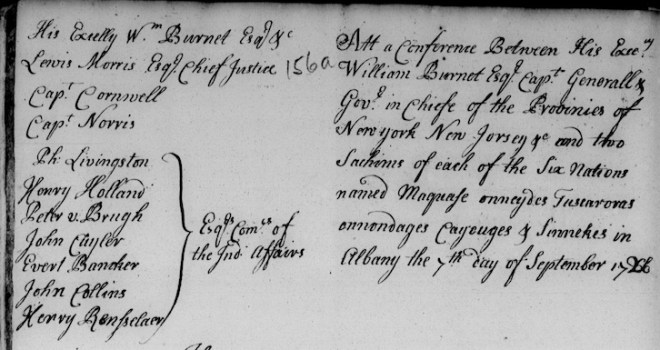
1726-9-7In preparation for the conference held September 7-14, Governor William Burnet issued a proclamation that prohibited giving liquor to Indians  or trading in Indian goods to be used as presents, thus maintaining control over goods that might influence native decision makers. The proceedings printed in Documents Relative to the Colonial History of the State of New York, Volume 5, beginning on page 786, are substantially the same as the version in the records of the Indian Commissioners. I have not transcribed them, but they are summarized below. DRCHNY also includes a letter that Governor Burnet sent to the Lords of Trade (p. 783 et seq.) along with the treaty, in which he explains that his main goal was to prevent the Six Nations from authorizing the French fort at Niagara. He added some related correspondence between himself and the Governor of Montreal and a questionable deed to Seneca, Cayuga, and Onondaga lands (DRCHNY 5:800) negotiated secretly with a small group of sachims at the end of the conference. The deed is not part of the records of the Indian Commissioners.

On September 7th Governor Burnet held a private meeting with his staff and a small group of two sachems from each of the Six Nations. Part of the record of this meeting is written out as a series of queries and answers, a different format from the usual one in which wampum belts were presented on specific points and the other side would consider them before responding to them as a group. Burnet, or whoever wrote up the minutes of the meeting, may have structured it this way in order to create a record that supported the idea that the Six Nations were subject to British dominion and the governor could query them as he would do with a subordinate official.

At the private meeting, the Onondaga speaker Ajewachta recounted how the French envoy “Monsieur Longueuil” (Charles Le Moyne de Longueuil, 1687-1755) had presented the building at Niagara as a trading house to replace an existing bark house that had fallen into disrepair. According to Ajewachta, the Onondagas agreed to it despite objections from the Senecas who actually owned the land. Ajewachta tried to reassure Governor Burnet that the region encompassing Niagara and Lake Ontario, would remain “a path of peace for all christians and Indians to come and go forward and backward on account of Trade.” He said the Six Nations told the French that they held firm to the alliance with the English as well as to peace with the French.  They wanted the French and the English to settle any disagreements “at Sea and not in [the Six Nations’] Country.”

When Governor Burnet asked the sachims whether they were not sorry that they had agreed to the new building at Niagara, they said Longueil had won them over but they immediately regretted it. They described the extensive negotiations between them and the French in which the Onondagas had tentatively agreed to the French request., but subject to the approval of the rest of the Six Nations and void if they disallowed it. A Seneca Sachim named Kanakarichton verified that the land at Niagara belonged to the Senecas along with land on the other side of the lake. Nonetheless, the French who came to build the fort insisted on finishing it even while the Six Nations were still discussing the situation with the French governor through the interpreter Jean Coeur (Louis-Thomas Chabert de Joncaire). When the building was finished it would be staffed by 30 soldiers as well as officers and a priest.

The Six Nations also said they had heard that two Frenchmen had asked an unidentified nation living on the Ohio River to take up the hatchet against the Six Nations on behalf of the French, but that nation had refused. The Frenchmen told them that papers were going to circulate to Philadelphia, New York, Albany, and Montreal about an agreement between the French and the English to cut off their nation once the fort at Niagara was complete, but the warriors burned the papers, preventing it. They also heard ominous things from Canada about proceedings between the French and the English, and asked Governor Burnet what news he had heard. Finally they said the traders in their country were cheating them by selling water disguised as rum that went bad in a day or two.

Governor Burnet promised to send someone to oversee the trade to prevent cheating. He explained that France and Great Britain were currently allies who were going to war with Spain.  He read them the text of a letter that he had sent to the governor of Canada about the Treaty of Utrecht, which required the French in Canada not to hinder or molest the five Nations or their allies and guaranteed free trade for all. After Governor Burnet encouraged them to do so, the 12 sachims asked him to contact King George and request him to write the King of France to object to Fort Niagara. Burnet closed the meeting by stating that what had transpired would now be stated publicly.

Two days later proceedings resumed with a full gathering of all the representatives of the Six Nations, Governor Burnet, the Commissioners for Indian Affairs, and aldermen from the City of Albany. Governor Burnet, who had been studying the French works on the subject, reviewed in detail the history of the wars between France, its native allies, and the Six Nations, as well as their peaceful relations with the English. He told them that the King of Great Britain was their “true father” who had always fed and cloathed them and provided them with arms.  He renewed the Covenant Chain and gave them a belt of wampum.

Governor Burnet told the gathering that Monsieur Longueuil (Charles Le Moyne de Longueuil, 1656-1729, Governor of Montreal, whose son of the same name was in charge of Fort Niagara) had sent him a letter claiming that the Six Nations had unanimously agreed to the new fort at Niagara, but the Six Nations now said they were afraid the fort would enable the French to keep them from their hunting grounds and prevent the far nations from coming to trade.  He explained the free trade provisions of the Treaty of Utrecht and said he would convey the Six Nations’ complaints about Fort Niagara to King George, who would ask the King of France to review whether it violated the Treaty of Utrecht. If the fort was in violation it should be removed.

Governor Burnet also said that when he conveyed a request from the Six Nations to the governor of Virginia to set up a meeting, Virginia and South Carolina had complained about attacks on their frontiers by Tuscaroras and others. Burnet asked that the offenders be punished. In particular the Senecas attacked an English trading house called Constichrohare at Characks (Cheraw) and captured an Indian boy who was the slave of Nathaniel Ford along with guns, blankets and powder.  The goods and the Indian slave should be delivered to Peter Barbarie, who would reimburse the captors in the name of the owner.  Burnet asked the Six Nations not to allow “French Indians” to pass through their country in order to attack the southern colonies.

Kanakarighton responded for the Six Nations. After renewing the Covenant Chain, he said that the Six Nations had already asked the Governor of Canada to stop building the fort at Niagara.  They now came to the English “howling” because the French were building on their land. He presented a belt to the governor and asked him to write to King George as soon as possible to have the fort removed.

Kanakarighton notified Governor Burnet that Jean Coeur was expected soon at Onondaga, where he would probably spread negative rumors about the English. He asked Burnet to send a “Man of Experience” to Onondaga to hold a meeting with Jean Coeur in front of the Six Nations. It should be conducted  speaking “nothing but Indian between the brother Corlaer and the French, every one to answer for himself concerning what ill Reports he shall have spread” in order to get to the truth and “know who is the lyar.”

Kanakarighton acknowledged Burnet’s concerns about frontier attacks on Virginia and South Carolina. He said that Senecas, Mohawks, Tuscaroras, and “French Indians” were all involved, but their intention was only to pursue Indian enemies present in the trading house that was attacked. The slave that Governor Burnet wanted returned had been given to “Indians who live on a Branch of Susquehannah River, which is called Soghniejadie.” He suggested that the English look for him there themselves because the place was “nearer to you than us” (probably meaning nearer to Virginia.) He asked that the attacks be forgiven as merely accidents committed without the approval of the sachems and agreed to try to stop French Indians to travel through Iroquoia to go fighting.  He pointed out that the English must do their part “for many go fighting thro’ Albany to the English Settlements, who do not come thro’ the Six Nations.

Kanakarighton concluded by adding to what Burnet had said about the history of relations between the Six Nations and the English. They arose through trade at a time when goods were cheap, but now goods had become expensive. He asked for cheaper prices, especially for powder.  Moreover, now that the Six Nations had agreed to let the English trade (“place Beaver Traps”) on the Onondaga River, they had been deceived, since traders there sold river water as rum for a high price. But instead of asking for better rum, he asked for no rum, since it was causing quarrels between married couples and between young Indians and sachims. When Indians from beyond Iroquoia wanted rum, they should come to Albany for it as they used to do, while traders to the Six Nations should bring powder and Indian goods for the same price as they would cost at Albany.

Finally he conveyed a request from the Senecas that Myndert Wemp return to their country as a smith along with an armorer, Andries Nak, who should be taught to speak their language.

Governor Burnet agreed to ask King George to persuade the King of France to remove Fort Niagara.  He did not agree to send a representative to Onondaga for a meeting with Joncaire, claiming that the Six Nations’ own experience should be enough to show that French reports about the English were false. However, he said he would send someone to the Senecas for the winter to address their concerns. He said he would tell the governor of Virginia what the Six Nations asked (that frontier incidents be forgiven) but the best way to prevent Virginia from taking up the hatchet was to stop such attacks. Burnet said he could not control what merchants charged for their goods, and refused to stop selling rum on the Onondaga River.  However, he would post someone there to oversee the trade and prevent cheating, and would ask Myndert Wemp to return to the Seneca country as a smith along with an armorer. He wished them a good journey home, told them he was providing them with a “noble Present” from the king, and explained that rum and provisions would be given to them for their journey after they were “past Schenectady.”

Burnet also held a brief conference with the River (Mohican) and Schaghticoke Indians the same day, condoling two sachims who had died, and recommending Wawiachech to replace them, renewing the Covenant Chain, and admonishing them to stay at Schaghticoke and not go to Canada.  They thanked him and explained that the people who left for Canada were fleeing debts, but those who remained would live and die at Schaghticoke.

On September 14th Burnet held another private conference, this time with two sachims each from the Senecas and Onondagas and three from the Cayugas, but no Oneidas, Tuscaroras, or Mohawks. The names of those who attended are given as Kanakarighton, Thanintsoronwee, Ottsochkooree, DeKanisoree, Aenjeweerat, Kackjakadorodon, and Sadekeenaghtie. Going considerably beyond what had been discussed in the full conference, the small group consented to Governor Burnet’s suggestion that they sign what Burnet called a “deed of surrender” putting their land in trust to the King of England to be protected for the use of their nations.

A deed was signed, becoming part of the “Original Roll in the Secretary of State’s Office” in Albany and later printed in DRCHNY 5:800. No copy was kept in the records of the Commissioners of Indian Affairs, which generally did not include deeds. Peter Wraxall was not aware of the deed when he wrote his Abridgement, which discusses the September 1726 conference on p. 168-169.

In his letter to the Lords of Trade sent with the treaty, (DRCHNY 5:783-785) Governor Burnet explained that he did not tell the Mohawks or Oneidas about the September 14th meeting, since their lands were not at issue and if he told them the French might learn about it sooner. Burnet told the Lords of Trade that he pursuaded the New York Assembly to agree to his proposal to build an English fort at the mouth of the Onondaga River (Oswego). Once it was built he intended to meet the Indians again and get them to publicly confirm the deed, which “some of them have signed.” Thus he acknowledged that it required further confirmation.  The deed surrenders the land to be “protected & Defended” by the king for the use of the three nations. It says nothing about building forts. At Burnet’s conference with the Six Nations in 1724, he had succeeded in getting them to agree reluctantly to a trading house at Oswego, but not to a fort.

In Library and Archives Canada’s digital copy of the original minutes, the proclamation of September 2 1726 starts here.

Minute Book 3: 1726-July: Major Schuyler Dies; Abenaki are Welcomed Back to Schaghticoke; Albany Reassures its Neighbours

On July 21 the commissioners informed Governor Burnet that a messenger had brought word that Major Abraham Schuyler was dead. They included no details about how it happened. They also said they had sent the interpreter (Laurence Claesson) to bring the Six Nations to the conference with the governor scheduled for September. They included the news that “Mr. Livingston” had just taken leave of them and departed for Canada, but did not explain what his goals were. Possibly Philip Livingston sought to protect his and Albany’s business interests from the impending threat that the French were going to use their new fort at Niagara to monopolize the fur trade.

The following day a man named Poquin arrived from “Assekontoquoq” with a group of other people to respond to a message sent by a wampum belt two years earlier.  Poquin said that no matter where his people went, they were always in danger. He also said that they used to be able to take shelter at Schaghticoke, the community established in 1677 where the Hoosick River meets the Hudson north of Albany. Because of threats from the “Lower Indians” they could not come sooner, so they had gone to “mesixque” in the lake where they used to live. My interpretation of this language is that Poquin’s group were people from Schaghticoke who moved to Missisquoi in August 1724 and joined the Abenaki who were raiding New England with support from the French. “Assekontiquoq” may refer to Arossagunticook, an Abenaki community on what is now called the Androscoggin River. However, an enlightening new book has recently come out on the mission communities of the Saint Lawrence Valley which reveals that the name of the mission community on the Ste. Francois River, now known as Odanak, was called “Arsikantegouk” during this period (Jean-Francois Lozier, Flesh Reborn: The Saint Lawrence Mission Settlements through the Seventeenth Century. p. 256-257.) I suspect that this community is where Poquin’s people had been. Now they wanted to come back to Schaghticoke. They were not sure whether they could safely return, given that they had fought against New England. The term “lower Indians” likely refers to the Mohawks or Mohicans who disapproved of their actions.

The Indian Commissioners clung to a neutral position in Dummer’s War and wanted to end it through diplomacy rather than by supporting Governor Dummer’s military ambitions. They also wanted native people to continue living at Schaghticoke. In August 1724, rather than driving away those who joined the raids against New England, they sent messengers with wampum belts to persuade them to stop raiding and come back. The belt to which Poquin referred was probably part of this process.

The commissioners told Poquin’s group that the Tree of Peace and Welfare still grew at Schaghticoke and they were welcome to live there again. They gave them a belt of wampum and a keg of rum.

The next entry is a copy of a letter from the commissioners that does not give the name of the recipient. The context suggests that it was probably a New England government official. The commissioners said they had no recent news, but would always pass on any information that came their way and behave themselves “as neighbours and brethren.” Possibly this letter reflects the need to reassure neighbouring New England towns that were uneasy about the return of the Schaghticoke Abenaki.

In Library and Archives Canada’s digital copy of the original minutes, July 1726 starts here.


Minute Book 3: 1726-June: An Impressive French Fort at Niagara Threatens British Trade

The rumors were true. The commissioners learned from Major Abraham Schuyler and others that the French had sent 120 men to Jagara (Niagara) to build a new fort there on the south side of the river. French ships filled with lime for its construction were on their way from Cadarachqui, the site of present day Kingston Ontario. A strong new fort at Niagara would cut off native fur traders bringing their goods to Oswego or Albany from the Great Lakes, and would even prevent the Senecas from returning with furs from their hunting territories. The French planned to store goods at Niagara in order to replace the English as suppliers to all the nations in the area.

The commissioners heard that the French had 400 militia men ready to go to Niagara to defend the fort if need be. They urged the governor to look for a legal remedy based on the treaty in force between France and England. Major Schuyler sent several letters that were not copied into the record, although there is a space left for them.  The Onondaga Indians who brought the most recent one appeared to be suspicious of the English and the commissioners urged the governor once again to post some “men of Experience and Conduct” in Iroquoia to restore good relations between the British and the Six Nations.

 An Old Frontier of France, by Frank Severance (NY: Dodd, Mead, 1917, p. 225 et seq.) explains in detail how Fort Niagara was planned and constructed. Below is the plan drawn up for the new fort by Governor Vaudreuil’s military engineer, Gaspard-Joseph Chaussegros de Lery.

Severance-FrenchFrontier_FtNiagPlan1
Plans for the fort that France wanted to build at Niagara. From Frank Severance, An Old Frontier of France, NY: Dodd Mead, 1917, v.1, p. 240.

In Library and Archives Canada’s digital copy of the original minutes, June 1726 starts here.

Minute Book 3: 1726-April: Major Abraham Schuyler is Sent to Onondaga to Promote the English Interest

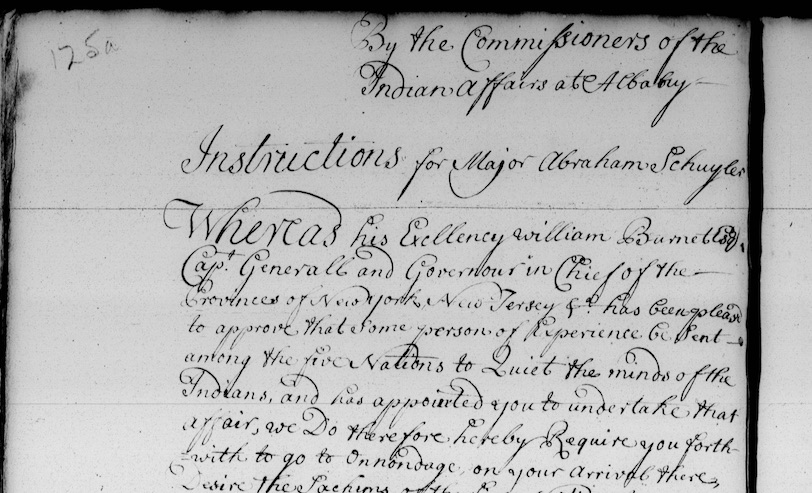
1726-4-21Stefan Bielinski‘s biography  of Major Abraham Schuyler (1663-1726), on the New York State Museum’s The People of Colonial Albany Live Here website, tells us that by 1726, Schuyler had spent years as a trader, interpreter, and diplomat in Iroquoia. In April Governor Burnet and the Commissioners of Indian Affairs sent him to Onondaga with orders to invite the Six Nations to Albany in the summer for a meeting with the governor.  Schuyler was told to address Iroquois concerns about traders who brought alcohol to their country and to ensure the safety of the traders.  He was also told to go to the Seneca’s Country or wherever else he could find information about French plans at Niagara, and to hire “trusty Indians” for this purpose. He was provided with gifts and a belt of wampum and instructed to keep a journal of his activities and observations. He was not to engage in trade himself, but to count on an appropriate reward for his services from the governor, although no amount was stated.

Major Schuyler was also told to keep order among the Dutch traders and prevent them from giving rum even to Indians from outside Iroquoia except when they were about to depart from the falls, probably meaning the falls near Oswego, where trade flourished now that Albany merchants were forbidden to trade with Montreal.

The commissioners wrote to Governor Burnet enclosing a copy of Schuyler’s instructions. They said that even the traders who originally opposed moving the trade west (meaning to Oswego) now planned to partake in it and as many as 50 canoes were expected that summer.  If the French did not prevent it, Albany merchants should do well. The commissioners also told the governor that they had learned that Frenchmen were traveling from Montreal to Jagara (Niagara) without revealing their purpose, which was probably to build the new fort.

The last item in the commissioners’ letter reveals that problems with alcohol were were also occuring at Fort Hunter.  People there had submitted a petition asking for a law preventing people from buying corn from Indians and selling them rum, which was proving “very destructive to them.”

There are no entries for May 1726.

In Library and Archives Canada’s digital copy of the original minutes, April 1726 starts here.

Minute Book 3: 1726-March: Conflicts Over Alcohol Continue; the French Presence in Iroquoia is Growing

It is not clear how well Laurence Claessen knew English.  The commissioners often instructed him to keep journals of his diplomatic missions, but they generally submitted their own versionVersion 3 into the record.  In March, Claessen appeared before them and gave them his journal of his recent trip. The minutes describe “in substance” what it said, including a day by day account of how he went to several towns of the Six Nations and invited leaders to a meeting that was held in Seneca country beginning on February 22nd.  The participants discussed the ongoing conflicts over the sale of alcohol in Iroquoia and other matters including an English boy taken captive from Virginia and thought to be held in Iroquoia. The Six Nations said they did not have the boy.  They asked once again that the English prohibit the sale of alcohol in their country, but Claessen could only tell them once again that sales would be restricted to “Far Indians” from outside Iroquoia to promote the fur trade. The sachems described how alcohol was leading to violence and other problems, even to murders.  They gave Claessen a belt of wampum to take back to the English authorities to confirm their position that it should be banned completely. However they agreed not to molest the traders or the far Indians.
In Seneca country, Claessen found Juriaen Hogan, the blacksmith sent by the English, as well as a party of French residents that included a French smith and his family.  The Iroquois said the French smith had come to live with them “in a deceitful manner,” returning with a Six Nations delegation that had gone to condole the death of the French governor Ramsay. The smith and his party were, of course, also sending information back to the French, just as Claessen and Hogan were doing for the English. Claessen provided an account of new French boats being constructed on Lake Ontario (Cataraqui) and said the Onondagas had given permission to the French to build a new trading house on the south side of the lake where the Niagara River flows into it. He described the composition of the parties that had gone out fighting over the previous winter, and conveyed the Six Nations’ request for a meeting with the governor in the spring. Claessen also reported that the Six Nations was sending ambassadors to the Waganhas proposing a meeting and invited the commissioners to send their own wampum belts along.

The commissioners wrote to Governor Burnet, passed on the intelligence about French activities, and told him (in somewhat confused English) that the French must be prevented from settling in Iroquoia, and asked for funds to support an ongoing English presence among the Six Nations.  They conveyed the request to stop selling alcohol, blamed it on the French influence, and insisted that the traders could not maintain the fur trade without alcohol. They expressed concern that the Six Nations had sent deputies to meet in Seneca country, where the French influence was strongest, instead of to Onondaga as was customary. They also sent the governor the English boy who had run away from the Mohawks at Fort Hunter earlier in the year. Finally they described how Jan Wemp and Jacob Glen had cleared and mended the road at the Oneida Carrying Place, and given a bond to repair the bridge there over Wood Creek.

In Library and Archives Canada’s digital copy of the original minutes, March 1726 starts here.

Minute Book 3: 1726-February

Laurence Claessen is Sent to Negotiate (and Obtain Intelligence)

The commissioners sent Laurence Claessen to Onondaga with instructions to resolve the ongoing conflicts between Albany traders and the Haudenosaunee over the sale of rum at the falls on the Onondaga River. The traders, backed by the commissioners, insisted that they had to sell rum to the “far Indians” from beyond Iroquoia in order to attract their trade in furs. The Haudenosaunee had now been saying for several years that they did not want rum sold at all in their country. Laurence Claesson was supposed to resolve this by delivering a belt of wampum telling them that their request had been received by Governor Burnet and that rum would not be sold to the Six Nations.

Claessen was also told to try to obtain the release of an English boy from Virginia who was being held captive in Iroquoia, and to work with Juriaen Hogan, the Anglo-Dutch smith, to obtain information about how many of the Six Nations were out fighting and the actions of the French smith and other Frenchmen living in Seneca Country.

The commissioners wrote to Governor Burnet and informed him about what they were doing, expressing regret for the Six Nations attacks on Virginia and explaining that the Six Nations were wavering in their attachment to the English, leaning instead towards the French at times. To counteract this they recommended posting “some persons of Distinction” in Iroquoia to advance the English cause. They also rejoiced in the news that a peace had been concluded between “Boston” (i.e. New England) and the Eastern Indians (Abenaki) in Dummer’s War.

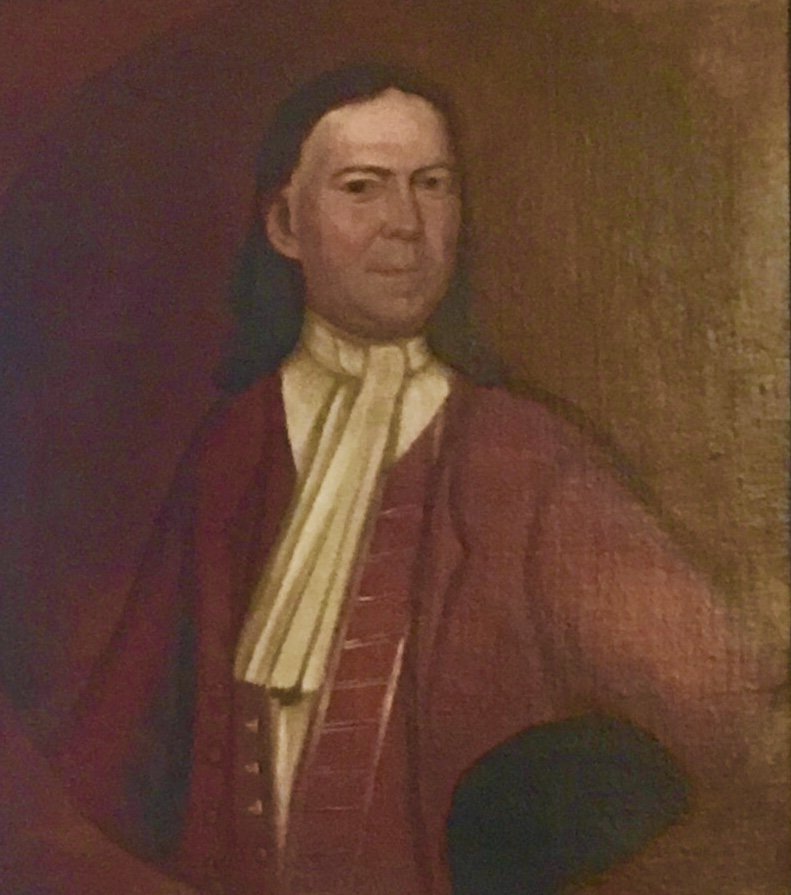
Many thanks to the Schenectady Historical Society for permission to use this image of the portrait of Laurence Claessen that hangs in their collection!

Laurence Claessen Van der Volgen
Attributed to Nehemiah Partridge. Held at the Schenectady Historical Society, 32 Washington Avenue, Schenectady, NY 12305 and used with their permission. They give the date as 1725.

In Library and Archives Canada’s digital copy of the original minutes, February 1726 starts here.

Minute Book 3: 1726-January

Conflicts in Iroquoia: Captives, Smiths, and Alcohol

The commissioners wrote to Governor Burnet to tell him about the English boy they had taken in after he ran away from the Mohawks at Fort Hunter. They had now learned that the boy was captured in a raid on Captain Robert Hicks’s estate in Virginia, in which the boy’s father was also captured, as well as five native women. The boy’s father was released, one of the women was killed “by the way,” while two were “burnt” in Oneida and then, according to the commissioners, eaten. Two remained captive. They had also heard that there was another English boy taken from Virginia who was still held captive, but they were doubtful whether there was any hope of getting him back. The letter uses the stories of the captives to attack the “falsehood of ye 5 nations” and suggest that the English should post “some able persons” permanently at Onondaga. The allegations about burning and eating people should likely be evaluated cautiously, especially because no source is given for them. Clearly relations between the commissioners and the Haudenosaunee were under a strain as they tried to implement Governor Burnet’s plans for a stronger English presence in the heart of Iroquoia.

The commissioners also corresponded with Jacob Brower and Jurian Hogan, who were serving as smiths at Onondaga and in the Seneca country respectively.  They arranged to provide Brower with a new bellows to replace one that had rotted out, and asked Hogan for information about a french smith who was living at the Seneca castle along with other frenchmen and their families. (It is interesting to speculate on what happened when the French and Anglo-Dutch smiths encountered each other, as must have occurred.)

The commissioners heard that the Six Nations expected an answer to their request the previous fall that the sale of alcohol be prohibited at the falls on the Onondaga River, (meaning the Oswego river at the site of present day Fulton New York) and intended to take steps themselves to end it if they did not get a satisfactory response. The commissioners feared for the safety of traders the following spring. They decided to send Laurence Claessen to Onondaga and sent him a request to appear before them to receive instructions.

In Library and Archives Canada’s digital copy of the original minutes, January 1726 starts here.

Conference on Iroquois Research 2017 Presentation

The Conference on Iroquois Research met last week in Oswego, New York. It included many excellent presentations. I gave a talk based on the AIC records for 1723-1725 entitled “The Sappony Prisoner: Servant, Captive, Runaway, or Chief?” It concerns a Sappony captive taken from Virginia to Kahnawake in 1723 and his subsequent fate.
Here is a pdf copy: Captivity_Paper .

The C.I.R. is evolving in very interesting ways. Check out the web page to learn about their work, including their journal, which just published a third issue. They also have a Facebook Page where you can see pictures of the conference and learn more about the presentations.

This is a map of Oswego in 1727, and a marker and plaque from the site of the fort built that year.


This is what it looks like now:


I kept thinking about the Iroquois of 1723, as well as the French and Anglo-Dutch traders. They used to navigate these waters in canoes like the ones now on display in the H. Lee White Maritime Museum, following the river up to Onondaga and Oneida. What would they make of the present  day city?

IMG_1124
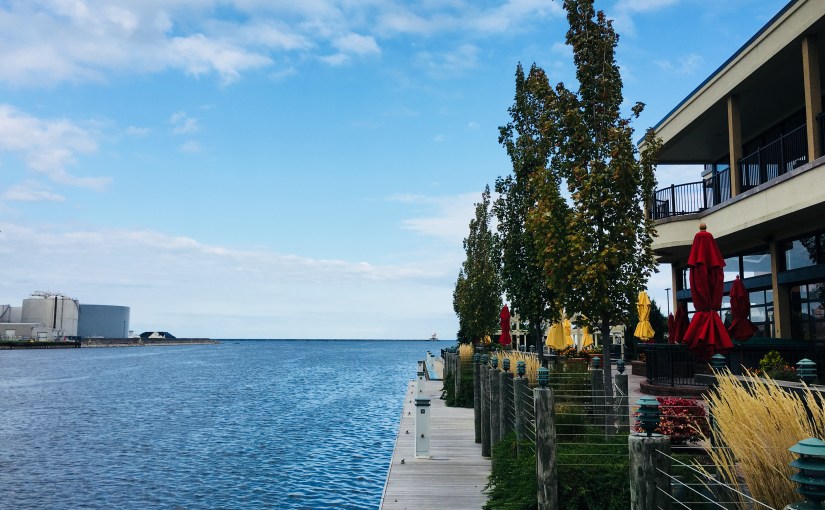
The view from my window at the Oswego Best Western Plus, where the conference took place.

IMG_1163
Small (wooden?)  boat outside the H. Lee White Maritime Museum at Oswego. My guess is that there were some boats a bit like this one around after the 1727 fort was constructed and certainly later in the century as French and British sailing ships began to ply Lake Ontario.

IMG_1179
Dugout and birchbark canoes on exhibit at the H. Lee White Maritime Museum on the pier at Oswego. Most traffic in 1723 was by canoe.

Cadwallader Colden’s Papers: Another source for 1707-1720 (Minute Book 2) besides the Schedule of Propositions …

In addition to Peter Wraxall’s An Abridgement of the Indian Affairs and the The Livingston Indian Records, I recently discovered that Cadwallader Colden compiled detailed notes from the records of theAlbany Indian Commissioners for the period from 1707 through 1720 for a continuation of his History of the Five Indian Nations. He never completed the book, but the notes are printed in Volume 9 of The Letters and Papers of Cadwallader Colden, printed for the New York Historical Society in 1937, which is available on the Internet Archive here. The continuation of the History begins on page 359.

Colden’s notes roughly correspond to the second volume of the records. They cover much of the same period as the detailed portion of the Schedule of Propositions Made by the Indians and Answers Given to Them … Colden’s notes are better written but less comprehensive. They confirm the basic accuracy the Schedule of Propositions by including some things covered in it that Wraxall omitted. Colden omits many things himself, but his notes are a valuable addition to the fragmentary record for this period.

cadwalladercolden-papers-v1-e1506377807349.jpg
Cadwallader Colden, by Matthew Pratt. (Engraving by P. Purdon Graham?] Frontispiece to volume one of the Cadwallader Colden Papers, in Collections of the New-York Historical Society 1917 (v. 50).

Minute Book 3: 1725-December

In December the commissioners received a letter from Captain John Collins in Schenectady about a Christian boy who had been taken captive by “some of our upper nations.” The commissioners still used “Christian” to mean “European” even though by this time many Native Americans and African Americans were also Christian. They had not yet adopted the use of the term “white,” or at least not in their records.

The boy was taken captive along with this father, who was employed driving horses for traders, and “a negro.” No mention is made of what happened to the other two captives. The boy was taken to Canojoharie (which during this period was one of the two major Mohawk (Kaniengeha’ka) towns, then moved to “the foremost Castle,” which probably means Tiononderoga. According to Collins’s letter, the Indians to whom the boy was given treated him badly and he was advised by other Indians to run away for fear of his life. He now wanted the Christians to rescue him from the “fury of the heathen.” The boy had forgotten English, and had to communicate by way of Laurence Claessen the interpreter.

The commissioners decided to take him in until Governor Burnet could advise them about what to do with him. They arranged to give him clothing and sent him to live with Captain [Evert] Bancker until spring. Like other captives mentioned in the records during this time, the boy, his father, and the African American taken captive with them, all remain unnamed.

In Library and Archives Canada’s digital copy of the original minutes, December 1725 starts here.

Minute Book 3: 1725-November

The next entry is a November 4th letter from the Commissioners but written by James Stevenson (perhaps the one in this biography) because Philip Livingston, the Secretary for Indian Affairs, was absent. James Stevenson was not a commissioner, raising the question why Henry Holland and Evert Bancker, the commissioners present, did not write the letter themselves. Perhaps the Dutch commissioners were still not confident about their ability to write adequate English. Their letter is a response to a letter from Joseph Willard, Secretary of Massachusetts Bay, who had received from Colonel Stoddard the Commissioners’ message about the forces that had left Canada to attack the New England frontiers. It informs him that they have no additional news except that the governor of Canada was dead. They would continue to watch the enemy and provide intelligence as occasion offered.

On November 25th the commissioners agreed with Jacob Brower and Harme Vedder to go to Onondage as smiths. They asked Juriaen Hogan, his brother, and the assistant “Lansingh” to stay on as smiths in Seneca country, giving them leave to return to Albany on lawful business if they wished. It does not appear that they complied with the Six Nations’ request to provide new and better smiths.

In Library and Archives Canada’s digital copy of the original minutes, November 1725 starts here.

Minute Book 3: 1725-October

Trade is Welcome in Iroquoia; Alcohol and Quarrels Are Not

On October 10th, another delegation from the Six Nations met with the Commissioners. This time Thanentsaronwe (Thannintsorowee) was the speaker. He came to complain again about the sale of alcohol by the European traders in Iroquoia, and to object once more to Governor Burnet’s proposed trading house on the Onnondage (Oswego) River. Alcohol had led to the death of a principal sachem, Sogeanjawa, who had been “stuck dead with a knife.” Several people had had noses and ears cut off, and nine of the “Far Indians” had killed each other. In the name of the whole Six Nations, he asked that no alcohol be transported to Iroquoia for the consumption of the Far Indians or the Six Nations. Traders were welcome to come and trade wherever they wished, with any other sort of goods. He also expressed uneasiness that the governors of New York and Canada could not agree. He begged them not to shed blood in the Six Nations’ country, where both were trading. He asked that if any English people should encounter the French “they may kindly love & friendly greet one another.” He explained that they had told the governor of Canada the same thing.

Thanentsorowee told the Commissioners that strowd blankets were now being sold to the French at the Onnondage River, despite the New York law against it. He said he had heard that people from Albany were taking credit for bringing Far Indians to Albany to trade, but actually the Six Nations should get the credit for going to the Far Nations and asking them to come to Albany to trade, with the result that five Far Nations had promised to do so. The Six Nations was paying the expenses in wampum and blankets to engage in this promotion. He asked that Albany help them with strowds, powder, and lead in order to continue doing so.

He also complained that the message that the governor of New York could not meet that summer had not been properly conveyed to the Senecas from Onondage, and if it had they would not have come. In the future, messages should be sent directly to the Senecas. He also asked for a better smith, since they did not like the one sent to them, and requested that Myndert Wemp come back with them immediately along with tools.

The Commissioners responded by thanking the delegates for bringing Far Nations to Albany to trade. They gave them powder, lead, and strowd blankets as they had requested, along with two kegs of Rum. They acknowledged the remainder of the message but did not respond to it. However they forwarded the minutes of the meeting to Governor Burnet.

In Library and Archives Canada’s digital copy of the original minutes, October 1725 starts here.

Minute Book 3: 1725-September

Blocked from Trading with Montreal, Albany Traders Move West

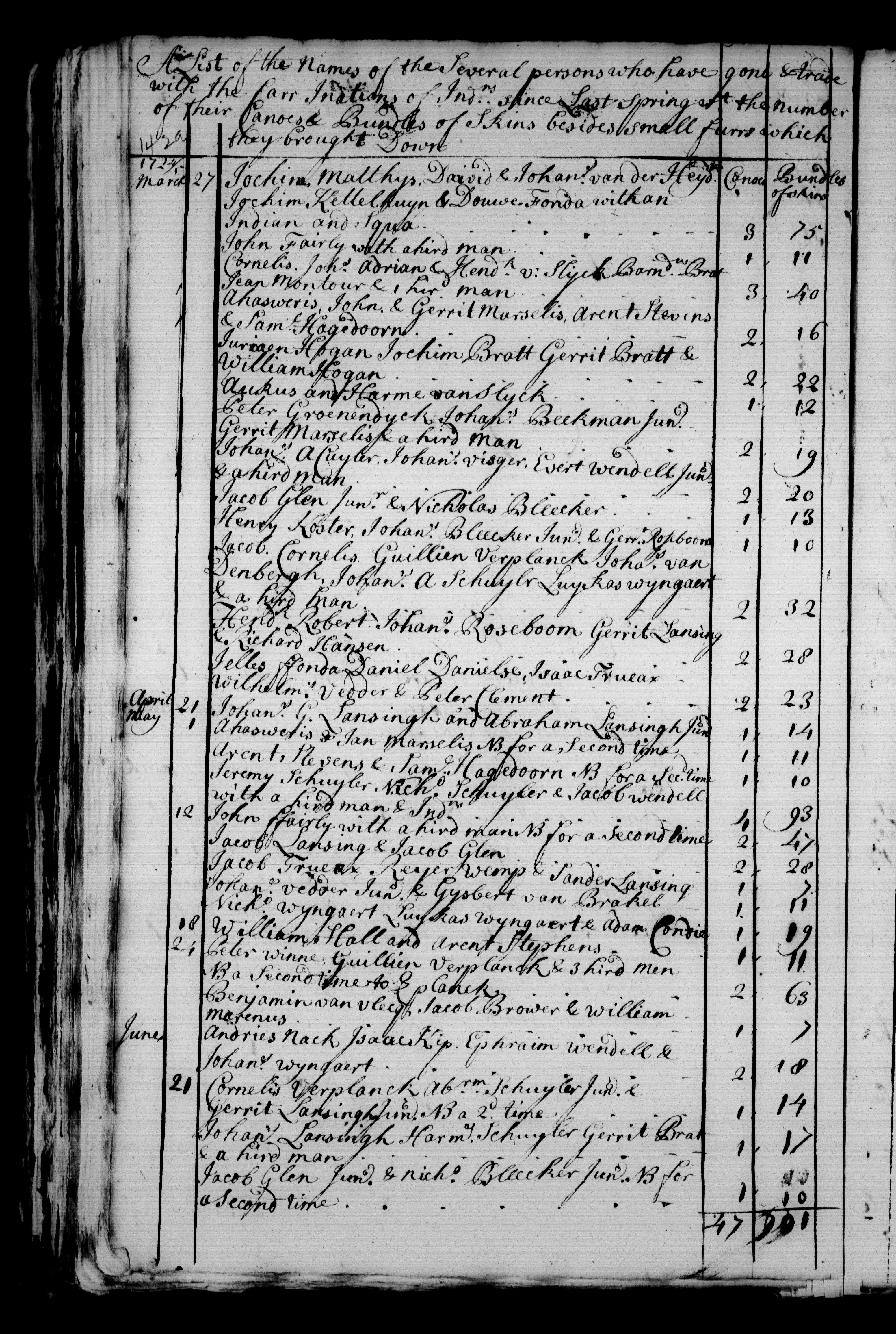
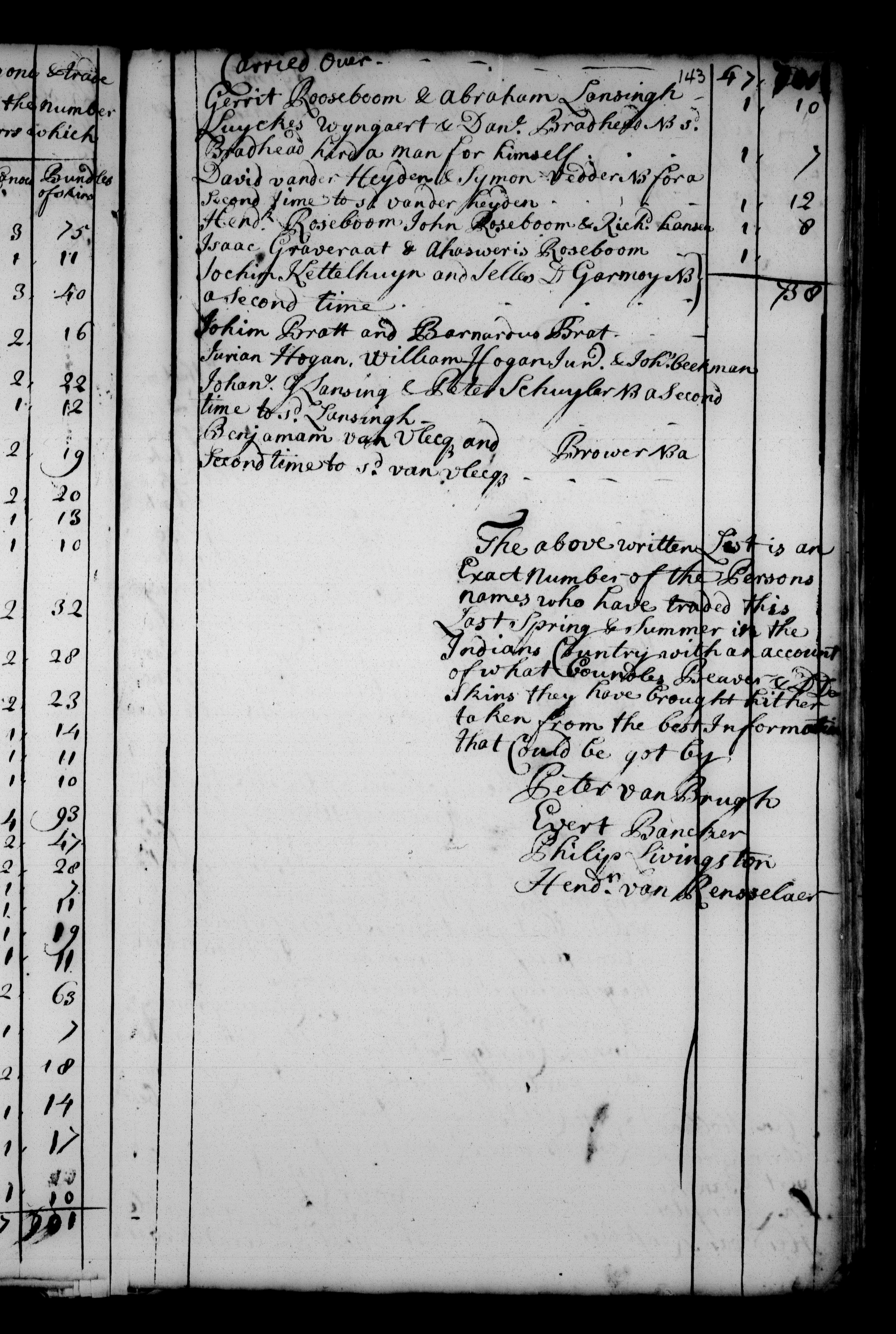
In September the commissioners made good on their promise to give the governor an account of the volume of the fur trade to the west. Captain Harme Vedder, stationed in Seneca Country, returned with his company and 50 bundles of fur. Many other traders were now going west as well. Despite the difficulties involved, the commissioners put together a detailed list of who had gone to Indian country and how many furs and skins they had purchased.  At least fifty-one canoes, each carrying several traders, had been to the lakes and returned with 738 bundles of furs. The list of names covers many if not most Albany families. It also includes an unnamed Indian couple, several unnamed hired men, and a member of the versatile Montour family, Jean Montour. Some traders went more than once and some trips for which details were not provided brought 50 additional bundles of furs.  In addition, 43 canoes of “far Indians” came to Albany and Schenectady with 200 bundles. 

The direct trade from Albany to Canada was far smaller, as estimated by the commissioners and Lieutenant Blood, who was stationed at the English garrison at Mount Burnet, on the Hudson north of Albany.

1725trade0288
1725trade0289

Commerce between Albany and Canada continued however. On September 6th, Colonel Myndert Schuyler and Captain De Peyster returned from Canada and took the oath required of persons suspected to have traded with the French, which strongly suggests that they had in fact traded with the French. Moreover they confirmed that they had seen large quantities of strowd blankets sent from Albany to Montreal.

Trade with Montreal is Illegal, But News from Montreal is Valuable;

Grey Lock is Raiding New England

Schuyler and De Peyster also brought important news. A party of 150 warriors had left Montreal on their way to attack New England, passing Chambly, where others were encamped who planned to go as well. The French, including their priests, were encouraging them to fight, and Montreal was fortifying itself with a stone wall. The commissioners informed both New York Governor Burnet and the government of New England about the situation. In a subsequent letter they told Governor Burnet that the party at Chambly had been persuaded to go home instead of attacking New England, but the party of 150 from Montreal were sill out fighting. Two small groups of nine and fourteen were supposed to be lurking on the western frontiers, lead by Grey Lock (Wawenorrawot). The commissioners told Governor Burnet that the Indians were tired of war and wanted peace, but the French continued to push them to war.

The Six Nations Meet with the French

Schuyler and De Peyster said that a large group of leaders from the Six Nations had come to Montreal, where they were honored with a cannon salute.   According to some Seneca leaders who came to Albany to tell the commissioners about the situation, and who had resolved not to go to Montreal themselves, the Six Nations contingent included eleven Seneca sachems from Canossodage and six from Onnahee. They went to condole the passing of “Lieutenant Governor” Monsieur “D Ramsay,”  (Claude de Ramezay, the governor of Montreal who had died the previous summer.) Probably they also discussed their concerns about the escalating construction of forts in their country by both the French and the English.

Kahnawage, Rondax, and Schawenadie Want a General Treaty

Lieutenant Colonel Stephanus Grosbeeck had also been in Montreal. He told the commissioners that the sachims of Kahnawage and Schawenadie had sent him an express as he passed La Prairie, asking him by seven hands of wampum to bring a message that they were coming to Albany about October 1st, where they wanted to meet with the governors of New York and Boston (i.e. Massachusetts Bay) as well as the Six Nations. The commissioners contacted Massachusetts Bay Governor William Dummer directly to pass on this message, sending their letter by way of the authorities of Westfield Massachusetts, in order to inform them that they were at risk of attack.

The Six Nations Confirm the Treaty of 1722 with New York and Virginia

On September 26th, twelve sachems from Onondage, Cayuga, and Tuscarora came to Albany and met with the Commissioners. They said they had been sent to look into rumors spread among them and find a way to prevent such stories. They asked the Commissioners to read them the treaty made in 1722 between Virginia and the Six Nations, which was done.

Their speaker D’Kanasore (Teganissorens) gave a speech addressed to Asserigoa, the Iroquois name for the Governor of Virginia, asking the Commissioners to pass it on. He pointed out that the Six Nations had returned two prisoners taken in Virginia, an Indian (probably meaning Governor Spotswood’s Saponi servant) and a “Negroe boy,” (probably Captain Robert Hicks’ slave). He said that whoever was going fighting towards Virginia from Canada or from the Six Nations’ castles was doing it without their consent. Nonetheless, if they went past the line agreed to in the treaty of 1722 and were taken prisoner, they should likewise be returned.

Teganissorens also complained that the gunpowder they had purchased recently was defective. He asked for more powder as well as lead and gunflints, pointing out that the cost would be made up by the value of the skins they could obtain with it through hunting. He also asked for a smith as soon as possible, one better than those who had been working there, whose work was not the best.

The Six Nations Have New Objections to Burnet’s Trading House

Like the delegation from Kahnawake and Schawenadie, Teganissorens was not happy with Governor Burnet’s proposal for a trading house on the Onnondage (Oswego) River. He admitted that the Six Nations had consented to it, but he said they now feared it would cause mischief because alcohol would be sold there. People would get drunk, become unruly, and and cause harm. In addition some would likely buy rum instead of ammunition. Teganissorens asked that in the future traders would bring powder and no rum. A slightly different version of this speech was written out and then crossed out. It appears on page 146a.

The Commissioners responded the next day in a speech that verged on being abrupt, even rude. They told the delegates they were glad they wanted to prevent rumors from spreading; the only way to do so was simply refuse to listen to those who tried to delude them. They promised to convey Teganissorens’ speech to the Governor of Virginia, but added that the Six Nations should not let their people go past the boundary line agreed to in 1722. The people of Virginia “will never molest you if you do not excite them to it” and if you commit mischief you will have to answer for it, as also for “those for whom you are become Security.” The reference was to Kahnawake and its allies, the “French Indians.”

In response to the complaint about powder, they said they were sorry the Six Nations were too impoverished to buy enough powder to meet their needs. The Commissioners would ask the governor to write to England to have better powder made, but the real reason for their poverty was that they went fighting against people who had not attacked them. Instead they should stick to hunting. They agreed to convey the request for a smith and expected the governor would send one.

In response to the Six Nations’ request that traders bring powder rather than rum to sell on the Onondaga River, the Commissioners would only say that they would ask the governor to prevent traders from selling rum to the Six Nations and to sell them powder and lead. However, the traders would continue selling rum to the Far Indians because otherwise they would be unable to sell their goods. They urged the delegates to be kind to all traders on the Onondaga River and the lakes and to invite the far Indians to come trade with Albany in order to get goods cheaper than from the French. To encourage this they agreed to supply them with power, lead, and flints to meet their present needs.

The Six Nations added that the bellows at Onondaga was old and not fit for service. They asked for a new one before winter set in. They said they expected their speech to go to the governor of New York and then be forwarded to Virginia, acknowledged that the commissioners had asked them to keep the Treaty, and said they expected Virginia and its Indian allies to do the same. They expected that those who brought evil reports to them (that is rumors) probably did the same with the governor of Virginia, so they hoped he would not listen. They agreed to be kind to traders in their country and assist them however they could.

The commissioners asked what Monsieur Longuiel said when he came to their country, and Teganissorens quoted him at length. “Fathers, [the Six Nations had adopted Longueuil as their “child”] I desire that you be not surpriz’d when any blood shall be shed on the Onnondage River or at the side of the Lake for we and the English can’t well abide one another, do you not meddle with the Quarrel butt Set Still smoke & be neuter.” Tegannisorens confirmed that they had sent wampum to Canada to answer the governor saying they were surprised that the French should “trample on the Blood of their Brethren” in the Six Nations country. If they wanted to fight, they should “go to sea and fight where you have Room.”

Kahnawage, Rondax, and Schawenadie Appear, Expecting the General Treaty; They Offer an Indian Woman to Make Up for the Murder of a Soldier

Prior to the commissioners’ response to Teganissorens, seven sachems from Kahnewake, Schawenadie and Rondax appeared.  They said they had come to meet with the governors of New York and Boston, as they had requested in the message they sent by Stephanus Grosbeeck a few weeks earlier. They expected the commissioners to provide lodging in Albany in the meantime. They had no wampum, for which they asked to be excused. The commissioners provided them with housing and necessities.

On September 28th, they formally condoled the man murdered at Saratoga by their people, presumably the English soldier named Williams from the garrison at Mount Burnet. They asked for reconciliation and forgiveness and gave wampum to wipe off the tears of those in mourning for him. And in addition they offered the commissioners a captive, an Indian woman, in place of the man they had lost. They said it was “not our maxim to do so yet we do it to satisfie you for the breach that is comitted.”

They said those who killed the soldier had been on their way to fight in New England. Their young men were unruly and could not be prevented from going to help the Eastern Indians fighting against the English. They asked the Commissioners to do everything they could to end the war.

The Commissioners explained that they had gotten the wampum message that Kahnawage, Rondax, and Schawenadie wanted to meet with the governors of New York and Massachusetts Bay and had sent notice to Boston. The governor there had said that he had to attend a treaty there with the Indians who were at war and asked the Commissioners to hear on his behalf what Kahnawage, Rondax, and Schawenadie had to say. The sachems said they would do so only if Colonel John Schuyler were present to represent Massachusetts. The Commissioners said that Colonel Schuyler was welcome to attend, but they did not think he would come. If the sachems did not want to deliver their message to the Commissioners to pass on to him, perhaps they could meet with him alone, or perhaps they would like to go to Boston, where they would be well received.

The next day the Commissioners gave a more full answer, reproaching the sachems for the murder of the soldier when the parties were at peace. They accused them of deliberately breaching the Covenant Chain in order to undermine the good relations between them. Those who committed such murders should be punished. But since the sachems had come to “mediate and reconcile” the matter, the commissioners said they would ask the governor to forgive the injury on condition that the sachems agree to deliver over anyone who committed such an offense in the future. They accepted the woman in place of the dead soldier “as a Token of your Repentance and sorrow for what is past” and gave a belt of wampum. After harangueing them further to the same effect, they gave them additional wampum. The sachems responded that they had heard the message and would communicate it to their leaders at home, since they were not empowered to promise to deliver up people who transgressed in the future.

The Commissioners wrote to the governor of Massachusetts Bay and described the meeting. They referred the governor to Colonel John Schuyler for more information, explaining that the sachems had refused to deliver their message except to him. They wished the governor success in making peace.

In Library and Archives Canada’s digital copy of the original minutes, September 1725 starts here at page 142 through 152a and jumps back here  to p. 113.