Minute Book 3: 1725-September

Blocked from Trading with Montreal, Albany Traders Move West

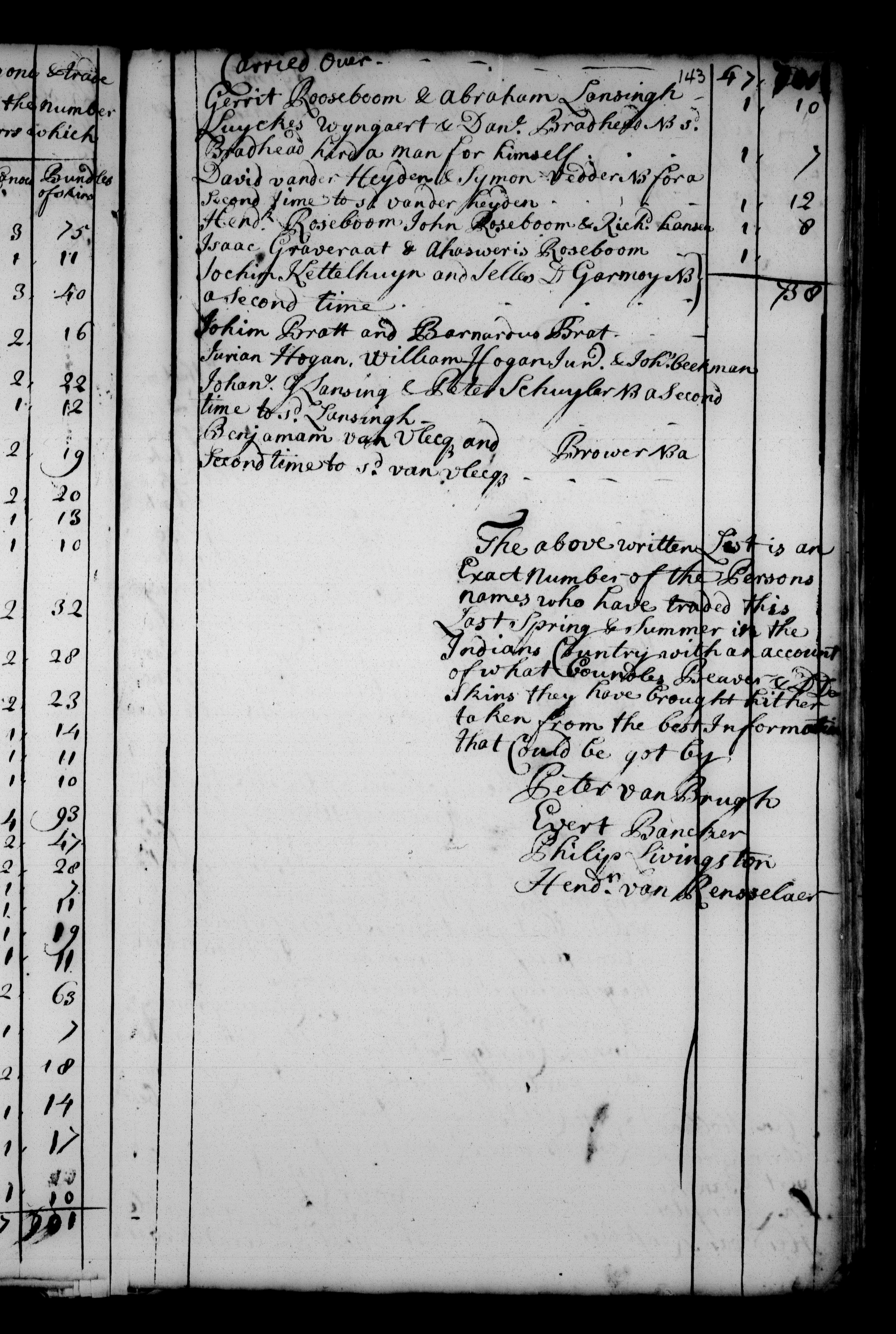
In September the commissioners made good on their promise to give the governor an account of the volume of the fur trade to the west. Captain Harme Vedder, stationed in Seneca Country, returned with his company and 50 bundles of fur. Many other traders were now going west as well. Despite the difficulties involved, the commissioners put together a detailed list of who had gone to Indian country and how many furs and skins they had purchased.  At least fifty-one canoes, each carrying several traders, had been to the lakes and returned with 738 bundles of furs. The list of names covers many if not most Albany families. It also includes an unnamed Indian couple, several unnamed hired men, and a member of the versatile Montour family, Jean Montour. Some traders went more than once and some trips for which details were not provided brought 50 additional bundles of furs.  In addition, 43 canoes of “far Indians” came to Albany and Schenectady with 200 bundles. 

The direct trade from Albany to Canada was far smaller, as estimated by the commissioners and Lieutenant Blood, who was stationed at the English garrison at Mount Burnet, on the Hudson north of Albany.
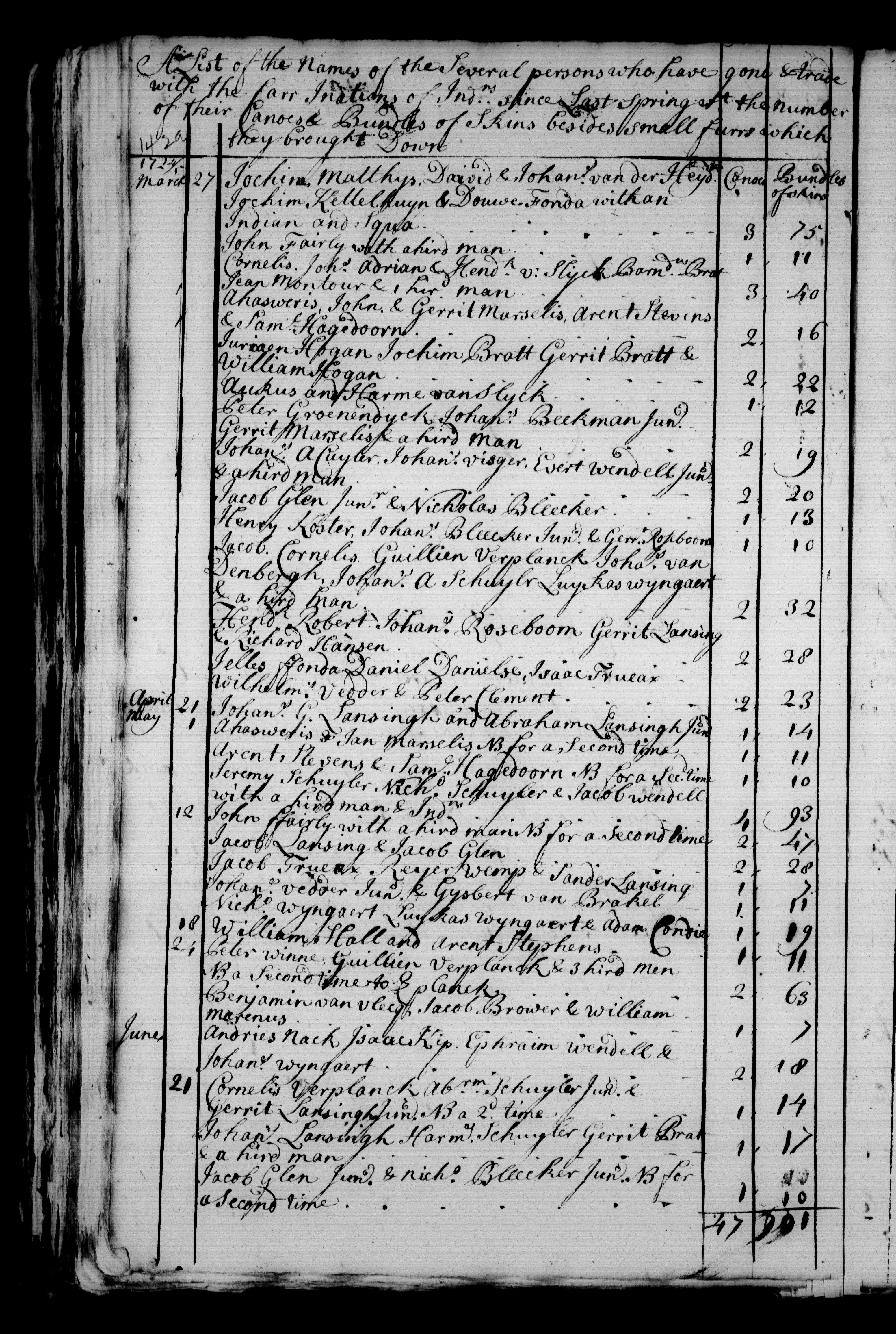
1725trade0288
1725trade0289

Commerce between Albany and Canada continued however. On September 6th, Colonel Myndert Schuyler and Captain De Peyster returned from Canada and took the oath required of persons suspected to have traded with the French, which strongly suggests that they had in fact traded with the French. Moreover they confirmed that they had seen large quantities of strowd blankets sent from Albany to Montreal.

Trade with Montreal is Illegal, But News from Montreal is Valuable;

Grey Lock is Raiding New England

Schuyler and De Peyster also brought important news. A party of 150 warriors had left Montreal on their way to attack New England, passing Chambly, where others were encamped who planned to go as well. The French, including their priests, were encouraging them to fight, and Montreal was fortifying itself with a stone wall. The commissioners informed both New York Governor Burnet and the government of New England about the situation. In a subsequent letter they told Governor Burnet that the party at Chambly had been persuaded to go home instead of attacking New England, but the party of 150 from Montreal were sill out fighting. Two small groups of nine and fourteen were supposed to be lurking on the western frontiers, lead by Grey Lock (Wawenorrawot). The commissioners told Governor Burnet that the Indians were tired of war and wanted peace, but the French continued to push them to war.

The Six Nations Meet with the French

Schuyler and De Peyster said that a large group of leaders from the Six Nations had come to Montreal, where they were honored with a cannon salute.   According to some Seneca leaders who came to Albany to tell the commissioners about the situation, and who had resolved not to go to Montreal themselves, the Six Nations contingent included eleven Seneca sachems from Canossodage and six from Onnahee. They went to condole the passing of “Lieutenant Governor” Monsieur “D Ramsay,”  (Claude de Ramezay, the governor of Montreal who had died the previous summer.) Probably they also discussed their concerns about the escalating construction of forts in their country by both the French and the English.

Kahnawage, Rondax, and Schawenadie Want a General Treaty

Lieutenant Colonel Stephanus Grosbeeck had also been in Montreal. He told the commissioners that the sachims of Kahnawage and Schawenadie had sent him an express as he passed La Prairie, asking him by seven hands of wampum to bring a message that they were coming to Albany about October 1st, where they wanted to meet with the governors of New York and Boston (i.e. Massachusetts Bay) as well as the Six Nations. The commissioners contacted Massachusetts Bay Governor William Dummer directly to pass on this message, sending their letter by way of the authorities of Westfield Massachusetts, in order to inform them that they were at risk of attack.

The Six Nations Confirm the Treaty of 1722 with New York and Virginia

On September 26th, twelve sachems from Onondage, Cayuga, and Tuscarora came to Albany and met with the Commissioners. They said they had been sent to look into rumors spread among them and find a way to prevent such stories. They asked the Commissioners to read them the treaty made in 1722 between Virginia and the Six Nations, which was done.

Their speaker D’Kanasore (Teganissorens) gave a speech addressed to Asserigoa, the Iroquois name for the Governor of Virginia, asking the Commissioners to pass it on. He pointed out that the Six Nations had returned two prisoners taken in Virginia, an Indian (probably meaning Governor Spotswood’s Saponi servant) and a “Negroe boy,” (probably Captain Robert Hicks’ slave). He said that whoever was going fighting towards Virginia from Canada or from the Six Nations’ castles was doing it without their consent. Nonetheless, if they went past the line agreed to in the treaty of 1722 and were taken prisoner, they should likewise be returned.

Teganissorens also complained that the gunpowder they had purchased recently was defective. He asked for more powder as well as lead and gunflints, pointing out that the cost would be made up by the value of the skins they could obtain with it through hunting. He also asked for a smith as soon as possible, one better than those who had been working there, whose work was not the best.

The Six Nations Have New Objections to Burnet’s Trading House

Like the delegation from Kahnawake and Schawenadie, Teganissorens was not happy with Governor Burnet’s proposal for a trading house on the Onnondage (Oswego) River. He admitted that the Six Nations had consented to it, but he said they now feared it would cause mischief because alcohol would be sold there. People would get drunk, become unruly, and and cause harm. In addition some would likely buy rum instead of ammunition. Teganissorens asked that in the future traders would bring powder and no rum. A slightly different version of this speech was written out and then crossed out. It appears on page 146a.

The Commissioners responded the next day in a speech that verged on being abrupt, even rude. They told the delegates they were glad they wanted to prevent rumors from spreading; the only way to do so was simply refuse to listen to those who tried to delude them. They promised to convey Teganissorens’ speech to the Governor of Virginia, but added that the Six Nations should not let their people go past the boundary line agreed to in 1722. The people of Virginia “will never molest you if you do not excite them to it” and if you commit mischief you will have to answer for it, as also for “those for whom you are become Security.” The reference was to Kahnawake and its allies, the “French Indians.”

In response to the complaint about powder, they said they were sorry the Six Nations were too impoverished to buy enough powder to meet their needs. The Commissioners would ask the governor to write to England to have better powder made, but the real reason for their poverty was that they went fighting against people who had not attacked them. Instead they should stick to hunting. They agreed to convey the request for a smith and expected the governor would send one.

In response to the Six Nations’ request that traders bring powder rather than rum to sell on the Onondaga River, the Commissioners would only say that they would ask the governor to prevent traders from selling rum to the Six Nations and to sell them powder and lead. However, the traders would continue selling rum to the Far Indians because otherwise they would be unable to sell their goods. They urged the delegates to be kind to all traders on the Onondaga River and the lakes and to invite the far Indians to come trade with Albany in order to get goods cheaper than from the French. To encourage this they agreed to supply them with power, lead, and flints to meet their present needs.

The Six Nations added that the bellows at Onondaga was old and not fit for service. They asked for a new one before winter set in. They said they expected their speech to go to the governor of New York and then be forwarded to Virginia, acknowledged that the commissioners had asked them to keep the Treaty, and said they expected Virginia and its Indian allies to do the same. They expected that those who brought evil reports to them (that is rumors) probably did the same with the governor of Virginia, so they hoped he would not listen. They agreed to be kind to traders in their country and assist them however they could.

The commissioners asked what Monsieur Longuiel said when he came to their country, and Teganissorens quoted him at length. “Fathers, [the Six Nations had adopted Longueuil as their “child”] I desire that you be not surpriz’d when any blood shall be shed on the Onnondage River or at the side of the Lake for we and the English can’t well abide one another, do you not meddle with the Quarrel butt Set Still smoke & be neuter.” Tegannisorens confirmed that they had sent wampum to Canada to answer the governor saying they were surprised that the French should “trample on the Blood of their Brethren” in the Six Nations country. If they wanted to fight, they should “go to sea and fight where you have Room.”

Kahnawage, Rondax, and Schawenadie Appear, Expecting the General Treaty; They Offer an Indian Woman to Make Up for the Murder of a Soldier

Prior to the commissioners’ response to Teganissorens, seven sachems from Kahnewake, Schawenadie and Rondax appeared.  They said they had come to meet with the governors of New York and Boston, as they had requested in the message they sent by Stephanus Grosbeeck a few weeks earlier. They expected the commissioners to provide lodging in Albany in the meantime. They had no wampum, for which they asked to be excused. The commissioners provided them with housing and necessities.

On September 28th, they formally condoled the man murdered at Saratoga by their people, presumably the English soldier named Williams from the garrison at Mount Burnet. They asked for reconciliation and forgiveness and gave wampum to wipe off the tears of those in mourning for him. And in addition they offered the commissioners a captive, an Indian woman, in place of the man they had lost. They said it was “not our maxim to do so yet we do it to satisfie you for the breach that is comitted.”

They said those who killed the soldier had been on their way to fight in New England. Their young men were unruly and could not be prevented from going to help the Eastern Indians fighting against the English. They asked the Commissioners to do everything they could to end the war.

The Commissioners explained that they had gotten the wampum message that Kahnawage, Rondax, and Schawenadie wanted to meet with the governors of New York and Massachusetts Bay and had sent notice to Boston. The governor there had said that he had to attend a treaty there with the Indians who were at war and asked the Commissioners to hear on his behalf what Kahnawage, Rondax, and Schawenadie had to say. The sachems said they would do so only if Colonel John Schuyler were present to represent Massachusetts. The Commissioners said that Colonel Schuyler was welcome to attend, but they did not think he would come. If the sachems did not want to deliver their message to the Commissioners to pass on to him, perhaps they could meet with him alone, or perhaps they would like to go to Boston, where they would be well received.

The next day the Commissioners gave a more full answer, reproaching the sachems for the murder of the soldier when the parties were at peace. They accused them of deliberately breaching the Covenant Chain in order to undermine the good relations between them. Those who committed such murders should be punished. But since the sachems had come to “mediate and reconcile” the matter, the commissioners said they would ask the governor to forgive the injury on condition that the sachems agree to deliver over anyone who committed such an offense in the future. They accepted the woman in place of the dead soldier “as a Token of your Repentance and sorrow for what is past” and gave a belt of wampum. After harangueing them further to the same effect, they gave them additional wampum. The sachems responded that they had heard the message and would communicate it to their leaders at home, since they were not empowered to promise to deliver up people who transgressed in the future.

The Commissioners wrote to the governor of Massachusetts Bay and described the meeting. They referred the governor to Colonel John Schuyler for more information, explaining that the sachems had refused to deliver their message except to him. They wished the governor success in making peace.

In Library and Archives Canada’s digital copy of the original minutes, September 1725 starts here at page 142 through 152a and jumps back here  to p. 113.

Minute Book 3: 1725-July

The commissioners wrote to the governor again, responding to a letter from him that is not part of the record. They told him that trade on the Lake (Ontario / Cadaraqui) was doing well, but needed more than cheap goods to succeed. They expressed concerns about the French threat and promised to give him a full account of the trade to lay before the New York Assembly.

In Library and Archives Canada’s digital copy of the original minutes, July 1725 starts here.


Minute Book 3: 1725-June

The French Still Plan to Build Fort at Niagara

On June 5th the commissioners wrote to the governor explaining that they had sent Laurence Claessen and two smiths to Onondaga. They added that David Van Dyck had resigned as commissioner, as Johannes Bleecker had done the previous November. A few days later, on June 11th, Claessen returned and gave an account of his journey.

Claessen arrived at Onondaga on May 27th to find the sachims of the Oneidas, Tuscaroras, Cayougas, and Senecas and Onondagas who had recently met with “Mons. Longueil, Lieut. Gov.r of Canada,” (Charles Le Moyne, Baron de Longueuil).

Claessen gave them seven strings of wampum, the agreed upon protocol that confirmed an official message. He told them that Governor Burnet (William Burnet, Governor of New York and New Jersey) had sent him to say that he could not comply with their request to meet, but that he would meet them the following year. They were happy to hear that Burnet only planned to build a trading house at Oswego, not a fort, and said they had nothing against building a house. They also thanked the governor for sending the smiths and promised to make them very welcome. They told Claessen that Longueuil had been at Onondaga until May 25th, two days before Claessen arrived. The records include what purports to be Longueuil’s speech at Onondaga.

Addressing the Haudenosaunee as “Children,” according to French custom, Longueuil said that he had been ordered to come there by the governor. He performed the customary condolence ceremony and gave a large belt of wampum, adding additional belts for each point in his speech. He said he had heard that the Six Nations were “jealous” of the French and expressed the hope that the bad feelings generated by the previous war between them were over and forgotten, since France and England were now at peace. He urged them to forget old differences and promised to “Imprint in the memory of our Children to observe the treaties of Peace & friendship” between them, so that it would live on even when “we aged Men” were dead and gone.

Longueuil confirmed that he was going to Tierondequoit (Irondequoit at the site of present day Rochester) and then to Seneca Country and Niagara, where he planned to build a strong trading house and sell goods more cheaply than before to the Six Nations as well as the nations beyond them. He also planned to build two ships to bring goods there.

Some Albany Traders Agree Not to Trade With the French

On June 11th the commissioners continued to attempt to enforce Governor Burnet’s prohibition against selling Indian goods to the French by resolving to direct the sheriff to issue summonses to a number of traders including John Schuyler, Stephanis Groesbeck, Nicholas Bleecker, Cornelis Cuyler, Hans Hansen, Edward Collins, David Schuyler Jr., Johannes Roseboom and Gerrit Roseboom Jr. They were directed to appear and take the oath against trading Indian goods with the French as required by the Act of 1720. All of them all except John Schuyler and Gerrit Roseboom Jr. appeared and took the oath. So did Jacob Verplanck. It is unclear whether “John Schuyler” refers to Colonel Johannes Schuyler or his son Johannes Schuyler, Jr.

The Jenondadies (Petun) Come to Trade

On June 19th, some “far Indians” came to trade, a group of “Jenondadies”  (Tionondati or Petun) who lived near the French fort at Detroit. Their leader Schaojiese thanked the commissioners for inviting them to come to Albany to trade and asked that the path be kept clear for them. They condoled Colonel Peter Schuyler and Hendrick Hanson, who had both died in February 1724, and requested “that their Eldest Sons may be accepted in their places that the tree may grow under w.h all ye upper nations may Shelter themselves.” They also said they were “great Lovers of Liquor” and asked for good Rum, not watered down.

The commissioners thanked them for coming and for their condolences and assured them that goods would be cheap. They promised to do what they could to prevent traders from watering down rum. They appeared taken aback by the request to appoint the eldest sons of Schuyler and Hansen in their place. They explained that the choice was in the hands of the governor. They assured the Tionontaties that the tree of peace and friendship would grow as strong as ever and the upper nations would be welcome to take Shelter under it.

The Twightwighs (Miamis) Send Joseph Montour and his Cousin Maconte as Messengers

Two members of the Montour family, who had married into the Twightwigh (Miami) nation and lived among them, met with the commissioners, Jean Fafar alias Maconte, was the nephew of Louis Montour, killed by the French in 1709 for encouraging far nations to trade with the English, and Joseph Montour, Louis’s son.  They brought a message from a group of Twightwigh (Miami) who had sent nine canoes to trade but were stopped at the falls of Oneida by the people who lived there. The reference appears to be to European traders, probably English subjects, because if they were French, the commissioners would have noted it. Possibly Abraham Schuyler and his party were trading while stationed with the Iroquois to reassure them about the expanding English presence in their country.

The Miami wanted to come renew their treaties and wondered why they had been stopped. Maconte and Joseph gave some dressed deerskins and a calumet pipe to the commissioners. The commissioners thanked them, but did not show much sympathy for the Miami. They expressed surprise that they had not come to Albany, since they had joined themselved in the Covenant Chain. They should not have allowed the people at Oneida falls to persuade them to trade there instead of at Albany, where goods were cheaper. They asked the Miami not to listen to such people in the future. They gave the Montour cousins some rum and blankets for the Miami sachems.

In Library and Archives Canada’s digital copy of the original minutes, June 1725 starts here.


Minute Book 3: 1725-May

Dummer’s War Drags On

The first entry for May is a letter from Samuel Thaxter, William Dudley, and Theodore Atkinson, representatives from Massachusetts Bay who had gone to meet with Governor Vaudreuil in Montreal to negotiate the release of captives and try to end the war. The first page is missing, but Peter Wraxall’s Abridgment of the Indian Affairs summarizes the complete letter on p. 157-158. Vaudreuil had heard about New York’s plan to build a block house at Oswego and he considered it a violation of the Treaty of Utrecht between France and England. If the blockhouse was constructed, he would tear it down. Vaudreuil claimed that he could order the Five Nations to take English prisoners whenever he liked.

Vaudreuil supported the Abenaki demand that if the English wanted peace, they must return all Abenaki lands, including all of Lacadie (Nova Scotia) except the fort at Anapolis Royall as well as everything claimed by Massachusetts for 30 leagues along the Atlantic coast, including existing English settlements and forts. Massachusetts Bay (and Wraxall) considered these demands to be absurd. The Abenaki also asked that their church at Norridgewalk, which the English had destroyed, be rebuilt, the plunder taken there returned, and a priest restored to them. Their priest, Father Sebastien Rale, had been killed in the fighting the previous summer.

Vaudreuil claimed that he did not encourage the Abenaki, although papers taken at Norridgewalk showed otherwise. He refused to put anything in writing. He also refused to do anything to retrieve the English captives held by Indians. Even as to English captives held by the French, he told the Massachusetts Bay representatives that they would have to ransom them at whatever price was set by their owners.

The Massachusetts Bay representatives bemoaned Vaudreuil’s conduct. Many French owners of captives had raised their ransom prices. The letter ended with a plea for help: everything showed “what hardships and Intolerable Burthen his Maj.es Good Subjects lye under, being used more like brute creatures than Men & Christians & call alowd upon all Men under the Same King to lend a helping hand to gett the aforesd. Governm.tts out of this Unjust War.”

The term “unjust war” carried a lot of legal weight during this period. It suggests that the representatives may have been starting to question their governor’s aggressive policies towards the Abenaki. Not surprisingly, Wraxall’s Abridgement does not include this part of the letter, in which the New England representatives sound strangely like the Six Nations, tired of the war and looking for help in persuading the government to end it. At the conference with Governor Burnet in September 1724, the Six Nations had reminded the governor that they had sent a wampum belt to King George with a message that “this matter of peace lieth with you.”

Albany Passes on the Iroquois Message to Governor Burnet

The next entry, dated May 6th, is a copy of a letter from the commissioners to the governor. They passed on the message from the “Canada Indians” (Kahnawake and its allies) and confirmed by the Six Nations asking the British and the French both to refrain from building additional forts and trading houses in the country of the Six Nations for fear they would come to blows with each other.  The commissioners had to be tactful because the governor had previously insisted that it was Albany traders who persuaded the Six Nations to oppose his proposed trading house at Oswego, where the Six Nations thought it was likely to provoke a French attack. The commissioners also passed on the Six Nations’ request for a meeting with the governor.

The 1722 Law Against Trading Indian Goods with Canada is Still Not Working

The commissioners told the governor that they would try “as much as lyes in our Sphere of bussiness” to discourage “French Indians” from transporting strowd blankets in violation of the governor’s trade policy, but the implication is clear: they did not believe they had the authority to take direct action. They also informed the governor that action had been taken against Nicholas Schuyler and Jacob Wendell, who had been caught with goods intended for the illegal trade with Canada the previous October, but their description probably did not satisfy the governor. The sheriff agreed to keep Schuyler at his own house while Schuyler gathered bedding and other things in preparation for going to jail, but as they were going there Schuyler made his escape. They informed Evert Wendell, a commisioner himself, about the situation. It is unclear what happened to Jacob Wendell.

Finally the commissioners said they were looking for a smith to go to Indian Country and passed on the information obtained from the Massachusetts Bay Commissioners.

Governor Burnet Won’t Meet the Six Nations; The Commissioners Try to Reassure Them

Governor Burnet wrote to the Commissioners telling them that he could not possibly meet the Six Nations that year because he was occupied with business in another province, but he would meet them the following year. The commissioners sent Laurence Claessen to Onondaga with this message and the mission to “quiet the minds of the Indians” in the face of the French efforts to undermine their alliance with New York. Laurence was told to explain that the governor did not plan to make a fort on Lake Ontario, but just a trading house on the “Onnondage River,” now called the Oswego River. The commissioners also agreed with Harme van Slyck Junior and Egbert Egbertse to work as smiths at Onondaga.

In Library and Archives Canada’s digital copy of the original minutes, May 1725 starts here.

Minute Book 3: 1725-April

The Six Nations Don’t Want a French-English War in Iroquoia

On April 11th, a delegation from Onondaga, Cayouga, and the Tuscaroras came to Albany on behalf of the Six Nations as a whole. They told the commissioners that Governor Vaudreuil had sent a message to Jean Coeur (Louis-Thomas Chabert de Joncaire) in Seneca Country telling him that someone from New England had revealed Governor Burnet’s plan for a trading house at the mouth of the Onondaga River (Oswego). Governor Vaudreuil described his own plans to build a fort at Niagara and ships to sail Cadarachqui (Lake Ontario) as well as his intention to destroy the English house at Oswego.

Severance-FrenchFrontier_FtNiagPlan1
Plans for the fort that France wanted to build at Niagara. From Frank Severance, An Old Frontier of France, NY: Dodd Mead, 1917, v.1, p. 240.

The delegates said that the Six Nations reminded Jean Coeur that the French and the Haudenosaunee had recently fought a bitter war that ended with an agreement not to make war over frivolous things such as “Beavers and furrs.” If the French destroyed the English trading house and built the proposed ships and fort, it could mean war. They urged the French to live in peace with the English. They did not want blood shed in their country.

They begged their brother Corlaer (New York) to listen to this message too.  The French and the English should “live like friends together,”  neither becoming the first aggressor.  The delegates said they would take particular note of whether Corlaer followed this advice, in support of which the sachims had sent a large belt of wampum. They had sent a belt to the French with the same message. They wanted Governor Burnet to meet them at the beginning of June to renew the covenant and discuss important matters.

The commissioners responded that they were surprised that the Six Nations would allow the French to impose on them in such a way, at which point the page ends.  The remainder of their answer is missing.

(I have edited this post to remove the sections relating to French forts, Abraham Schuyler’s assignment, and problems at Tiononderogue. The records begin to get out of order here, and I made a mistake in the dates of the entries relating to these issues, which date from 1726, not 1725. Apologies to my readers!)

In Library and Archives Canada’s digital copy of the original minutes, April 1725 starts here .

Minute Book 3: 1725-March

A Conference With Kahnawake, Schawenadie, the Kaniengeha’ka, and Albany

On March 13 the commissioners met with five leaders from Kahnawake (spelled Cachnawage in the records) and Kahnawake’s ally Schawenadie, in this case spelled Scanrinadie. (My best guess is that Schawenadie is the Iroquois name for the community that gradually relocated in the early 18th century from the Island of Montreal to Lac des Deux Montagnes on the Ottawa River nearby, becoming known as Kanesetake.) Some Kaniengeha’ka (Mohawk) leaders were also present. The record of this conference is a good example of the ongoing diplomacy between Iroquois communities in the Saint Lawrence Valley, the Six Nations, New France, and Albany that was conducted outside the initiatives of English governors. It also shows how events in Dummer’s War looked from a native perspective and confirms that Burnet was wrong when he accused the Albany traders of manipulating the Six Nations into objecting to Burnet’s plans for a trading house at Oswego. In reality those objections reflected the Six Nations’ valid concerns about the situation, concerns that Albany shared. The conference is omitted from Peter Wraxall’s  Abridgement except for a brief reference to the information provided about French plans. I have not found that it is printed anywhere else.

The Iroquois Object to Shifting the Fur Trade to Oswego

The speaker was Ondatsagto (possibly the Oneida leader Ondatsighta).  The minutes say he spoke for Cachnawage and Schawendie, although he seemed at times to speak for the Haudenosaunee as a whole. He began by saying that he was glad that some of the Maquas (Kaniengeha’ka or Mohawk) sachems were present. After explaining that “we are but youngsters, our ancestors understood affairs better than we,” he said that they would speak plainly. The ancient friendship among the parties was declining as though they were no longer brothers. They came to rekindle the fire at Albany, long established as the place to treat about matters of public concern.

Ondatsagto went on to explain that Kahnawake had six sachims, two of whom had been made “children” of Albany who were responsible for telling the commissioners if there was a threat to them. One of them had died and the commissioners had appointed someone to take his place. He was now present and would convey important information.

Ondatsagto next referred to the treaty conference held the previous year with Governor Burnet. New York had asked the Iroquois to persuade the Eastern Indians to end their war with New England. Ondatsagto said that the Iroquois had tried to end the war, but their efforts were undermined by the news that New England had taken an Eastern Indian town. This news made the Iroquois ambassadors ashamed. The Eastern Indians accused them of being spies because they remained at peace with New England while it subjected the Eastern Indians to a bloody war. Ondatsagto reproached the commissioners with not keeping their promise to write to the governor of New England to ask him to stop his people from attacking the Eastern Indians.

Next Ondatsagto said that D Cannihogo, the Kahnawake leader appointed to maintain ties between New York and Kahnawake, now had news for them. Kahnawake had learned that at the treaty the previous year, Governor Burnet insisted on his plans to build a trading house at the mouth of the Onnondaga River (Oswego) over the objections of the Six Nations, who wanted it to be located at the west end of Oneida Lake. But there were serious problems with Burnet’s desired location. It was already in use by the French to travel from Montreal to the “far nations” beyond Iroquoia, and was first possessed by them. The Governor of Canada would undoubtedly destroy any English trading house built at that location, which could trigger a conflict between the French and the English.  Ondatsagto advised the commissioners to keep the trade at Albany. They would get more beaver that way, and the French might be persuaded not to build their proposed fort at Niagara. On this proposition he gave a large belt of black wampum. The recorder first wrote and then crossed out that if the English insisted on their location a war would ensue and destroy the beaver trade.

Ondatsagto reminded the commissioners that the Onondagas had accepted Monsr. De Longueuil, the Governor of Montreal, as their child and allowed him to build a house at Onondaga. Pieter Schuyler then tore the building down, claiming that its construction was a breach of the Covenant Chain. The French could be expected to destroy Governor Burnet’s proposed building at Oswego for the same reason.

The “French Indians,” that is the people from Kahnawake and Schawenadie, then addressed the Mohawks and said their ancestors all lived in one country as one people, but now everyone had gone where they pleased and it was their lot to settle in Canada. They acknowledged a belt sent to them by the Mohawks asking them to keep the Covenant Chain, promised to do so, and said they expected the same on the Mohawks’ part.

The pages of the minutes are out of order at this point and it is possible that some material has been lost.

The Commissioners Response: England Claims the Six Nations as Subjects

Three days later the commisioners responded. They thanked the Sachims for speaking clearly and clearing up “the mistake that happen’d.” It is not clear exactly what they meant. They expressed appreciation that the other Sachims had come with DCannihogo to tell them about the French plans. They renewed the Covenant Chain, assuring all present of their continued friendship, and gave a belt of Wampum.

Then they explained the trading house situation from England’s point of view. They claimed that Pieter Schuyler destroyed the French trading house at Onondaga because Onondaga was on “Land belonging to the five Nations who are Subjects to the King of Great Britain.” The same logic allowed the English to build their house at Oswego on “Land belonging to the English.” The French would not dare to break it down because the two crowns were at peace. They said they would give Governor Burnet the information about the French plans and gave another belt of wampum. If Ondatsagto responded to the commissioners’ claim that the Six Nations were English subjects and England owned the land in their country, his answer is not recorded.

The commissioners said they did not remember promising to write to New England to ask them to end hostilities and they could not do such a thing while the Eastern Indians continued to kill New England settlers. They asked D Cannihogo to continue bringing information.

D Cannihogo said again that the French intended to break down the proposed trading house at Oswego. He added that the Governor of Canada planned to build two ships at Cadaraqui (the location of present day Kingston, Ontario) to be used in transporting furs from Niagara to Montreal, another ship above Niagara Falls to bring furs there, and a strong fort at Niagara itself.

The Commissioners Ask the Governor to Work Directly With the Senecas

The commissioners passed this information on to Governor Burnet in a letter, enclosing a copy of the minutes of the meeting. They asked the governor to give the Senecas presents in order to persuade them not to allow the French to execute their plans for a fort and repeated their suggestion to make an English settlement at Irondequoit (present day Rochester, NY) in order to counter the influence of the French. Significantly, they did not offer to negotiate with the Senecas themselves, a sign of the ongoing tensions between them and Governor Burnet. At the treaty conference the previous year, when the Six Nations objected to Burnet’s proposed location for a trading house, he accused them of being manipulated by Albany traders. Now the commissioners seemed to be trying to put the burden of dealing with the situation back on him.

In Library and Archives Canada’s digital copy of the original minutes, March 1725 starts here and then jumps to here.

Minute Book 3: 1725-January

Things were still not going well between the commissioners and William Burnet, the governor of New York and New Jersey.

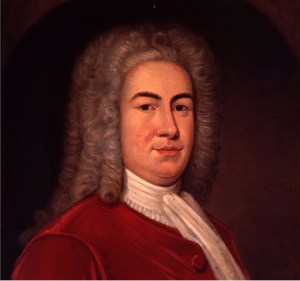
Governor William Burnet
Governor William Burnet. Portrait by John Watson, from Wikipedia (https://en.wikipedia.org/wiki/William_Burnet_(colonial_administrator))

In January the commissioners replied to a letter from the governor in which he told them not to give Nicholas Schuyler and Jacob Wendell the oath against trading with the French because they were already trading with the French in contravention of the Act of 1720 that prohibited it. In this letter the governor accused the commissioners of taking ‘no more Notice of [his] minute in Council then if it had been waste paper.” Presumably he was angry about the incident the previous October in which Schuyler and Wendell had been caught red-handed in the woods north of Albany with a group of native people and a large quantity of strowd blankets that they were obviously transporting to Canada to trade with the French. No doubt it seemed pointless to have traders take loads of goods to Montreal and take the oath against doing so only after they returned.

In their reponse to the governor, the commissioners said they were sorry that he felt this way. They insisted that they were doing their best to comply with his directions but the Act of 1720 did not authorize them to do more than what they were doing.

The governor’s letter also asked for changes to their report responding to the petition of the London merchants opposed to the Act and sent them a printed copy of the Act. They thanked him for it, and for the suggestions for changes. The London merchants’ petition and the final version of the response of the New York government can be seen here in the printed Papers Relating to an Act of the Assembly of Province of New-York, For Encouragement of the Indian Trade &c. and for Prohibiting the Selling of Indian Goods to the French viz. of Canada. NY: Bradford, 1724. The papers include a map that shows the route from Albany to Iroquoia, featuring the Five Nations, and showing rivers, lakes, and carrying places. The map does not show the native communities in the Saint Lawrence Valley and elsewhere that were affected by suppressing the trade between Albany and Montreal.

Colden's Map included with Papers on the Fur Trade
Map included with Papers Relating to an Act of the Assembly of Province of New-York, For Encouragement of the Indian Trade &c. and for Prohibiting the Selling of Indian Goods to the French viz. of Canada. NY: Bradford, 1724.

In their letter to the governor the commissioners also suggested that it would be useful to have an English settlement at Irondequoit (the location of present-day Rochester) so that if there was a dispute between the far Indians (members of nations coming to trade from beyond Iroquoia)  and the French who wanted to prevent that trade, they could encourage the Six Nations to support the far Indians.

In Library and Archives Canada’s digital copy of the original minutes, January 1725 starts here

Minute Book 3: 1724-November

In Library and Archives Canada’s digital copy of the original minutes, November 1724 starts here

In November the Commissioners completed their response to the petition against Governor Burnet’s trade policy prohibiting the sale of Indian trade goods to the French.I have not transcribed it because it is printed beginning on page 740 of O’Callaghan’s Documents Relative to the Colonial History of the State of New York, volume 5, along with many other documents relating to the controversy.  The report complied with Burnet’s request to find reasons to support the policy, but in practice the policy continued to meet with strong opposition in Albany.  The commissioners informed the governor that many traders still refused to take the oath against trading with the French, nor would they respond to inquiries about the volume of the trade. Resistance had increased following the incident at Mount Burnet. Johannes Bleecker refused to be a commissioner any longer.

There are no entries for December 1724.


Minute Book 3: 1724-October

In Library and Archives Canada’s digital copy of the original minutes, October 1724 starts here

The records for October demonstrate the utter failure of Governor Burnet’s policy prohibiting trade in Indian goods between New York  and the French.  The policy was codified in an act that required traders to take an oath that they were not engaging in the trade, but nearly everyone in Albany was doing so, including commissioners and their relatives. Moreover, the trade was a mainstay of the economy for native people in the area, including the Kaniengeha’ka (Mohawks) both in the Mohawk Valley and in the mission communities on the Saint Lawrence River.

The records document a dramatic encounter that occurred on October 1st, when Lieutenant Edmund Blood and Sergeant Charles Buckley, British officers garrisoned at Mount Burnet, north of Albany, traveled up Fish Creek west of the Hudson River to go hunting. Unexpectedly they came across Nicholas Schuyler and Jacob Wendell in the woods, where they were camping in a tent along with twenty or thirty Indians. They had in their possession 58 pieces of strouds, a kind of cloth that was a staple item in the fur trade. The names and nations of the Indians are never identified anywhere in the documents, but Schuyler and Wendell were both from prominent Albany families. They emerged from their tent, surprised to see the Lieutenant, who asked them where they were going. They said they were headed down the river, but could not produce a permit. The British officers seized the strouds in the King’s name by marking them in chalk with “the Broad Arrow,” and Schuyler and Wendell spoke to the Indians in their native tongue, which the British did not understand. The Indians began to pack up the strowds and the officers stopped them and seized the strouds over again.  Outnumbered, the British officers consulted with each other and decided to return to their blockhouse for reinforcements. Not surprisingly they came back to find the group and the strouds had disappeared. They issued warrants against Schuyler and Wendell to require them to appear and take the oath against trading.

In the meantime, “Mr. Hansen” and Cornelis Cuyler had returned from Canada with 117 backs of beavers and some dressed deerskins. More canoes were still expected. Hansen took the oath, but Cuyler refused, apparently planning to send more strouds to Canada by way of a group of Indians who were in town before he took it. He was fined 100 pounds. Hansen testified that he saw other strouds being delivered to Canada on his trip.

Philip Schuyler, father of Nicholas Schuyler, had still not paid the 100 pound fine assessed against him for violating the act.

The records also show in a letter to Governor Burnet dated October 3rd, that the Six Nations sachems met again with the commissioners following the September treaty with Governor Burnet.  Once again they refused to take up arms on Boston’s behalf. They told the commissioners “that they would still be their friends & adhere to them desiring & Recommending them to make a peace w.t the Eastern Ind.ns by Restoring them their Land and sending them their hostages.”

Governor Burnet was adamantly attached to his trade policy, but opposition was widespread even in London, where a group of merchants had signed a petition to the king in opposition to it. Turning the screws tighter on the Indian Commisisoners, Burnet asked them to respond to the London petition to refute the points that it made.

Minute Book 3: 1724-September

In Library and Archives Canada’s digital copy of the original minutes, September 1724 starts here

Most of the minutes for September cover a treaty conference with New York Governor William Burnet, the Six Nations, and the Schaghticokes that was held in Albany beginning on September 14th. They are printed in O’Callaghan’s Documents Relative to the Colonial History of the State of New York, volume 5, beginning on page 713. I have not transcribed them because O’Callaghan’s version is essentially identical, but will briefly summarize them here.

On September 14th, Governor Burnet held a private conference with the Six Nations, New York Council member Francis Harrison, and Massachusetts Bay Council member John Stoddard. They discussed what had happened between the Six Nations messengers sent to bring the Eastern Indians to a peace treaty at Boston and the Eastern Indians (Abenaki) at the mission town of St. Francis.

The messengers said that they went first to Montreal and met with the Governor, who wanted to hold the meeting at Montreal so that he could be there. The messengers agreed in order to get an interpreter. While waiting for the St. Francis Indians, they went to Caughnawaga (Kahnawake) until the St. Francis delegates arrived. They invited the St. Francis sachems to come to Albany to talk about peace, but they replied that they could not lay down the hatchet against New England, because New England had taken their land and still held their people prisoner. They said that they would make peace when New England restored the land and freed the prisoners. They suggested that the parties wishing to make peace should come to Montreal rather than Albany.

Governor Burnet reminded the messengers that the Six Nations had told Boston that they would take up arms against the Eastern Indians if they did not comply with their requests. They denied agreeing to this, despite all his efforts,  “they knew not of any promise or Engagement, only that they promised His Excellency to be mediators for Peace.”

1724-9-15

The next day Governor Burnet welcomed the Six Nations in the name of King George and gave them wampum belts incorporating letters of the alphabet. The meanings of many of these initials are somewhat obscure. He thanked them for opening the path for far nations to come trade at Albany, claiming that this meant that goods were now more plentiful for the Six Nations. (While this might have been the case for those in the west, it is questionable whether things were working out equally well for the Mohawks). He noted that he had also improved the passage at Wood Creek where goods were carried from the Mohawk River watershed to Oneida Lake and eventually Lake Ontario by way of the Onondaga River (now called the Oswego River), a bottleneck for trade to and from the west.

Governor Burnet also said that he was keeping a force of young men with the Senecas with a smith and a trading house and that he also planned to send some men to the Onondagas, where the main trade with the far nations would pass. They planned to build a block house at the mouth of the Onondaga River. (“Onondaga River” did not mean what is now called Onondaga Creek, but rather what is now called the Oswego River where it enters Lake Ontario at Oswego.) Burnet’s men planned to live there along with a smith so they could be good neighbors to the Six Nations “and live as comfortably among you as they do here at home.” He explained that this would bring the beaver trade into Iroquoia along with cheaper goods. Governor Burnet explained that to show how much he wanted their beavers, he was wearing clothes made of beaver cloth. He asked the Six Nations to keep the path open for the far nations and to welcome the New Yorkers living in Seneca country as well as those who would be coming to Onondaga to build the new blockhouse.

Next Governor Burnet reminded the Six Nations that they had said they would send messengers to the Eastern Indians and take appropriate measures if the Eastern Indians continued to fight against New England. He said their continued friendship depended on them keeping their word, but he would leave it to the deputies from Boston to discuss the details.

On September 16th, the Six Nations met with the Commissioners for Massachusetts Bay. Despite the decision of Massachusetts Bay not to print records relating to their war with the Abenaki, the minutes of this meeting made it to England. They were not included in the Albany Indian Commissioner record books, but they are printed in O’Callaghan’s Documents Relative to the Colonial History of the State of New York, volume 5, beginning on page 723.  Massachusetts rehearsed the occasions on which the Six Nations had allegedly said they would take up arms against the Eastern Indians if they did not stop attacking New England and urged them to do so now that the Eastern Indians had refused to comply with all requests to stop fighting. The Six Nations said that they were still waiting for an answer to the belt of wampum which they had sent to King George in England. They reiterated the position of the Eastern Indians that they would not make peace until their land and hostages were returned. They said that because England and France were at peace, “this matter of Peace lieth with you.” The best way to move forward would be to for Boston to return its Indian captives.

“Tho the Hatchett lays by our side yet the way is open between this Place and Canada, and trade is free both going and coming and so the way is open between this place of Albany and the six Nations and if a War should break out and we should use the Hatchett that layes by our Side, those Paths which are now open wold be stopped, and if we should make war it would not end in a few days as yours doth but it must last till one nation or the other is destroyed as it has been heretofore with us.” The speaker blamed the Governor of Canada for pushing the Eastern Indians to keep fighting even though they were inclined to peace. They asked the Massachusetts commissioners to try themselves to make peace with the Eastern Indians, since the Six Nations’ efforts had not succeeded. They intended to remain at peace and were not forsaking their brothers.

The next day, on September 17th, the Six Nations renewed the Covenant Chain with New York and thanked the governor for providing a smith to the Senecas and Onondaga, for clearing the passage at Wood Creek and for encouraging the far Indians to come to trade. They agreed to the block house near Onondaga, but expressed concern about what the prices for goods would be. They asked that the proposed blockhouse be located at the end of Oneida Lake instead of at the mouth of the Onondaga River. They acknowledged having said that they would “resent it” if the Eastern Indians continued to attack New England, and agreed to speak to the Boston commissioners about it. The Senecas asked why Myndert Wemp, a smith who they found “good, kind, & charitable” had not returned after spending time there with Major Abraham Schuyler two years before.

Despite the decision of Massachusetts Bay not to print records relating to their war with the Abenaki, the minutes of the proceedings between the  Commissioners for Massachusetts Bay and the Six Nations on September 16th made it to England. They were not included in the Albany Indian Commissioner record books, but they are printed inO’Callaghan’s Documents Relative to the Colonial History of the State of New York, volume 5, beginning on page 723.  Massachusetts rehearsed the occasions on which the Six Nations had allegedly said they would take up arms against the Eastern Indians if they did not stop attacking New England and urged them to do so now that the Eastern Indians had refused to comply with all requests. The Six Nations said that they were still waiting for an answer to the belt of wampum which they had sent to King George in England. (This belt is described in the record of the treaty conference at Boston in August 1723, which can be found on page 197 of volume 5 of the Massachusetts General Court, Journals of the House of Representatives of Massachusetts 1723-1724.) The Six Nations explained the position of the Eastern Indians, who refused to make peace until their land and hostages were returned. They said that because England and France were at peace, “this matter of Peace lieth with you.” The best way to move forward would be to for Boston to return its Indian captives.

“Tho the Hatchett lays by our side yet the way is open between this Place and Canada, and trade is free both going and coming and so the way is open between this place of Albany and the six Nations and if a War should break out and we should use the Hatchett that layes by our Side, those Paths which are now open wold be stopped, and if we should make war it would not end in a few days as yours doth but it must last till one nation or the other is destroyed as it has been heretofore with us.” The speaker blamed the Governor of Canada for pushing the Eastern Indians to keep fighting even though they were inclined to peace. They asked the Massachusetts commissioners to try themselves to make peace with the Eastern Indians, since the Six Nations’ efforts had not succeeded. They intended to remain at peace and were not forsaking Massachusetts.

A few days later, on September 19th, Governor Burnet addressed the Six Nations again. Burnet’s tone was testy, even autocratic, and reveals the rifts still present between the British authorities and the Albany traders. Burnet told the sachems that the English blockhouse needed to be at the mouth of the Onondaga River in order to control the beaver trade, and that it must be the bad advice of the Albany traders that led the Six Nations to prefer the Oneida Lake location. He also blamed the traders for suggesting that goods should be as cheap at Onondaga as at Albany despite the additional work involved to bring them there from Albany, and for suggesting that Abraham Schuyler and Myndert Wemp return. He said that Albany was interfering in order to preserve its own trade with the French and asked the Six Nations not to consult the Albany traders in the future. He told them that he, not the Six Nations, would appoint his officers, that he would not appoint Abraham Schuyler because “he has taken a wrong way to get himself named,” and that he was sending Harme Vedder and Myndert Wemp’s brother to the Seneca instead of Schuyler and Mydert Wemp. (In the end, however, he appears to have sent Myndert Wemp after all.) He said that if he knew who had put these false notions into the minds of the Six Nations he would punish them.

Burnet said that the Six Nations had admitted to the Boston commissioners that they had agreed to support Boston against the Eastern Indians. He was not happy with their decision to wait for a response from the King of Great Britain before taking up arms. He claimed that the colonies were authorized by the king to make war with Indians on their own without the king’s consent. Burnet insisted that if the Six Nations were so “unworthy and cowardly” as to refuse to make war, they must at least allow their young men to enlist as soldiers in Boston’s army. He gave them what he described as “a very large Present” and wished them a safe journey home.

The Six nations sachems replied by D’Kannasore (Teganissorens) that since the governor did not approve of the location at Oneida Lake, they wished him “joy” where he proposed to make it and hoped it would bring many beavers. He thanked the governor for wishing them a good trip home, for many of their leaders had been lost on such journeys. He asked how many people planned to settle at the end of the Onnondaga river, to which the governor estimated 40 or 50. Teganissorens explained that he had been appointed as speaker by the Six Nations on the governor’s recommendation and that they had agreed to take his advice. He asked the governor whether he would also accept his advice, which the governor said he would do on matters of consequence.

Governor Burnet also met with the Schaghticoke sachems and complained that some of their people had been involved in attacks on New England. The Boston Commissioners at the meeting accused individuals from Schaghticoke named Schaschanaemp and Snaespank of injuring settlers on the frontiers, acknowledging that people at Schaghticoke had formerly lived “on our frontiers”. They were still welcome to hunt there “on the Branches of our Rivers” and considered friends who should not harbor New England’s enemies. The Schaghticokes admitted that Schaschanaemp and another person had come through Schaghticoke and had gone to the Half Moon and Saratoga. They said that the attacks might have been committed by people who had left Schaghticoke to live in Canada. In response to Governor Burnet’s question as to why so many people were moving from Schaghticoke to Canada, they said that one group had left because they heard that they were going to be attacked next by the Indians who were attacking New England, but they did not tell the rest of the Schaghticokes before they left. The governor accused the sachems of having no command over their people and reminded them that a Tree was planted by a former governor for them to live under (a metaphor for Governor Edmund Andros’s policy of sanctuary for refugees from New England).

The Schaghticokes said the tree was decaying, its leaves withering, and they had only a little land now to plant on. Some of them had gone hunting peacefully on the New England frontiers two years before, but were taken prisoner and put in jail in Boston. Jacob Wendell, an Albany trader who became a merchant in Boston, rescued them, but without him they would have been treated as enemies. Some of those who had been jailed had now gone to fight against New England to revenge themselves. The Boston commissioners said they were jailed by mistake because they were on Pennecook River where Boston’s enemies lived, but they were freed as soon as the mistake was discovered.

The Schaghticokes ended by renewing the covenant and affirming the Tree of Peace and Friendship planted at Schaghticoke. They would turn down requests to fight with the Eastern Indians against New England and follow the lead of the Six Nations. They, like the Six Nations, were waiting to hear King George’s response to the wampum belt message sent to him. Governor Burnet renewed the covenant and gave them gifts.

The Albany Indian Commissioners records for September 1724 include one document not printed in O’Callaghan, the record of a meeting on September 19th between the commissioners and Governor Burnet. Burnet changed the makeup of the commissioners by removing Johannes Wendell and restoring Robert Liviingston Junior. He arranged to pay back Jan Wemp and Jacob Glen for financing the work done at the Wood Creek carrying place by Major Goose Van Schaick and David Vanderheyden. He also arranged to get additional work done there to make a bridge over the creek and remove trees from the Mohawk River channel. He appointed Harme Vedder to go the Seneca Country and specified that he get the canoes used there by Jacob Verplank.  He also laid out other details about work to be done in Iroquoia. Myndert Wemp or Juriaen Hogan were preferred as smiths at Onondaga, and tools were to be provided there, although he said he would need to get the funding confirmed by the New York Council.

Last but not least, Governor Burnet said that he would not allow any more money for the interpreter’s travel expenses except if the governor ordered him to go. The interpreter, Lawrence Claessen, traveled to Iroquoia on a regular basis and these trips were important in diplomatic relations between New York and the Six Nations. Burnet was making it more difficult for the Albany Indian Commissioners to conduct their affairs. Clearly matters were still not resolved between the governor and the commissioners.

Minute Book 3: 1724-August

In Library and Archives Canada’s digital copy of the original minutes, August 1724 starts here

The commissioners began to prepare for another major treaty conference with Governor William Burnet and the Six Nations by sending Laurence Claessen to invite them to come to Albany on September 10th. They asked that the total delegation not exceed 70 people, probably because of the expenses involved in hosting such events. Claessen was told to come back to Albany with the most distant group.

More far nations came to trade. On August 7th, the “Kenondadies” arrived. They also condoled the deaths of both Pieter Schuyler and Hendrick Hansen. They gave twelve hands of wampum to wash off the tears of their relatives, and many skins and furs “to bury them.” I have not found any informations on “Kenondadie.” It might be a misspelling of “Tionondadie,” a name for the Petun  people who were close allies of the Wendat (Huron). Or perhaps it is the name of a particular village.

Jacob Adatsondie and the other messengers sent by the Six Nations to the Eastern Indians returned and gave an account to the commissioners, but they did not write down what they said. However their next entry concerns a group of Schaghticoke Indians who had gone to Missisquoi, an Abenaki territory on Lake Champlain and joined in the attacks on New England. The commissioners decided to have Johannes Knickerbacker (who had land at Schaghticoke and a connection to the Schaghticokes as an interpreter) arrange to send a delegation of “trusty Indians” with wampum belts to persuade the Schaghticokes to come back.

The oath against trading Indian goods to the French was offered to a number of Albany merchants, including some of the commissioners, pursuant to the Act of 1720 prohibiting the trade. Those who took the oath included Johannes Cuyler, Philip Livingston, Evert Wendell, Abraham Cuyler, Nicholas Bleecker, Gerrit Roseboom, and Robert Roseboom. John (Johannes) Schuyler refused to take it. The sheriff was directed to levy a fine against him of 100 pounds.

Minute Book 3: 1724-July

In Library and Archives Canada’s digital copy of the original minutes, July 1724 starts here

The commissioners’ minutes do not record the meetings between the New England delegates, the Six Nations, and the four allied nations headed by Kahnawake / Caughnawaga, although it is clear that such meetings took place.  This might be related to a decision by the Massachusetts government not to publish records related to the ongoing war with the Abenaki (Eastern Indians). The government had published the record of the treaty conference at Boston in August 1723, which can be found on page 197 of the Massachusetts General Court, Journals of the House of Representatives of Massachusetts 1723-1724 (v. 5) The Massachusetts Historical Society, 1924, but decided (p. 235) that publicizing proceedings related to the war was impeding the war effort. They also decided to bury their collection of scalps (Journals … v. 6 p. 210) in secret “so as not to be discovered or produced again.”

On July 1 the Albany Indian Commissioners suggested to the Massachusetts Bay delegates that Albany should have a private conference with the Six Nations sachems. With Massachusetts Bay’s approval, they tried to persuade the Six Nations to send envoys to the Eastern Indians who were still out fighting to order them “come to Terms of Peace and Submission” with Massachusetts Bay, end their hostilities, and send representatives to Boston to conclude a formal peace treaty. They asked the Six Nations to be guarantees for the good behavior of the Eastern Indians.

The minutes do not record the initial response of the Six Nations except to note that it was “delitory and not Satisfactory.” After further consultation, the Six Nations said that they had made proposals to the Kahnawake sachems and their allies and they had agreed to peace. The Six Nations had thought that would conclude the war, but they now agreed with the proposed plan and appointed three men, Tarighdoris, Jacob alias Adatsondie, and Assredowax, to go to negotiate with the Eastern Indians. They asked for wampum belts and a canoe as well as reimbursement for the messengers to pay them for their “trouble & fatigue.” They also asked that someone from New York go with them.

The commissioners wrote to Massachusetts Bay expressing the hope that the Massachusetts Bay delegates would confirm that they had acted in New England’s best interests and worked with the Six Nations to persuade Kahnawake and its allies to bury the hatchet. They said that the Six Nations had insisted “tho’ very absurd” that peace would be concluded when the Indian hostages were returned (by Massachusetts Bay), but had finally agreed to send messengers to stop the Eastern Indians from fighting and require them to come to Boston with the Six Nations for a peace treaty. The commissioners said the Six Nations would compel them by the sword to do so if they did not agree, although it is clear from the wording that the Six Nations was not fully behind this idea.

In the midst of the peace negotiations, the Board met with the Seneca messengers who had gone to the far nations the previous winter to invite them to trade at Albany. They had met with six different nations, none of which are named, adding some extra wampum belts in order to do so. Most of those nations promised to come to Albany. But several of their canoes were met and stopped by near “the Palatines Land at the ffalls,” probably the vicinity of present day Little Falls, where many Palatines had settled. The people there pressured and bribed them to sell their goods there instead of bringing them to Albany. The far Indians and the Six Nations were highly displeased about this.

A letter from the commissioners to Governor Burnet explained the results of the negotiations with the Six Nations as well as the problems encountered by the far Indians intercepted on their way to Albany by “our people who go up to trade.” They asked for reimbursement for redeeming two captives from the Indians who were now being returned to other kinds of captivity. One was a negro boy belonging to Captain Hicks of Virginia, conveyed home by Captain (Henry?) Holland. The other was an Indian who was probably the Sapponi Indian servant of Governor Alexander Spotswood of Virginia.

Finally on July 14th, some far Indians did come to Albany, explaining that the French had persuaded many of their group to go to Canada instead by telling them that they would be poisoned in Albany. They had an additional purpose in coming besides trade: to condole Pieter Schuyler (Quider), who had died in February. The commissioners welcomed them and thanked them for condoling Colonel Schuyler according to custom, promising that they would always be welcomed as they were by Schuyler himself. The commissioners accepted the calumet pipe presented by the visitors and gave them food, blankets, rum, pipes, and tobacco, assuring them that the French were lying and that they would find cheap goods in Albany.

Minute Book 3: 1724-May

In Library and Archives Canada digital copy of the original minutes, May 1724 starts here

Two Seneca sachems, Canakadrichha and Sagonadayane, met with the commissioners on May 11 and added to what they had heard in February from Sconondo about the relations between the Six Nations, the “far Indians” and New France. They confirmed that Onondaga leaders had met with the French governor (Philippe de Rigaud de Vaudreuil) and discussed their fears that western nations passing through the Six Nations on their way to Albany to trade might attack them. Governor Vaudreuil confirmed their fears and suggested that for their protection they should allow him to build two forts, one at “Jagara” (the present day Niagara River)

NiagaraFalls1751-Severance_FrenchFrontier
Niagara Falls, from Frank Severance, An Old Frontier of France, NY: Dodd, Mead, 1917, v. 1 p. 330.

and one at the mouth of the Onondaga River where it enters Cadaraghqua Lake (Lake Ontario in the vicinity of present day Oswego, where the English were also planning to build a fort.) The governor gave the Onondagas wampum belts to convey his request to the rest of the Six Nations.

Severance-FrenchFrontier_FtNiagPlan1
Plans for the fort that France wanted to build at Niagara. From Frank Severance, An Old Frontier of France, NY: Dodd Mead, 1917, v.1, p. 240.

At a public meeting to consider whether to let New France build the proposed forts, the Six Nations decided to deny the request. They returned the belts to the French governor with a message that he should talk to Corlaer (the Iroquois name for the Governor of New York) and get “a proper answer” as to whether forts could be built at the proposed locations.  The Oneidas and Mohawks were not at the meeting, but later concurred in the decision. Nonetheless, the Seneca envoys had learned from reliable sources that Jean Coeur (Louis-Thomas Chabert de Joncaire, also known as Sononchiez) was planning to go to Niagara with 50 men to build the fort there. They also told the commissioners that the Seneca messengers sent to the far nations to invite them to come trade at Albany were expected back in a few days. They had conveyed the message, but did not know how many far nations would actually come to Albany. Messieur Tonty (Alphonse de Tonty, Baron de Paludy), the commander of the French fort at Le Detroit (Tuchsagrondie, the location of present day Detroit) had told them not to come. Canakadrichha and Sagonadayane asked the commissioners to send their own representatives to Seneca country to hear what the messengers had to say and to find out what Joncaire planned to do with his 50 men.

The commissioners thanked the Seneca sachems for refusing the French request to build forts. They said the forts were intended to prevent them from hunting and keep them poor so that eventually the French could “drive them into the sea.” They gave them gifts of blankets, clothing, and rum.

A few weeks later on May 29, messengers arrived from Kahnawake and Skawiennadie bringing seven hands of wampum to confirm what they had to say. They asked the commissioners to send messengers to the Six Nations to come to Albany to meet with representatives of their own nations and New England. New England had asked for the Albany meeting because Albany was the appointed place to meet about public affairs. The commissioners assured them that the path was open and that they were happy about the meeting. They informed them that “Some Gentlement from N England” were in town, probably sent for the purpose of talking to their sachems. They said that the New York Governor did not know about the meeting so they could not comply with the request to send their own messengers. However, it would be proper to let the New England representatives know about their message so that they could send for the Six Nations themselves. They offered to do what they could to bring the proposed treaty to a good conclusion.