Conflicts in Iroquoia: Captives, Smiths, and Alcohol
The commissioners wrote to Governor Burnet to tell him about the English boy they had taken in after he ran away from the Mohawks at Fort Hunter. They had now learned that the boy was captured in a raid on Captain Robert Hicks’s estate in Virginia, in which the boy’s father was also captured, as well as five native women. The boy’s father was released, one of the women was killed “by the way,” while two were “burnt” in Oneida and then, according to the commissioners, eaten. Two remained captive. They had also heard that there was another English boy taken from Virginia who was still held captive, but they were doubtful whether there was any hope of getting him back. The letter uses the stories of the captives to attack the “falsehood of ye 5 nations” and suggest that the English should post “some able persons” permanently at Onondaga. The allegations about burning and eating people should likely be evaluated cautiously, especially because no source is given for them. Clearly relations between the commissioners and the Haudenosaunee were under a strain as they tried to implement Governor Burnet’s plans for a stronger English presence in the heart of Iroquoia.
The commissioners also corresponded with Jacob Brower and Jurian Hogan, who were serving as smiths at Onondaga and in the Seneca country respectively. They arranged to provide Brower with a new bellows to replace one that had rotted out, and asked Hogan for information about a french smith who was living at the Seneca castle along with other frenchmen and their families. (It is interesting to speculate on what happened when the French and Anglo-Dutch smiths encountered each other, as must have occurred.)
The commissioners heard that the Six Nations expected an answer to their request the previous fall that the sale of alcohol be prohibited at the falls on the Onondaga River, (meaning the Oswego river at the site of present day Fulton New York) and intended to take steps themselves to end it if they did not get a satisfactory response. The commissioners feared for the safety of traders the following spring. They decided to send Laurence Claessen to Onondaga and sent him a request to appear before them to receive instructions.
In Library and Archives Canada’s digital copy of the original minutes, January 1726 starts here.
In December the commissioners received a letter from Captain John Collins in Schenectady about a Christian boy who had been taken captive by “some of our upper nations.” The commissioners still used “Christian” to mean “European” even though by this time many Native Americans and African Americans were also Christian. They had not yet adopted the use of the term “white,” or at least not in their records.
The boy was taken captive along with this father, who was employed driving horses for traders, and “a negro.” No mention is made of what happened to the other two captives. The boy was taken to Canojoharie (which during this period was one of the two major Mohawk (Kaniengeha’ka) towns, then moved to “the foremost Castle,” which probably means Tiononderoga. According to Collins’s letter, the Indians to whom the boy was given treated him badly and he was advised by other Indians to run away for fear of his life. He now wanted the Christians to rescue him from the “fury of the heathen.” The boy had forgotten English, and had to communicate by way of Laurence Claessen the interpreter.
The commissioners decided to take him in until Governor Burnet could advise them about what to do with him. They arranged to give him clothing and sent him to live with Captain [Evert] Bancker until spring. Like other captives mentioned in the records during this time, the boy, his father, and the African American taken captive with them, all remain unnamed.
In Library and Archives Canada’s digital copy of the original minutes, December 1725 starts here.
On June 5th the commissioners wrote to the governor explaining that they had sent Laurence Claessen and two smiths to Onondaga. They added that David Van Dyck had resigned as commissioner, as Johannes Bleecker had done the previous November. A few days later, on June 11th, Claessen returned and gave an account of his journey.
Claessen arrived at Onondaga on May 27th to find the sachims of the Oneidas, Tuscaroras, Cayougas, and Senecas and Onondagas who had recently met with “Mons. Longueil, Lieut. Gov.r of Canada,” (Charles Le Moyne, Baron de Longueuil).
Claessen gave them seven strings of wampum, the agreed upon protocol that confirmed an official message. He told them that Governor Burnet (William Burnet, Governor of New York and New Jersey) had sent him to say that he could not comply with their request to meet, but that he would meet them the following year. They were happy to hear that Burnet only planned to build a trading house at Oswego, not a fort, and said they had nothing against building a house. They also thanked the governor for sending the smiths and promised to make them very welcome. They told Claessen that Longueuil had been at Onondaga until May 25th, two days before Claessen arrived. The records include what purports to be Longueuil’s speech at Onondaga.
Addressing the Haudenosaunee as “Children,” according to French custom, Longueuil said that he had been ordered to come there by the governor. He performed the customary condolence ceremony and gave a large belt of wampum, adding additional belts for each point in his speech. He said he had heard that the Six Nations were “jealous” of the French and expressed the hope that the bad feelings generated by the previous war between them were over and forgotten, since France and England were now at peace. He urged them to forget old differences and promised to “Imprint in the memory of our Children to observe the treaties of Peace & friendship” between them, so that it would live on even when “we aged Men” were dead and gone.
Longueuil confirmed that he was going to Tierondequoit (Irondequoit at the site of present day Rochester) and then to Seneca Country and Niagara, where he planned to build a strong trading house and sell goods more cheaply than before to the Six Nations as well as the nations beyond them. He also planned to build two ships to bring goods there.
Some Albany Traders Agree Not to Trade With the French
On June 11th the commissioners continued to attempt to enforce Governor Burnet’s prohibition against selling Indian goods to the French by resolving to direct the sheriff to issue summonses to a number of traders including John Schuyler, Stephanis Groesbeck, Nicholas Bleecker, Cornelis Cuyler, Hans Hansen, Edward Collins, David Schuyler Jr., Johannes Roseboom and Gerrit Roseboom Jr. They were directed to appear and take the oath against trading Indian goods with the French as required by the Act of 1720. All of them all except John Schuyler and Gerrit Roseboom Jr. appeared and took the oath. So did Jacob Verplanck. It is unclear whether “John Schuyler” refers to Colonel Johannes Schuyler or his son Johannes Schuyler, Jr.
The Jenondadies (Petun) Come to Trade
On June 19th, some “far Indians” came to trade, a group of “Jenondadies” (Tionondati or Petun) who lived near the French fort at Detroit. Their leader Schaojiese thanked the commissioners for inviting them to come to Albany to trade and asked that the path be kept clear for them. They condoled Colonel Peter Schuyler and Hendrick Hanson, who had both died in February 1724, and requested “that their Eldest Sons may be accepted in their places that the tree may grow under w.h all ye upper nations may Shelter themselves.” They also said they were “great Lovers of Liquor” and asked for good Rum, not watered down.
The commissioners thanked them for coming and for their condolences and assured them that goods would be cheap. They promised to do what they could to prevent traders from watering down rum. They appeared taken aback by the request to appoint the eldest sons of Schuyler and Hansen in their place. They explained that the choice was in the hands of the governor. They assured the Tionontaties that the tree of peace and friendship would grow as strong as ever and the upper nations would be welcome to take Shelter under it.
The Twightwighs (Miamis) Send Joseph Montour and his Cousin Maconte as Messengers
Two members of the Montour family, who had married into the Twightwigh (Miami) nation and lived among them, met with the commissioners, Jean Fafar alias Maconte, was the nephew of Louis Montour, killed by the French in 1709 for encouraging far nations to trade with the English, and Joseph Montour, Louis’s son. They brought a message from a group of Twightwigh (Miami) who had sent nine canoes to trade but were stopped at the falls of Oneida by the people who lived there. The reference appears to be to European traders, probably English subjects, because if they were French, the commissioners would have noted it. Possibly Abraham Schuyler and his party were trading while stationed with the Iroquois to reassure them about the expanding English presence in their country.
The Miami wanted to come renew their treaties and wondered why they had been stopped. Maconte and Joseph gave some dressed deerskins and a calumet pipe to the commissioners. The commissioners thanked them, but did not show much sympathy for the Miami. They expressed surprise that they had not come to Albany, since they had joined themselved in the Covenant Chain. They should not have allowed the people at Oneida falls to persuade them to trade there instead of at Albany, where goods were cheaper. They asked the Miami not to listen to such people in the future. They gave the Montour cousins some rum and blankets for the Miami sachems.
In Library and Archives Canada’s digital copy of the original minutes, June 1725 starts here.
The first entry for May is a letter from Samuel Thaxter, William Dudley, and Theodore Atkinson, representatives from Massachusetts Bay who had gone to meet with Governor Vaudreuil in Montreal to negotiate the release of captives and try to end the war. The first page is missing, but Peter Wraxall’s Abridgment of the Indian Affairs summarizes the complete letter on p. 157-158. Vaudreuil had heard about New York’s plan to build a block house at Oswego and he considered it a violation of the Treaty of Utrecht between France and England. If the blockhouse was constructed, he would tear it down. Vaudreuil claimed that he could order the Five Nations to take English prisoners whenever he liked.
Vaudreuil supported the Abenaki demand that if the English wanted peace, they must return all Abenaki lands, including all of Lacadie (Nova Scotia) except the fort at Anapolis Royall as well as everything claimed by Massachusetts for 30 leagues along the Atlantic coast, including existing English settlements and forts. Massachusetts Bay (and Wraxall) considered these demands to be absurd. The Abenaki also asked that their church at Norridgewalk, which the English had destroyed, be rebuilt, the plunder taken there returned, and a priest restored to them. Their priest, Father Sebastien Rale, had been killed in the fighting the previous summer.
Vaudreuil claimed that he did not encourage the Abenaki, although papers taken at Norridgewalk showed otherwise. He refused to put anything in writing. He also refused to do anything to retrieve the English captives held by Indians. Even as to English captives held by the French, he told the Massachusetts Bay representatives that they would have to ransom them at whatever price was set by their owners.
The Massachusetts Bay representatives bemoaned Vaudreuil’s conduct. Many French owners of captives had raised their ransom prices. The letter ended with a plea for help: everything showed “what hardships and Intolerable Burthen his Maj.es Good Subjects lye under, being used more like brute creatures than Men & Christians & call alowd upon all Men under the Same King to lend a helping hand to gett the aforesd. Governm.tts out of this Unjust War.”
The term “unjust war” carried a lot of legal weight during this period. It suggests that the representatives may have been starting to question their governor’s aggressive policies towards the Abenaki. Not surprisingly, Wraxall’s Abridgement does not include this part of the letter, in which the New England representatives sound strangely like the Six Nations, tired of the war and looking for help in persuading the government to end it. At the conference with Governor Burnet in September 1724, the Six Nations had reminded the governor that they had sent a wampum belt to King George with a message that “this matter of peace lieth with you.”
Albany Passes on the Iroquois Message to Governor Burnet
The next entry, dated May 6th, is a copy of a letter from the commissioners to the governor. They passed on the message from the “Canada Indians” (Kahnawake and its allies) and confirmed by the Six Nations asking the British and the French both to refrain from building additional forts and trading houses in the country of the Six Nations for fear they would come to blows with each other. The commissioners had to be tactful because the governor had previously insisted that it was Albany traders who persuaded the Six Nations to oppose his proposed trading house at Oswego, where the Six Nations thought it was likely to provoke a French attack. The commissioners also passed on the Six Nations’ request for a meeting with the governor.
The 1722 Law Against Trading Indian Goods with Canada is Still Not Working
The commissioners told the governor that they would try “as much as lyes in our Sphere of bussiness” to discourage “French Indians” from transporting strowd blankets in violation of the governor’s trade policy, but the implication is clear: they did not believe they had the authority to take direct action. They also informed the governor that action had been taken against Nicholas Schuyler and Jacob Wendell, who had been caught with goods intended for the illegal trade with Canada the previous October, but their description probably did not satisfy the governor. The sheriff agreed to keep Schuyler at his own house while Schuyler gathered bedding and other things in preparation for going to jail, but as they were going there Schuyler made his escape. They informed Evert Wendell, a commisioner himself, about the situation. It is unclear what happened to Jacob Wendell.
Finally the commissioners said they were looking for a smith to go to Indian Country and passed on the information obtained from the Massachusetts Bay Commissioners.
Governor Burnet Won’t Meet the Six Nations; The Commissioners Try to Reassure Them
Governor Burnet wrote to the Commissioners telling them that he could not possibly meet the Six Nations that year because he was occupied with business in another province, but he would meet them the following year. The commissioners sent Laurence Claessen to Onondaga with this message and the mission to “quiet the minds of the Indians” in the face of the French efforts to undermine their alliance with New York. Laurence was told to explain that the governor did not plan to make a fort on Lake Ontario, but just a trading house on the “Onnondage River,” now called the Oswego River. The commissioners also agreed with Harme van Slyck Junior and Egbert Egbertse to work as smiths at Onondaga.
In Library and Archives Canada’s digital copy of the original minutes, May 1725 starts here.
In Library and Archives Canada’s digital copy of the original minutes, August 1724 starts here
The commissioners began to prepare for another major treaty conference with Governor William Burnet and the Six Nations by sending Laurence Claessen to invite them to come to Albany on September 10th. They asked that the total delegation not exceed 70 people, probably because of the expenses involved in hosting such events. Claessen was told to come back to Albany with the most distant group.
More far nations came to trade. On August 7th, the “Kenondadies” arrived. They also condoled the deaths of both Pieter Schuyler and Hendrick Hansen. They gave twelve hands of wampum to wash off the tears of their relatives, and many skins and furs “to bury them.” I have not found any informations on “Kenondadie.” It might be a misspelling of “Tionondadie,” a name for the Petun people who were close allies of the Wendat (Huron). Or perhaps it is the name of a particular village.
Jacob Adatsondie and the other messengers sent by the Six Nations to the Eastern Indians returned and gave an account to the commissioners, but they did not write down what they said. However their next entry concerns a group of Schaghticoke Indians who had gone to Missisquoi, an Abenaki territory on Lake Champlain and joined in the attacks on New England. The commissioners decided to have Johannes Knickerbacker (who had land at Schaghticoke and a connection to the Schaghticokes as an interpreter) arrange to send a delegation of “trusty Indians” with wampum belts to persuade the Schaghticokes to come back.
The oath against trading Indian goods to the French was offered to a number of Albany merchants, including some of the commissioners, pursuant to the Act of 1720 prohibiting the trade. Those who took the oath included Johannes Cuyler, Philip Livingston, Evert Wendell, Abraham Cuyler, Nicholas Bleecker, Gerrit Roseboom, and Robert Roseboom. John (Johannes) Schuyler refused to take it. The sheriff was directed to levy a fine against him of 100 pounds.
In Library and Archives Canada digital copy of the original minutes, February 1724 starts here
On February 14th, the commissioners continued negotiations with the four nations in Canada that included Kahnawake, Rondax, Schawenadie, and Skightqan (Nippising). On February 14, they met with a delegation led by a Kahnewake sachem whose name is spelled in various ways, including Sconondo, Schonondoe, Sconondoe, and other variations. Possibly this was the Oneida leader John Skenandoa, who died in 1816 and may have been born as early as 1704. It was not uncommon in the 18th century for people to move back and forth between Kahnawake and the communities in Oneida and Mohawk country further south. However, even if the 1704 date is correct, he would have been very young to be a sachem in 1724. The commissioners used the word “sachem” to refer to many different kinds of leaders, and judging by later developments, Sconondo was the leader of a small group of people who were trading or hunting when they came to Albany, but later went raiding against New England. If Sconondo is not John Skenandoa, perhaps he was an ancestor.
Sconondo told the commissioners that an Onondaga called the Great World had asked the French authorities about a rumor that the Ottowawas planned to attack the Six Nations. If Sconondo was referring to Ohonsiowanne, an Onondaga sachem who is documented for the period between 1699-1704, this would mean that Ohonsiowanne continued to exert influence for a much longer period than historians have realized.
Governor Vaudreuil denied the rumor, but the Great World remained suspicious. He told the governor that he planned to prevent the Wagonhaes (Anishinaabeg) from coming to Albany. (The Odawa (Ottawawas) were included in the term Wagonhaes.) The Governor thanked the Great World (since France did not want western nations to trade at Albany), but advised him not to strike first. If the Wagonhaes attacked them, the Six Nations should ask the French for help. The French would then be mediators between the parties. Schonondoe asked the commissioners not to name him as the source of this information.
The commissioners asked Sconondo to bring wampum belt messages to Kannawake and the other three nations asking them to make peace with New England. They said that if the four nations did not stop fighting with the Eastern Indians against New England, the path between Albany and Canada might become completely blocked and it would be their own doing. They reminded the delegation that the Eastern Indians had been their enemies in the past and were not to be trusted.
The commissioners reproached Sconondo’s delegation with committing new assaults on New England even after agreeing to peace the previous summer, reminding them that England and France were at peace and could not approve of the subjects of either one being murdered. Sconondo said that he understood and would do his best to persuade Kahnawake and its allies to listen to the message. He said the Sachems of the four nations were planning to come to Albany early in the Spring and asked for assurance that they could travel safely, without fear of attack by New England’s forces. He asked that the Governor of New York speak to the Governor of Boston in order to guarantee their safe passage.
The next entry for February is a letter from the commissioners to New York Governor Burnet. It is obvious from their letter that they were still in conflict with him. He had accused them of undermining New England’s efforts to recruit the Six Nations and their allies to fight on the side of New England in the ongoing conflict with the Abenaki known as Father Rale’s War. More specifically Governor Burnet believed that the commissioners had privately told the Six Nations not to allow their young men to accept New England’s call to arms. The commissioners denied this charge. They protested that they would be blamed if the Indians did not fight for New England, even if it was really because of pressure from the French or other reasons. They expressed doubts about the wisdom of Governor Burnet’s suggestion to “break” the fort that the French were trying to build at Irondequoit Bay.
The commissioners explained that they had sent Lawrence Claessen to the Senecas to ask them to send messengers to invite the “far Indians” living beyond the Six Nations to come to Albany to trade. They also said that the Eastern Indians were trying to draw the Schaghticoke Indians away to fight with them, and asked for more fortifications to ensure the safety of the local farmers and remove their “pannick frights.” The commissioners asked for money to reimburse the costs of recovering an Indian captive, the “negroe boy” mentioned in the January minutes. They asked how the governor would like to send him back to his owner in Virginia. Finally they told the governor that Captain Verplank, who was stationed in Seneca country, had written them that many far Indians were coming to trade in the spring, although the French were sending a force out to stop them.
The death of Pieter Schuyler marked the end of an era. Representatives from many native nations honored him with condolence rituals over the following months. The image was downloaded from the New York State Museum web site via Wikipedia. According to the NYSM, it was painted by Nehemiah Partridge between 1710 and 1718 and is now in the collection of the City of Albany.
In a postscript the commissioners noted that two former commissioners had passed away that month.The trader Hendrick Hansen, who challenged the infamous sale of the Mohawk Valley tract to Godfridius Dellius, Pieter Schuyler, and others in 1697, died on February 17th. His rival Colonel Pieter Schuyler, the famous “Quider,” died the following day.
In the final entry for February, the commissioners noted that people from the government of Massachusetts or Connecticut were in Kinderhook trying to buy land in New York from the Indians illegally, without a license from the government. They resolved to issue a warrant to bring the offenders in to answer this charge.
In Library and Archives Canada’s digital copy of the original minutes, January 1724 starts here
The pace of competition between France and England was heating up as both attempted to build new forts at strategic locations on the routes into the interior. The image is from Frank Severance, An Old Frontier of France, NY: Dodd Mead, 1917, v. 1 p.236
As 1724 began, the struggle between England and France for trade and a military presence in the North American interior continued in full force even though technically they were at peace. Both imperial powers were pressuring the Six Nations and the many nations to the west, south, and north of them for exclusive trade agreements. English and French diplomats and military commanders came into conflict with each other as they attempted to get permission from the Six Nations and other native people to build trading centers and forts around the Great Lakes.
In the meantime, the war between New England and the Eastern Indians (primarily the Abenaki Confederacy) continued.
Laurence Claessen returned from a trip to the Six Nations (Haudenosaunee), where the commissioners had sent him in November 1723, and gave them an account of what had transpired. His first order of business was to ask the Seneca to take wampum belts to the “far nations” to the west of Iroquoia to encourage them not to listen to the French government in Canada. The commissioners believed that the French were encouraging the far nations to join the Eastern Indians in their war against New England (Father Rale’s War), thus preventing them from trading with Albany.
The Six Nations met and considered this proposal for several days before telling Lawrence that they agreed that the French would do everything possible to prevent a direct trade between the far Indians and New York. The Six Nations feared that the Governor of Canada was planning to incite the far Indians to attack the Haudenosaunee, and for that reason the Seneca had stayed home. Finally three Seneca sachems agreed to take the commissioners’ belts to the far nations and added six belts of their own, explaining that they needed additional belts to cover all the different nations that needed to get the message.
The Seneca said they would come to Albany the following Spring with a large number of the far Indians and would meet Captain Jacob Verplank at the Lake, as the Governor of New York had requested. “The Lake” probably means Lake Ontario near Irondequoit Bay, where a contingent of Dutch traders had been living among the Seneca. They also explained that Jean Coeur (Louis Thomas Chabert de Joncaire) planned to build a fort and trading house at Irondequoit the following Spring with the Six Nations consent.
The commissioners conveyed this information to New York Governor Burnet in a letter. They added that they had retrieved a “negroe boy” from a “ffrench Indian” who had taken the boy from “Captain Hicks,” probably Captain Robert Hicks, a Virginia trader who commanded Fort Christianna, Governor Alexander Spotswood’s project to educate (and control) the Saponi and other indigenous nations.
In Library and Archives Canada digital copy of the original minutes, November 1723 starts here
The two observer-messengers (or spies) sent to Canada in October returned in November. They told the commissioners what they had seen there, but the commissioners asked them to repeat it with Lawrence Claessen present. Perhaps this was because the commissioners did not speak the Mohawk language as well as he did, or perhaps it was because they wanted to bring in his expertise in diplomacy. Either way, it shows how much they relied on him. For most of 1723, no members of the Schuyler family are included in the lists of those present at the commissioners’ meetings, and developments in October had already revealed that John (Johannes) Schuyler was conducting parallel diplomacy on his own. The commissioners may have felt that they were loosing their influence with the Six Nations and needed all the help that Claessen could provide.
In any case, the messengers confirmed that John Schuyler gave them wampum belts to take to three “castles,” i.e. native communities, in Canada: Cachnawage (Kahnawake) Kanighnoghquadee (Gananoque?) and Rondaxis. (The Rondaxes or Adirondacks were Algonquian speakers who lived at Three Rivers and Oka, according to p. 239 of the Livingston Indian Records.) Schuyler had not informed the commissioners about the belts, but he sent them in the name of Boston and New York. Apparently he was working behind the Albany Indian Commissioners’ back with New York as well as Massachusetts.
Schuyler’s wampum belt messages asked the three castles to stop fighting with the French and Abenaki against New England in the ongoing hostilities known to historians as Dummer’s War. He also invited them to “use and Cultivate the Road from Canada hither and trade as Usual,” promising to remove any obstacles to doing so. “Hither” apparently meant Albany. Did Schuyler promise to restore the trade in Indian goods between Albany and Montreal, a short distance from Kahnawake? That trade had benefits for both native and French traders in the St. Lawrence Valley, as well as for many Dutch traders in Albany, even though the commissioners were working with New York’s Governor Burnet to suppress it.
The few Kahnawake leaders who were home when the messengers arrived promised to convey their message to those who were away hunting and fighting. They sent wampum belts in return to the belts brought by the messengers, but they were delivered directly to John Schuyler.
The commissioners also learned that the French and their native allies had asked more distant “upper and remote” nations to join the French side in Dummer’s War the following spring. The commissioners feared that this would not only put New England in peril, but also jeopardize the trade between those distant nations and Albany that they were trying to encourage. They sent Lawrence Claessen to the Seneca Country to engage paid messengers there to negotiate with those nations on Albany’s behalf, in particular they wanted to encourage the “Denighcariages”, a nation that, at least in the understanding of the commissioners, had joined the Six Nations that summer as the Seventh Nation. Claessen was told to assure the far nations that peace was being negotiated between the Eastern Indians and New England, the road to Albany though the Six Nations would be safe, and Albany had cheap and plentiful goods for sale.
The remainder of the entries for November concern the Schaghticoke Indians. Located north of Albany where the Hoosick River joins the Hudson from the east, Schaghticoke was on Mohican land and the path along the Hoosick was a well used road to the Connecticut Valley, one of the areas where New England was under attack. The Schaghticoke community were refugees under New York’s protection, mainly people displaced by settlers in New England and the lower Hudson, close allies of the Mohican. They were caught in the middle of Dummer’s War both geographically and diplomatically, since many were Abenaki themselves. The commissioners reproached them with leaving their homes and “Stragling & Scatter[ing]” from one place to another, instead of staying at Schaghticoke under the “Tree of Friendship and Welfare” that was the symbol for New York’s protection. People from Schaghticoke had even been seen on their way to Canada, where the commissioners undoubtedly feared that they would join the French. The commissioners believed that the Schaghticokes needed to appoint some leading men as sachems to keep them in one place, and persuade those who had left for Canada to come back.
The Schaghticokes acknowledged the agreement made almost half a century earlier with New York, joining them together and giving them protection at Schaghticoke. They said they wanted to stay there even if Canada offered them land. They agreed to consider the proposal to appoint leaders and try to bring back those who had left. They offered the commissioners gifts of venison and strings of wampum, as was customary. But the following day they said it would be impossible to get the people who had left to come back, since they had fled after committing robberies at Saratoga. They also pointed out that the Tree of Welfare was now bare at the roots, that is that their relationship with Albany was under a strain because they did not have enough land at Schaghticoke and the (Dutch) inhabitants there were harassing them. The Minute Book entry does not say what the commissioners knew well. The reason the Schaghticokes had little land left was that under New York law Albany owned that land and was leasing more and more of it out to Dutch farmers. It was Albany’s tenants who were harassing the Schaghticokes.
The Schaghticokes proposed that part of their people should move to Sinchjack, where there was still good land available. Sinchjack, which they also spelled as Sinkhaijck, probably refers to the area farther up the Hoosic River from Schaghticoke, near where the Walloomsac River flows into it in the vicinity of present day Williamstown Massachusetts. It was also known as St. Croix. Its history is discussed in Arthur Latham Perry’s Origins In Williamstown, beginning on p. 114.
The Schaghticokes asked the commissioners to nominate leaders for them and to mend their weapons, as was customary. The commissioners agreed to all of this, including the move to Sinckhaijck. They nominated Nanratakietam, Aspenoot, Wapelanrie, Kakaghsanreet, Mashequant, and Akamsomett, with Nansasant as a successor if any of them passed away. They said it was essential to bring back those who had gone to Canada, and offered to forgive those who had committed faults, that is the Saratoga robbers. They also promised to stop the settlers at Schaghticoke from interfering with the Schaghticokes’ use of their land. They thanked them for the venison, promised to have their weapons mended, and gave them gifts of ammunition, shirts, and alcohol, with blankets for the elders Nanratakelam and Waleghlanret..
There are no entries in the Minute Book for December, so this concludes the summaries for 1723.
In Cornell’s digital copy of the original minutes, August 1723 starts here
In Library and Archives Canada digital copy of the original minutes, August 1723 starts here
On August 9th, delegates of the Six Nations stopped at Albany on their way to Boston for the upcoming peace conference to resolve the war between Massachusetts Bay and the Abenaki. Their speaker Odastichta told the commissioners that a new leader, Annatseineiin, or Annutseerie, had been appointed to replace Blue Back, who had recently passed away and who had cultivated good relations with the English. They also addressed the issue of forts and trading posts in their country, taking a diplomatic approach in explaining why the French had not removed the trading post at Niagara as New York Governor Burnet had requested. They explained that they had asked the French interpreter and diplomat to the Six Nations, Jean Coeur (Louis-Thomas Chabert de Joncaire) to remove it, but he said he would have to discuss it with the French governor. Odasticha said he thought that the kings of France and England would have informed the commissioners about this by now.
The Six Nations also announced that they were now entirely at peace with the Waganhas (Anishinaabeg), French allies who had nonetheless joined with the Six Nations in the Covenant Chain. Last but not least, they asked the commissioners to appoint three representatives to go with them to Boston.
The commissioners condoled the deaths of Blue Back and two other sachems who recently died. They agreed to tell the governor about the Six Nations attempts to remove the trading house at Niagara and Jean Coeur’s response, and said they were glad that the Waganhas had joined the Covenant Chain. Somewhat surprisingly, the commissioners declined to send representatives to Boston, explaining that the New York governor had not asked them to do so.
On the 20th of August the commissoners wrote to New York Governor Burnet, explaining what they had done to enforce the oath against trading with Canada and informed him that they had heard from Laurence Claessen that a party of Eastern Indians were going to attack New England, and also a rumor that Rutland had actually been attacked. They feared being attacked themselves, and asked for help in building stockades for the blockhouse at Mount Burnet.
They also informed the Governor that Massachusetts had communicated directly with Peter and John Schuyler about the upcoming peace negotiations, that John Schuyler had gone to Boston, and that Massachusetts would ask him to lead their forces [against the Abenaki]
The last entry for August is a request that the government reimburse the Reverend Thomas Barclay for the costs of educating Michell Montour, the son of Louis Couq dit Montour, a French and native trader who was killed by Chabert de Joncaire in 1709 after he began to work for the English recruiting “far Indians” to trade at Albany. The year before he was killed, Montour asked Barclay to care for Michell, who was five years old at the time.
In Library and Archives Canada digital copy of the original minutes, May 1723 starts here
In May, the Albany Indian Commissioners were busy on several different fronts simultaneously. They entertained and traded with two groups of people from “far Nations,” a general term for the peoples to the west and north of Iroquoia. The second group of Far Indians came not only to trade, but to meet with the Mohawks and to tell the commissioners that they were joining the Five Nations. The proceedings held with them are printed in Volume 5 of O’Callaghan’s Documents Relative to the Colonial History of the State of New York, beginning on page 693. Simultaneously, Albany hosted a major treaty conference with representatives from the Five Nations and Massachusetts Bay to discuss the ongoing war between New England and the Abenaki. They also met with an Abenaki delegate who appeared unexpectedly (at least to the reader.) The initial proceedings between the Five Nations and Massachusetts can be found in the Livingston Indian Records beginning on page 236, but the Livingston records do not include a gruesome Massachusetts proposal to pay for Abenaki scalps.
The May minutes also include related entries not printed in these sources, including a report by Laurence Claessen Van der Volgen about his recent trip to invite the Five Nations to the meeting with Massachusetts, during which which he learned that they had officially accepted the Tuscaroras as a sixth nation. He also encountered problems with the Senecas and Onondagas, who initially did not want to come to the meeting because the French had advised them to stay away. Representatives of all of the Six Nations came to Albany in the end.
The first group of twenty “far Indians” arrived on May 8th, followed by a larger group on May 29th that included 80 men in addition to women and children whose number is not given. Simultaneously, the Five Nations sent a delegation of 80 people and Massachusetts sent at least three representatives, William Tailer, Spencer Phips, and John Stoddard. The first group of twenty “far Indians” was housed in the Indian houses that Albany maintained in order to provide a place where people who came to trade could stay without being pressured to sell their goods to a particular trader. If all the other native visitors stayed there as well, the Indian houses must have been filled to capacity.
Cadwallader Colden described one of these houses as it looked when he visited it two years earlier in early September 1721:
Wee diverted ourselves one day before the Indians were all meet in a Large boarded house without the towne which stands their alway for Lodging the Indians Their wee saw a great many animals tollerably well delineated with coal by the Indians on the boards of the house The most remarkable was a Crocodile very well designed which shows that they travell very far to the southward’s perhaps near to the mouth of the river Misasipi The Indians pointed towards the southwest as the place where these animals are found The Interpeter told us they have the dried skin of one of them att one of their Castles They had beefs likewise drawn in sevaral postures which show’d that the persone who did them was not without a genius for Painting these the Indians pointed to us were found to the Westward We saw fowls exactly resembling Harpies butt perhaps they were design’d for owls. [Collections of the New-York Historical Society for the Year 1917, NY, 1918, p. 128]
Trade
The nation of the first group of 20 Far Indians is never identified. Possibly they were an advance party from the second group. They began by smoking the calumet (peace pipe) and singing, after which they said they had come to Albany to trade. They explained that they came from several castles (communities) which had sent them to see whether they could get good prices at Albany. The commissioners welcomed them, accepted their calumet to show to others of their nations who might come to trade, warned them against listening to the French, gave them a present of blankets, shirts, food, and liquor, and assured them that they would find cheap goods and pure rum at Albany.
Expanding the Six Nations to Seven?
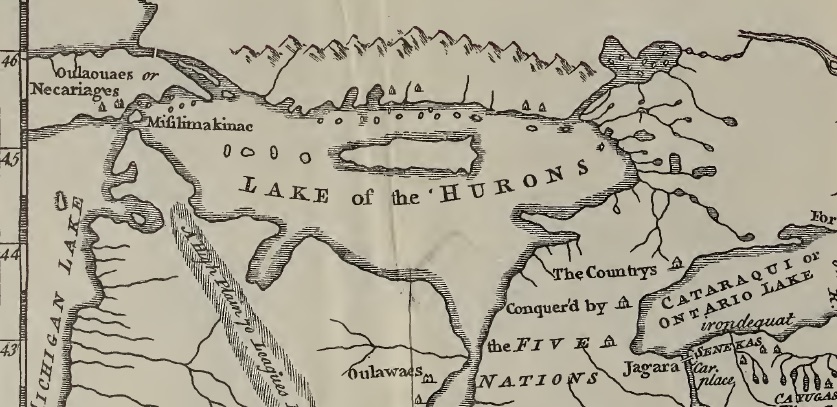
The second group, led by Awistoenis, or Owiestoenis, and a Seneca translator, Sakema, described themselves as the true members of the “Denighcariages Nation.” They told the commissioners that others who had visited Albany claiming to be from that nation were not telling the truth. The commissioners asked what the French called their settlements, to which they responded “Monsiemakerac.” They came from six communities, one of which, Neghkareage (probably the same word as “Denighcariages”) had two castles (towns). The other four are written as Ronawadainie, Onnighsiesannairoene, Kajenatroene, and Tienonoatdeaga. In a note on p. 693 of DRCHNY 5, O’Callaghan identifies them as Hurons from “Mtellimakenack,” based on a French map. The name of their fourth town suggests that they were from the Tobacco Nation. also known as the Petun or Tionondati. The French built Fort Michilimackinac on the Straits of Mackinac between Lake Michigan and Lake Huron around 1715. In describing the Denighcariages visit to Albany, Governor Burnet said in a letter to Lords of Trade that they came from “Misilimakenak, which lyes between Lac superieur & Lac Huron” (DRCHNY 5:684). Clearly they were from somewhere in the area where the three great lakes meet. Like the first group, they brought a calumet and left it with the commissioners to use when others from their nation came to Albany.
The Denighcariages, the Mohawks, and the commissioners began by smoking the calumet together, then proceeded to discuss trade, as well as a proposal that the Denighcariages join the Five Nations as the Tuscarora were in the process of doing. The commissioners promised them cheap goods and encouraged the idea that they should join the Five Nations, becoming the Seventh Nation, since the Tuscaroras were now the Sixth. The commissioners worded this in terms of joining “this Government,” seeming to imply that New York and the Five Nations were one. The commissioners promised to address Awistoenis’s complaint that local waggoners had overcharged them for transporting their goods, assuring them that it would not happen again and sending them on their way with blankets, shirts, food, and 26 gallons of rum.
The map at the front of Volume 2 of Cadwallader Colden’s History of the Five Indian Nations, shows the Necariages of Misilimacinac. The legend explains that they were “received to be the seventh Nation at Albany, May 30th 1723: at their own desire, 80 Men of that Nation being present beside Women and children.”
“A Map of the Country of the Five Nations belonging to the Province of New York and of the Lakes near which the Nations of Far Indians live, with part of Canada” from Cadwallader Colden, The History of the Five Indian Nations …
Massachusetts Offers to Pay for Scalps
In the conference between the Five Nations and the three commissioners sent from Massachusetts, the parties began with an initial meeting on May 28th in which they followed the usual protocols to renew the covenant chain of friendship. The Five Nations reminded Massachusetts that it was customary for the English to mend their guns, kettles, and hatchets on such occasions.
On May 30th the Massachusetts commissioners proceeded to business, laying out a proposal from Governor Dummer that spelled out the the terms on which Massachusetts wanted the Five Nations to join it in fighting the Abenaki Confederacy. After rehearsing the ways in which Massachusetts considered the Abenaki to have wronged the English, the proposal, worded like a legal contract, says that “for the further Encouragement of your Warlike peopl[e]” Massachusetts will pay 100 pounds for the scalp of every male enemy Indian of twelve years or older, and 50 pounds for the scalps of all others killed “in fight.” Massachusetts will pay 50 pounds for each male prisoner. The Five Nations may keep female prisoners and children under twelve, as well as any plunder taken. The Massachusetts government will supply the Five Nations with any needed provisions or ammunition, but the value will be deducted from the money paid for scalps.
For each ten members of the Five Nations, Massachusetts planned to assign two Englishmen to accompany them in order to protect them from “any mischief that may happen to them from our Souldiers by mistake” and to avoid disputes about scalps. The Englishmen would confirm under oath that the scalp was that of an enemy Indian killed in battle as well as the age and sex of the person scalped. For testifying, the Englishman would receive an amount equal to what was payed to the warrior who took the scalp or prisoner.
Guns, kettles, and hatchets would be mended only if the Five Nations accepted the offer, and Massachusetts would also give them a large present if and when they did so.
At Least Some of the Abenaki Want Peace
As was customary, the Five Nations did not respond right away to Massachusetts’ proposal. And on the following day the minutes record a new development with the arrival of Achjamawat, a delegate sent to the Six Nations by three Eastern Indian castles, “Owanagonga, Kwepowanne, and Onjanawarea.” Although they were still in Albany, the Massachusetts commissioners are not listed as being present when Achjamawat met with the Albany commissioners. The Five Nations are not listed either, but his words are addressed to them (as the Six Nations) and the interpreter for the meeting was the Mohawk leader Hendrick, who translated from Abenaki to Mohawk, after which Laurence Claessen translated from Mohawk to Dutch and Philip Livingston translated from Dutch to English for the written record.
Achjamawat began with an extended condolence ritual in which he reiterated several times that Albany was the place to treat about peace and to condole any blood shed “through Rashness or misunderstanding.” He went on to say that the Eastern Indians regret that they could not meet with the Six Nations when they came to Boston the previous fall to meditate between them and Massachusetts. They received the message sent by the Six Nations asking them to stop fighting. His people have now sent him to lay down the hatchet against New England and bury it forever.
In Library and Archives Canada digital copy of the original minutes, March 1723 starts here
The two entries for March 1723 describe the arrangements for the meeting between Massachusetts Bay, the Five Nations, and New York scheduled to be held in May. The commissioners resolve to send Laurence Claessen Van der Volgen, translator and unsung hero of New York diplomacy, to invite the Five Nations to the meeting. There is also an entry for March 26th that is blank except for the heading.
In Library and Archives Canada’s digital copy of the original minutes, January 1723 starts here
The minutes for January begin with the Albany Indian Commissioners and the Haudenosaunee (Five Nations) in the middle of negotiations with New England authorities, usually referred by the Five Nations to as “Boston” or “the Brethren of New England,” and the “Eastern Indians,” a coalition of Abenaki nations allied with New France. (“Abenaki” loosely translates as “Eastern Indians.”) Massachusetts and the Abenaki coalition were caught up in a conflict known by various names, including Dummer’s War,Gray Lock‘s War, and Father Rale’s War. The fighting had started a year earlier in 1722, triggered by conflicts over land, sovereignty, and Massachusetts’ attack on Father Sebastian Rale, a Jesuit priest who lived at the Abenaki town of Norridgewock on the Kennebec River in what is now Maine.
Massachusetts, supported by New York Governor William Burnet, wanted the Albany Commissioners to persuade the Five Nations (Haudenosaunee) to enter the war on Massachusetts’ side. The Haudenosaunee preferred to try to negotiate a peace. Albany also preferred peace. As they explain to Governor Burnet in a letter dated January 9, they do not want to get caught up in a war that might lead to retaliation on their own settlements by France and its native allies. For diplomatic reasons, however, neither Albany nor the Five Nations want to directly refuse the requests of Governor Burnet or the Massachusetts authorities. Their language in the minutes must be read with these complications in mind.
The initial entry is a report by Laurence Claessen (Van der Volgen), Albany’s main interpreter and on the ground liaison to the Five Nations during this period. He describes a recent trip by Haudenosaunee diplomats to Boston, where they tell the Boston government that the Eastern Indians have put themselves under the Five Nations’ protection and are required to remain peaceful under that arrangement. They assure Boston that New England has a valid case, and promise to destroy the Eastern Indians if they don’t stop fighting, but they ask for time to speak to them. They set up a meeting with the Governor of Massachusetts at Albany for the coming Spring. In an interesting footnote, “Hendrik,” a member of the Five Nations’ delegation, says that he talked to a minister at Boston who spoke “the Eastern Language” about coming to teach the Mohawks in their country. “Hendrik” is probably Tejonihokarawa (ca. 1660-1735), although he could also be Theyanoguin (ca. 1691=1755), who would have known “the Eastern language” because his father was Mohegan. The Albany Commissioners send this report to Governor Burnet and propose to work with the Five Nations on a diplomatic solution.
The second theme in January concerns a prisoner, a servant of Colonel Alexander Spotswood, the Governor of Virginia. He was taken prisoner in Virginia by “French Indians” from Canastoque & two from Fort Hunter, a statement that does not make sense since Fort Hunter at this period can only refer to the Lower Mohawk Town, Tiononderoga, in the Mohawk Valley at the mouth of Schoharie Creek. His captors are taking him to Kahnawake, the Mohawk community on the Saint Lawrence river, but they agree to meet with the Albany Commissioners. “Canastoque” is probably Kanesatake, near Montreal, although there was also a settlement of the Susquehannock nation at Conestoga on the Susquehanna River in Pennsylvania at this time.
The prisoner is identified as a Saponi Indian, but never identified by name, although he speaks good English. He tells the commissioners he is from “Christiana,” presumably Fort Christanna, where Governor Spotswood had settled the Sapponis on a reservation designed to educate them in English and incorporate them into colonial society. Governor Spotswood has requested the prisoner’s return, and the Albany Commissioners tell Governor Burnet they are trying to secure it. The nature of the prisoner’s servitude is never described. Is he a slave or an indentured servant? What claim of ownership does Governor Spotswood have to him, and how was it acquired? Has he been taken prisoner or liberated? For more on the Saponi (also spelled Sappony) Nation and their history, see http://www.sappony.org/index.htm and http://haliwa-saponi.com .




 The Albany Indian Commissioners
